
期刊文章
过刊浏览
- Volumes 108-119 (2025)
-
Volumes 96-107 (2025)
-
Volume 107
Pages 1-376 (December 2025)
-
Volume 106
Pages 1-336 (November 2025)
-
Volume 105
Pages 1-356 (October 2025)
-
Volume 104
Pages 1-332 (September 2025)
-
Volume 103
Pages 1-314 (August 2025)
-
Volume 102
Pages 1-276 (July 2025)
-
Volume 101
Pages 1-166 (June 2025)
-
Volume 100
Pages 1-256 (May 2025)
-
Volume 99
Pages 1-242 (April 2025)
-
Volume 98
Pages 1-288 (March 2025)
-
Volume 97
Pages 1-256 (February 2025)
-
Volume 96
Pages 1-340 (January 2025)
-
Volume 107
-
Volumes 84-95 (2024)
-
Volume 95
Pages 1-392 (December 2024)
-
Volume 94
Pages 1-400 (November 2024)
-
Volume 93
Pages 1-376 (October 2024)
-
Volume 92
Pages 1-316 (September 2024)
-
Volume 91
Pages 1-378 (August 2024)
-
Volume 90
Pages 1-580 (July 2024)
-
Volume 89
Pages 1-278 (June 2024)
-
Volume 88
Pages 1-350 (May 2024)
-
Volume 87
Pages 1-338 (April 2024)
-
Volume 86
Pages 1-312 (March 2024)
-
Volume 85
Pages 1-334 (February 2024)
-
Volume 84
Pages 1-308 (January 2024)
-
Volume 95
-
Volumes 72-83 (2023)
-
Volume 83
Pages 1-258 (December 2023)
-
Volume 82
Pages 1-204 (November 2023)
-
Volume 81
Pages 1-188 (October 2023)
-
Volume 80
Pages 1-202 (September 2023)
-
Volume 79
Pages 1-172 (August 2023)
-
Volume 78
Pages 1-146 (July 2023)
-
Volume 77
Pages 1-152 (June 2023)
-
Volume 76
Pages 1-176 (May 2023)
-
Volume 75
Pages 1-228 (April 2023)
-
Volume 74
Pages 1-200 (March 2023)
-
Volume 73
Pages 1-138 (February 2023)
-
Volume 72
Pages 1-144 (January 2023)
-
Volume 83
-
Volumes 60-71 (2022)
-
Volume 71
Pages 1-108 (December 2022)
-
Volume 70
Pages 1-106 (November 2022)
-
Volume 69
Pages 1-122 (October 2022)
-
Volume 68
Pages 1-124 (September 2022)
-
Volume 67
Pages 1-102 (August 2022)
-
Volume 66
Pages 1-112 (July 2022)
-
Volume 65
Pages 1-138 (June 2022)
-
Volume 64
Pages 1-186 (May 2022)
-
Volume 63
Pages 1-124 (April 2022)
-
Volume 62
Pages 1-104 (March 2022)
-
Volume 61
Pages 1-120 (February 2022)
-
Volume 60
Pages 1-124 (January 2022)
-
Volume 71
- Volumes 54-59 (2021)
- Volumes 48-53 (2020)
- Volumes 42-47 (2019)
- Volumes 36-41 (2018)
- Volumes 30-35 (2017)
- Volumes 24-29 (2016)
- Volumes 18-23 (2015)
- Volumes 12-17 (2014)
- Volume 11 (2013)
- Volume 10 (2012)
- Volume 9 (2011)
- Volume 8 (2010)
- Volume 7 (2009)
- Volume 6 (2008)
- Volume 5 (2007)
- Volume 4 (2006)
- Volume 3 (2005)
- Volume 2 (2004)
- Volume 1 (2003)
Volume 107
Deng, L., Dai, B., Liu, F., Yuan, W., & Yang, J. (2025). Micromechanical exploration of asymmetric mobilization of arching effect in granular materials by DEM. Particuology, 107, 176-191. https://doi.org/10.1016/j.partic.2025.10.005
Micromechanical exploration of asymmetric mobilization of arching effect in granular materials by DEM
Linjie Deng a, Beibing Dai a b c *, Fengtao Liu d, Weihai Yuan e, Jun Yang f
a School of Civil Engineering, Sun Yat-sen University, Guangzhou, China
b State Key Laboratory for Tunnel Engineering, Guangzhou, China
c Southern Marine Science and Engineering Guangdong Laboratory (Zhuhai), Zhuhai, China
d Guangxi Key Laboratory of Geotechnical Mechanics and Engineering, Guilin University of Technology, Guilin, China
e Department of Engineering Mechanics, Hohai University, Nanjing, China
f Department of Civil Engineering, The University of Hong Kong, China
10.1016/j.partic.2025.10.005
Volume 107,
December 2025,
Pages 176-191
Received 15 July 2025, Revised 22 September 2025, Accepted 8 October 2025, Available online 16 October 2025, Version of Record 27 October 2025.
E-mail:
daibb@mail.sysu.edu.cn
Highlights
• We probe the macro-micro mechanical responses of granular deposit in trapdoor tests.
• We reveal the asymmetric arching effect from a multi-scale perspective.
• The origin of the asymmetry of arching mobilization lies in the fabric anisotropy.
• We identify the fabric orientation, where the strongest asymmetrical arching occurs.
Abstract
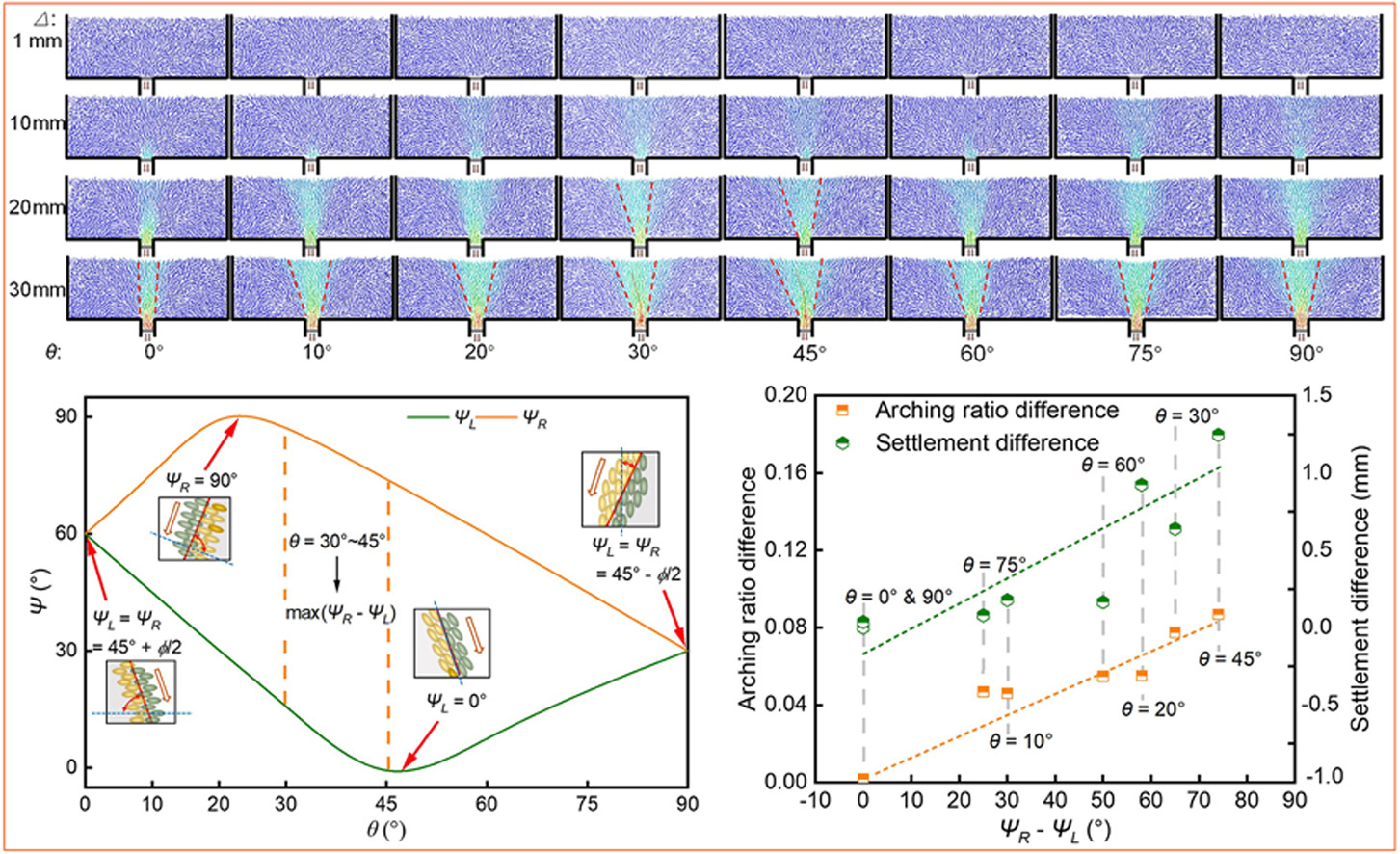
This study investigates the asymmetrical arching phenomenon in inclined granular deposits by performing the DEM simulations of trapdoor tests. The results indicate that the weakest arching effect occurs at deposit inclination angles of 30° ∼ 45°, evidenced by the highest arching ratio on the trapdoor, largest deposit settlement, and lowest fabric anisotropy intensity. The asymmetrical arching effect is manifested by lower arching ratios, greater deposit settlements and larger fabric anisotropy magnitudes on the left part beside the trapdoor compared to the right part. The arching asymmetry depends on the angle Ψ formed between the potential failure plane's orientation and the deposit inclination direction, and this angle (ΨL) for region L is on average lower than that (ΨR) for region R. A larger ΨR leads to a more notable inter-particle locking effect and a higher resistance to deformation for region R, which further causes larger arching ratios and less remarkable deposit settlements. Moreover, the arching asymmetry degree is positively correlated with the discrepancy between ΨL and ΨR. The disparity of mechanical responses between regions L and R aggravates with increasing ΨR – ΨL, and the strongest asymmetrical arching effect occurs around θ = 30°, where ΨR – ΨL takes the maximum value.
Graphical abstract
Keywords
Asymmetrical arching effect; Granular materials; Fabric anisotropy; Interlocking effect; Discrete element method
文章导读