
期刊文章
过刊浏览
- Volumes 108-119 (2025)
-
Volumes 96-107 (2025)
-
Volume 107
Pages 1-376 (December 2025)
-
Volume 106
Pages 1-336 (November 2025)
-
Volume 105
Pages 1-356 (October 2025)
-
Volume 104
Pages 1-332 (September 2025)
-
Volume 103
Pages 1-314 (August 2025)
-
Volume 102
Pages 1-276 (July 2025)
-
Volume 101
Pages 1-166 (June 2025)
-
Volume 100
Pages 1-256 (May 2025)
-
Volume 99
Pages 1-242 (April 2025)
-
Volume 98
Pages 1-288 (March 2025)
-
Volume 97
Pages 1-256 (February 2025)
-
Volume 96
Pages 1-340 (January 2025)
-
Volume 107
-
Volumes 84-95 (2024)
-
Volume 95
Pages 1-392 (December 2024)
-
Volume 94
Pages 1-400 (November 2024)
-
Volume 93
Pages 1-376 (October 2024)
-
Volume 92
Pages 1-316 (September 2024)
-
Volume 91
Pages 1-378 (August 2024)
-
Volume 90
Pages 1-580 (July 2024)
-
Volume 89
Pages 1-278 (June 2024)
-
Volume 88
Pages 1-350 (May 2024)
-
Volume 87
Pages 1-338 (April 2024)
-
Volume 86
Pages 1-312 (March 2024)
-
Volume 85
Pages 1-334 (February 2024)
-
Volume 84
Pages 1-308 (January 2024)
-
Volume 95
-
Volumes 72-83 (2023)
-
Volume 83
Pages 1-258 (December 2023)
-
Volume 82
Pages 1-204 (November 2023)
-
Volume 81
Pages 1-188 (October 2023)
-
Volume 80
Pages 1-202 (September 2023)
-
Volume 79
Pages 1-172 (August 2023)
-
Volume 78
Pages 1-146 (July 2023)
-
Volume 77
Pages 1-152 (June 2023)
-
Volume 76
Pages 1-176 (May 2023)
-
Volume 75
Pages 1-228 (April 2023)
-
Volume 74
Pages 1-200 (March 2023)
-
Volume 73
Pages 1-138 (February 2023)
-
Volume 72
Pages 1-144 (January 2023)
-
Volume 83
-
Volumes 60-71 (2022)
-
Volume 71
Pages 1-108 (December 2022)
-
Volume 70
Pages 1-106 (November 2022)
-
Volume 69
Pages 1-122 (October 2022)
-
Volume 68
Pages 1-124 (September 2022)
-
Volume 67
Pages 1-102 (August 2022)
-
Volume 66
Pages 1-112 (July 2022)
-
Volume 65
Pages 1-138 (June 2022)
-
Volume 64
Pages 1-186 (May 2022)
-
Volume 63
Pages 1-124 (April 2022)
-
Volume 62
Pages 1-104 (March 2022)
-
Volume 61
Pages 1-120 (February 2022)
-
Volume 60
Pages 1-124 (January 2022)
-
Volume 71
- Volumes 54-59 (2021)
- Volumes 48-53 (2020)
- Volumes 42-47 (2019)
- Volumes 36-41 (2018)
- Volumes 30-35 (2017)
- Volumes 24-29 (2016)
- Volumes 18-23 (2015)
- Volumes 12-17 (2014)
- Volume 11 (2013)
- Volume 10 (2012)
- Volume 9 (2011)
- Volume 8 (2010)
- Volume 7 (2009)
- Volume 6 (2008)
- Volume 5 (2007)
- Volume 4 (2006)
- Volume 3 (2005)
- Volume 2 (2004)
- Volume 1 (2003)
Volume 107
Pan, M., Mu, L., Liu, C., & Chen, X. (2025). Knowledge-informed reduced-order modeling for erosion prediction in pipe bends. Particuology, 107, 204-215. https://doi.org/10.1016/j.partic.2025.10.010
Knowledge-informed reduced-order modeling for erosion prediction in pipe bends
Ming Pan a, Lijing Mu b, Cenfan Liu b *, Xizhong Chen a *
a Department of Chemical Engineering, School of Chemistry and Chemical Engineering, Shanghai Jiao Tong University, Shanghai, 200240, China
b Key Laboratory of Special Equipment Safety and Energy-saving, State Administration for Market Regulation, China Special Equipment Inspection and Research Institute, Beijing, 100029, China
10.1016/j.partic.2025.10.010
Volume 107,
December 2025,
Pages 204-215
Received 31 July 2025, Revised 19 September 2025, Accepted 14 October 2025, Available online 25 October 2025, Version of Record 3 November 2025.
E-mail:
liucenfan@csei.org.cn; chenxizh@sjtu.edu.cn
Highlights
• CFD–DEM simulations quantify erosion behavior under single-parameter variation.
• A POD–Kriging surrogate is developed for efficient erosion field prediction.
• Knowledge-informed Kriging significantly improves erosion prediction accuracy.
• Optimized surrogate enables fast and accurate prediction in pipelines.
Abstract
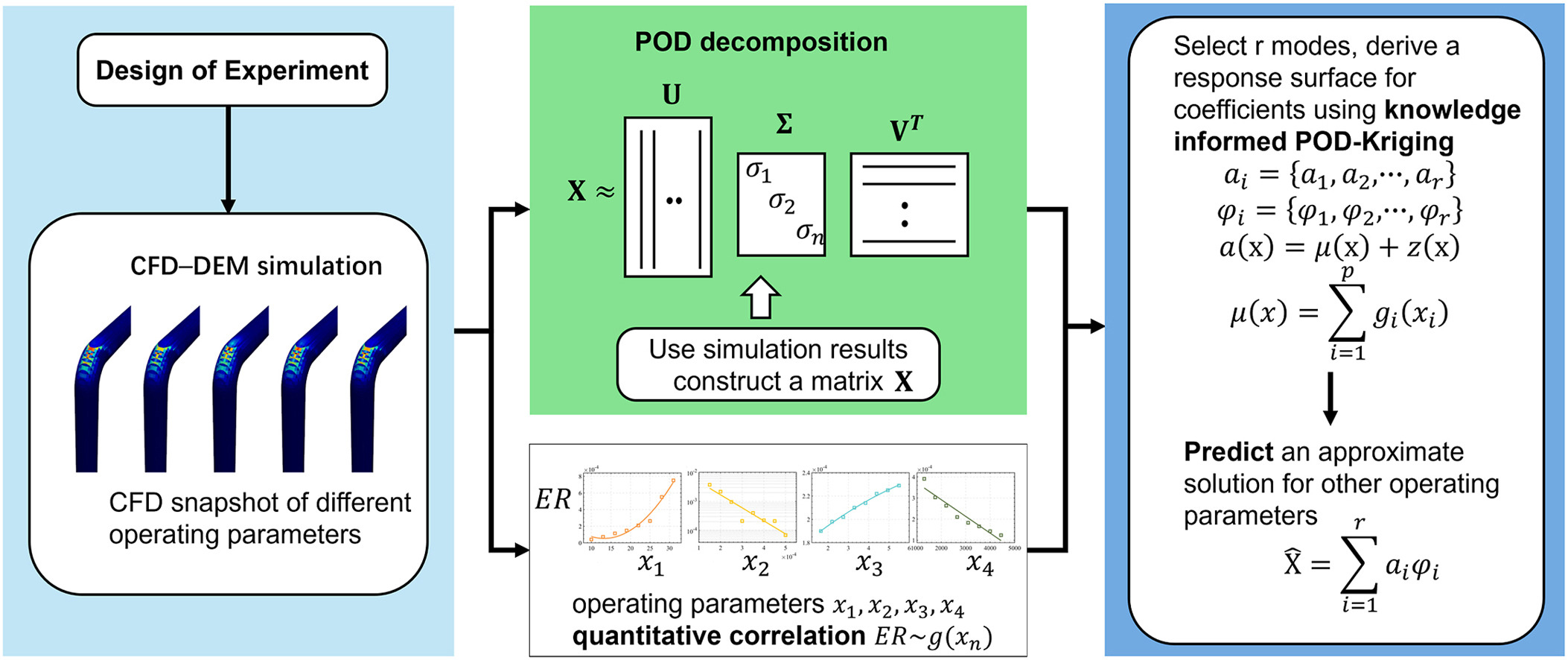
Solid particle erosion in pipeline elbows poses a persistent challenge in the energy and process industries, where accurate yet efficient prediction methods are urgently needed. While computational fluid dynamics–discrete element method (CFD–DEM) simulations provide high-fidelity erosion predictions, their computational demands severely limit practical deployment. To bridge this gap, this study proposes a knowledge-informed reduced-order modeling framework that couples proper orthogonal decomposition (POD) with Kriging interpolation. The surrogate model is enhanced by numerically validated, physically motivated correlations between erosion ratios and key impact parameters, enabling improved extrapolation and interpretability. Validation against full-order CFD–DEM results demonstrates that the enhanced POD–Kriging model accurately reproduces spatial erosion fields while achieving speedups exceeding 2000 × . Compared to the conventional POD-based surrogate, the proposed approach reduces prediction errors by up to 76 %, with local error at high-risk elbow regions reduced to within 4 %. These results highlight the model's robustness and generalizability across both single- and multi-parameter operating conditions. The framework offers a computationally efficient and physically consistent alternative for erosion assessment and design optimization in industrial pipeline systems.
Graphical abstract
Keywords
CFD‒DEM; Reduced-order modeling; Erosion; POD‒Kriging
文章导读