
期刊文章
过刊浏览
- Volumes 108-119 (2025)
-
Volumes 96-107 (2025)
-
Volume 107
Pages 1-376 (December 2025)
-
Volume 106
Pages 1-336 (November 2025)
-
Volume 105
Pages 1-356 (October 2025)
-
Volume 104
Pages 1-332 (September 2025)
-
Volume 103
Pages 1-314 (August 2025)
-
Volume 102
Pages 1-276 (July 2025)
-
Volume 101
Pages 1-166 (June 2025)
-
Volume 100
Pages 1-256 (May 2025)
-
Volume 99
Pages 1-242 (April 2025)
-
Volume 98
Pages 1-288 (March 2025)
-
Volume 97
Pages 1-256 (February 2025)
-
Volume 96
Pages 1-340 (January 2025)
-
Volume 107
-
Volumes 84-95 (2024)
-
Volume 95
Pages 1-392 (December 2024)
-
Volume 94
Pages 1-400 (November 2024)
-
Volume 93
Pages 1-376 (October 2024)
-
Volume 92
Pages 1-316 (September 2024)
-
Volume 91
Pages 1-378 (August 2024)
-
Volume 90
Pages 1-580 (July 2024)
-
Volume 89
Pages 1-278 (June 2024)
-
Volume 88
Pages 1-350 (May 2024)
-
Volume 87
Pages 1-338 (April 2024)
-
Volume 86
Pages 1-312 (March 2024)
-
Volume 85
Pages 1-334 (February 2024)
-
Volume 84
Pages 1-308 (January 2024)
-
Volume 95
-
Volumes 72-83 (2023)
-
Volume 83
Pages 1-258 (December 2023)
-
Volume 82
Pages 1-204 (November 2023)
-
Volume 81
Pages 1-188 (October 2023)
-
Volume 80
Pages 1-202 (September 2023)
-
Volume 79
Pages 1-172 (August 2023)
-
Volume 78
Pages 1-146 (July 2023)
-
Volume 77
Pages 1-152 (June 2023)
-
Volume 76
Pages 1-176 (May 2023)
-
Volume 75
Pages 1-228 (April 2023)
-
Volume 74
Pages 1-200 (March 2023)
-
Volume 73
Pages 1-138 (February 2023)
-
Volume 72
Pages 1-144 (January 2023)
-
Volume 83
-
Volumes 60-71 (2022)
-
Volume 71
Pages 1-108 (December 2022)
-
Volume 70
Pages 1-106 (November 2022)
-
Volume 69
Pages 1-122 (October 2022)
-
Volume 68
Pages 1-124 (September 2022)
-
Volume 67
Pages 1-102 (August 2022)
-
Volume 66
Pages 1-112 (July 2022)
-
Volume 65
Pages 1-138 (June 2022)
-
Volume 64
Pages 1-186 (May 2022)
-
Volume 63
Pages 1-124 (April 2022)
-
Volume 62
Pages 1-104 (March 2022)
-
Volume 61
Pages 1-120 (February 2022)
-
Volume 60
Pages 1-124 (January 2022)
-
Volume 71
- Volumes 54-59 (2021)
- Volumes 48-53 (2020)
- Volumes 42-47 (2019)
- Volumes 36-41 (2018)
- Volumes 30-35 (2017)
- Volumes 24-29 (2016)
- Volumes 18-23 (2015)
- Volumes 12-17 (2014)
- Volume 11 (2013)
- Volume 10 (2012)
- Volume 9 (2011)
- Volume 8 (2010)
- Volume 7 (2009)
- Volume 6 (2008)
- Volume 5 (2007)
- Volume 4 (2006)
- Volume 3 (2005)
- Volume 2 (2004)
- Volume 1 (2003)
Volume 107
Kersaudy, R., Rouabah, M., Ly, A., Achouri, I. E., Gosselin, R., & Abatzoglou, N. (2025). Predicting granule size via in-line NIR spectroscopy during fluidized bed foam granulation and drying. Particuology, 107, 232-242. https://doi.org/10.1016/j.partic.2025.10.011
Predicting granule size via in-line NIR spectroscopy during fluidized bed foam granulation and drying (Open Access)
Romain Kersaudy a, Maroua Rouabah a *, Abdoulah Ly b, Inès Esma Achouri a, Ryan Gosselin a, Nicolas Abatzoglou a
a Department of Chemical and Biotechnology Engineering, Université de Sherbrooke, Quebec J1K 2R1, Canada
b School of Chemical and Bioprocess Engineering, University College Dublin, Belfield, Dublin, Ireland
10.1016/j.partic.2025.10.011
Volume 107,
December 2025,
Pages 232-242
Received 17 February 2025, Revised 19 October 2025, Accepted 21 October 2025, Available online 27 October 2025, Version of Record 5 November 2025.
E-mail:
maroua.rouabah@usherbrooke.ca
Highlights
• In-line monitoring of fluidized bed foam granulations via NIR spectroscopy.
• Partial least squares regression model built to predict mean granule diameter.
• Model predictions used with batch statistical process control to track granule size.
Abstract
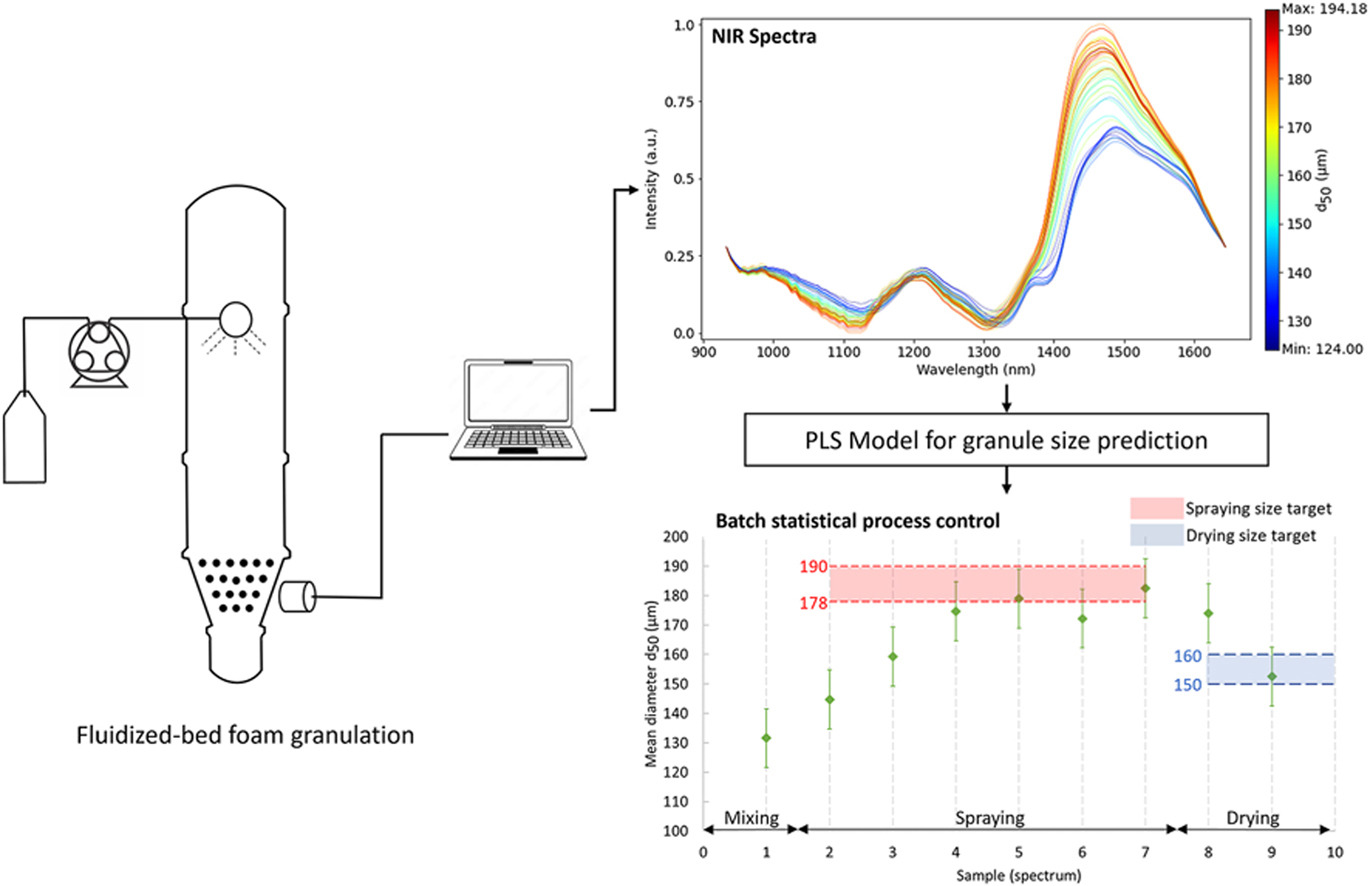
Wet granulation-a unit operation involving mixing polymeric binders with powdered formulations-is well established in the pharmaceutical industry, playing a major role in the manufacturing of oral solid dosage forms and improving the physical properties of granules (size, density, shape factor, etc.) before tableting. The foaming properties of aqueous polymeric binders prove useful for binder delivery within the mixing vessel, with foamed binders leading to enhanced process efficiency (binder distribution, drying time, and temperature) and product quality (heat-sensitive components) during granulation. Given the importance of this stage in producing oral solid dosage forms, understanding the relationship between critical process parameters and critical quality attributes is essential. The process analytical technology (PAT) framework enables process design, analysis, and control and facilitates process development via in-line spectroscopy combined with multivariate data analysis to yield critical product information during the unit operation. Herein, we used in-line NIR spectroscopy to monitor granule size in foam granulations of a pharmaceutical compound. The mean granule diameter was predicted using a partial least squares regression (PLSR) model (with a prediction error of 11.8 μm) and combined with a batch statistical process control (BSPC) approach for the temporal monitoring of granule size during three foam granulations.
Graphical abstract
Keywords
Foam granulation; In-line monitoring; NIR spectroscopy; Size prediction; Batch statistical process control
文章导读