
期刊文章
过刊浏览
- Volumes 108-119 (2025)
-
Volumes 96-107 (2025)
-
Volume 107
Pages 1-376 (December 2025)
-
Volume 106
Pages 1-336 (November 2025)
-
Volume 105
Pages 1-356 (October 2025)
-
Volume 104
Pages 1-332 (September 2025)
-
Volume 103
Pages 1-314 (August 2025)
-
Volume 102
Pages 1-276 (July 2025)
-
Volume 101
Pages 1-166 (June 2025)
-
Volume 100
Pages 1-256 (May 2025)
-
Volume 99
Pages 1-242 (April 2025)
-
Volume 98
Pages 1-288 (March 2025)
-
Volume 97
Pages 1-256 (February 2025)
-
Volume 96
Pages 1-340 (January 2025)
-
Volume 107
-
Volumes 84-95 (2024)
-
Volume 95
Pages 1-392 (December 2024)
-
Volume 94
Pages 1-400 (November 2024)
-
Volume 93
Pages 1-376 (October 2024)
-
Volume 92
Pages 1-316 (September 2024)
-
Volume 91
Pages 1-378 (August 2024)
-
Volume 90
Pages 1-580 (July 2024)
-
Volume 89
Pages 1-278 (June 2024)
-
Volume 88
Pages 1-350 (May 2024)
-
Volume 87
Pages 1-338 (April 2024)
-
Volume 86
Pages 1-312 (March 2024)
-
Volume 85
Pages 1-334 (February 2024)
-
Volume 84
Pages 1-308 (January 2024)
-
Volume 95
-
Volumes 72-83 (2023)
-
Volume 83
Pages 1-258 (December 2023)
-
Volume 82
Pages 1-204 (November 2023)
-
Volume 81
Pages 1-188 (October 2023)
-
Volume 80
Pages 1-202 (September 2023)
-
Volume 79
Pages 1-172 (August 2023)
-
Volume 78
Pages 1-146 (July 2023)
-
Volume 77
Pages 1-152 (June 2023)
-
Volume 76
Pages 1-176 (May 2023)
-
Volume 75
Pages 1-228 (April 2023)
-
Volume 74
Pages 1-200 (March 2023)
-
Volume 73
Pages 1-138 (February 2023)
-
Volume 72
Pages 1-144 (January 2023)
-
Volume 83
-
Volumes 60-71 (2022)
-
Volume 71
Pages 1-108 (December 2022)
-
Volume 70
Pages 1-106 (November 2022)
-
Volume 69
Pages 1-122 (October 2022)
-
Volume 68
Pages 1-124 (September 2022)
-
Volume 67
Pages 1-102 (August 2022)
-
Volume 66
Pages 1-112 (July 2022)
-
Volume 65
Pages 1-138 (June 2022)
-
Volume 64
Pages 1-186 (May 2022)
-
Volume 63
Pages 1-124 (April 2022)
-
Volume 62
Pages 1-104 (March 2022)
-
Volume 61
Pages 1-120 (February 2022)
-
Volume 60
Pages 1-124 (January 2022)
-
Volume 71
- Volumes 54-59 (2021)
- Volumes 48-53 (2020)
- Volumes 42-47 (2019)
- Volumes 36-41 (2018)
- Volumes 30-35 (2017)
- Volumes 24-29 (2016)
- Volumes 18-23 (2015)
- Volumes 12-17 (2014)
- Volume 11 (2013)
- Volume 10 (2012)
- Volume 9 (2011)
- Volume 8 (2010)
- Volume 7 (2009)
- Volume 6 (2008)
- Volume 5 (2007)
- Volume 4 (2006)
- Volume 3 (2005)
- Volume 2 (2004)
- Volume 1 (2003)
Volume 107
Wang, Z., Lu, J., Zhang, J., Li, F., Sun, B., Zhao, T., & Bahiuddin, I. (2025). Quantitative evaluation of particle distribution status of lithium-ion battery (LIB) slurry under effects of rotational speeds. Particuology, 107, 265-273. https://doi.org/10.1016/j.partic.2025.10.018
Quantitative evaluation of particle distribution status of lithium-ion battery (LIB) slurry under effects of rotational speeds
Zhilong Wang a, Jianhang Lu a, Jiatan Zhang a, Feixiang Li a, Bo Sun a, Tong Zhao a *, Irfan Bahiuddin b
a Faculty of Mechanical and Precision Instrument Engineering, Xi'an University of Technology, Xi'an, 710048, China
b Department of Mechanical Engineering, Universitas Gadjah Mada, Yogyakarta, 55281, Indonesia
10.1016/j.partic.2025.10.018
Volume 107,
December 2025,
Pages 265-273
Received 1 September 2025, Revised 22 October 2025, Accepted 24 October 2025, Available online 1 November 2025, Version of Record 10 November 2025.
E-mail:
tongzhao@xaut.edu.cn
Highlights
• Coordinates of LiCoO2 particles can be identified by MAM-enhanced Mask R-CNN.
• Higher γLiCoO2 can be quantitatively explained by the larger η, the larger Smin
and the smaller β.
• Higher γCB can be quantitatively explained by the larger η and the smaller β.
Abstract
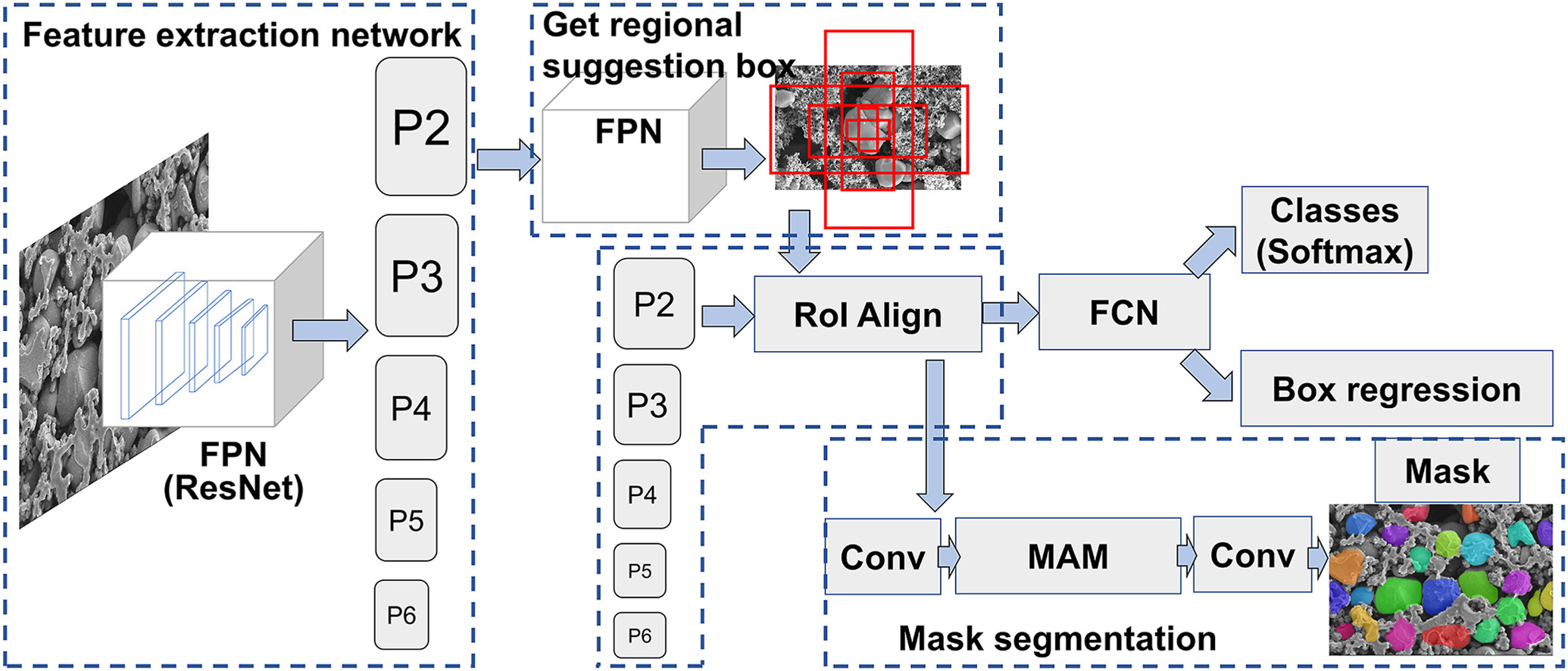
This paper proposed a quantitative evaluation approach to respectively define the particle dispersion degree (PDD) of LiCoO2 particles and the PDD of carbon black (CB) particles based on the scanning electron microscopy (SEM) images of lithium-ion battery (LIB) slurries. A mixed attention module (MAM) is introduced into the instance segmentation algorithm of Mask R-CNN, which successfully identifies LiCoO2 particles and their pixel coordinates in the SEM images of LIB slurry. Subsequently, the image subtraction method is used to remove LiCoO2 particles from the SEM images with the aim of obtaining the pixel coordinates of CB particles. Additionally, the PDD of LiCoO2 particles is comprehensively evaluated by using the proportion of discrete particles, the average value of the minimum distance and the uniform deviation value; while the PDD of CB particles is evaluated by using the proportion of discrete particles and the average value of the minimum distance. Moreover, four different rotational speeds which are 300, 900, 1050 and 1200 rpm are used to differentiate particle distribution status of LIB slurry. Furthermore, in order to verify the correctness of the proposed approach, the electrochemical characteristics of LIB slurries are also analyzed by using electrochemical impedance spectroscopy (EIS) method. After performing the investigations, the conclusions illustrated that both the PDDs of LiCoO2 and CB particles have the capability of evaluating particle dispersion status within LIB slurry. Specifically, larger proportion of discrete particles and average value of the minimum distance together with smaller uniform deviation value result in higher PDDs of LiCoO2 and CB particles in the case that rotational speed is 1050 rpm when compared with other cases including 300, 900 and 1200 rpm. Those results are also consistent with the electrochemical characterizations of LIB slurries, which verified the correctness of the proposed approach. The proposed quantitative evaluation approach is of great importance for the quantitative evaluation of the dispersion degree of microscale and nanoscale particles in dense liquid-solid two-phase flow.
Graphical abstract
Keywords
Quantitative evaluation; Lithium-ion battery slurry; Particle dispersion degree; SEM
文章导读