
期刊文章
过刊浏览
- Volumes 108-119 (2025)
-
Volumes 96-107 (2025)
-
Volume 107
Pages 1-376 (December 2025)
-
Volume 106
Pages 1-336 (November 2025)
-
Volume 105
Pages 1-356 (October 2025)
-
Volume 104
Pages 1-332 (September 2025)
-
Volume 103
Pages 1-314 (August 2025)
-
Volume 102
Pages 1-276 (July 2025)
-
Volume 101
Pages 1-166 (June 2025)
-
Volume 100
Pages 1-256 (May 2025)
-
Volume 99
Pages 1-242 (April 2025)
-
Volume 98
Pages 1-288 (March 2025)
-
Volume 97
Pages 1-256 (February 2025)
-
Volume 96
Pages 1-340 (January 2025)
-
Volume 107
-
Volumes 84-95 (2024)
-
Volume 95
Pages 1-392 (December 2024)
-
Volume 94
Pages 1-400 (November 2024)
-
Volume 93
Pages 1-376 (October 2024)
-
Volume 92
Pages 1-316 (September 2024)
-
Volume 91
Pages 1-378 (August 2024)
-
Volume 90
Pages 1-580 (July 2024)
-
Volume 89
Pages 1-278 (June 2024)
-
Volume 88
Pages 1-350 (May 2024)
-
Volume 87
Pages 1-338 (April 2024)
-
Volume 86
Pages 1-312 (March 2024)
-
Volume 85
Pages 1-334 (February 2024)
-
Volume 84
Pages 1-308 (January 2024)
-
Volume 95
-
Volumes 72-83 (2023)
-
Volume 83
Pages 1-258 (December 2023)
-
Volume 82
Pages 1-204 (November 2023)
-
Volume 81
Pages 1-188 (October 2023)
-
Volume 80
Pages 1-202 (September 2023)
-
Volume 79
Pages 1-172 (August 2023)
-
Volume 78
Pages 1-146 (July 2023)
-
Volume 77
Pages 1-152 (June 2023)
-
Volume 76
Pages 1-176 (May 2023)
-
Volume 75
Pages 1-228 (April 2023)
-
Volume 74
Pages 1-200 (March 2023)
-
Volume 73
Pages 1-138 (February 2023)
-
Volume 72
Pages 1-144 (January 2023)
-
Volume 83
-
Volumes 60-71 (2022)
-
Volume 71
Pages 1-108 (December 2022)
-
Volume 70
Pages 1-106 (November 2022)
-
Volume 69
Pages 1-122 (October 2022)
-
Volume 68
Pages 1-124 (September 2022)
-
Volume 67
Pages 1-102 (August 2022)
-
Volume 66
Pages 1-112 (July 2022)
-
Volume 65
Pages 1-138 (June 2022)
-
Volume 64
Pages 1-186 (May 2022)
-
Volume 63
Pages 1-124 (April 2022)
-
Volume 62
Pages 1-104 (March 2022)
-
Volume 61
Pages 1-120 (February 2022)
-
Volume 60
Pages 1-124 (January 2022)
-
Volume 71
- Volumes 54-59 (2021)
- Volumes 48-53 (2020)
- Volumes 42-47 (2019)
- Volumes 36-41 (2018)
- Volumes 30-35 (2017)
- Volumes 24-29 (2016)
- Volumes 18-23 (2015)
- Volumes 12-17 (2014)
- Volume 11 (2013)
- Volume 10 (2012)
- Volume 9 (2011)
- Volume 8 (2010)
- Volume 7 (2009)
- Volume 6 (2008)
- Volume 5 (2007)
- Volume 4 (2006)
- Volume 3 (2005)
- Volume 2 (2004)
- Volume 1 (2003)
Volume 107
Cao, X., Qu, H., Xu, Z., Zhang, H., Zhang, Z., Peng, W., & Bian, J. (2025). Modeling erosion in dense liquid-solid jet: A comparative study of particle interaction effects using DDPM and DPM. Particuology, 107, 274-286. https://doi.org/10.1016/j.partic.2025.10.015
Modeling erosion in dense liquid-solid jet: A comparative study of particle interaction effects using DDPM and DPM
Xuewen Cao a b *, Haoxuan Qu a, Zhongying Xu a, Haopeng Zhang a, Zeyu Zhang a, Wenshan Peng b *, Jiang Bian c
a College of Pipeline and Civil Engineering, China University of Petroleum (East China), Qingdao, 266580, China
b National Key Laboratory of Marine Corrosion and Protection, Luoyang Ship Material Research Institute, Qingdao, 266237, China
c School of Petroleum Engineering, Yangtze University, Wuhan, 430100, China
10.1016/j.partic.2025.10.015
Volume 107,
December 2025,
Pages 274-286
Received 2 September 2025, Revised 11 October 2025, Accepted 20 October 2025, Available online 30 October 2025, Version of Record 10 November 2025.
E-mail:
caoxw@upc.edu.cn; pengwenshan1386@126.com
Highlights
• A new erosion rate prediction method considers particle interactions under high concentration conditions.
• DDPM model reveals particle interactions reduce erosion rates.
• The erosion rate increases with flow rate and particle size.
Abstract
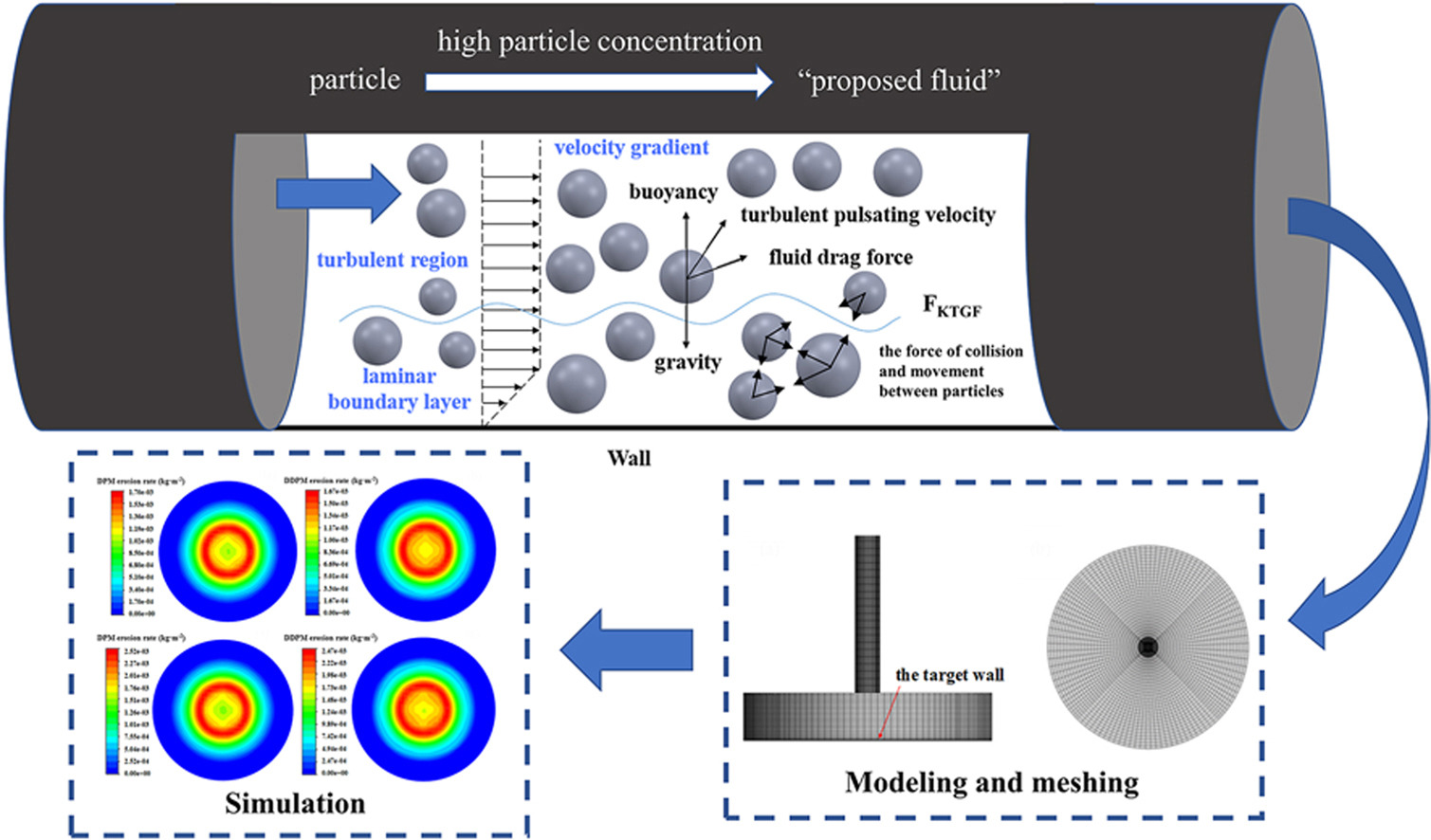
Operational reliability of shale gas pipelines is critically compromised by solid particle erosion, and the effect of particle interactions on the erosion mechanism under high concentration conditions has not been fully investigated. In this study, a numerical model of liquid-solid direct jet erosion considering particle interactions is established, and the fluid flow characteristics, particle trajectories and erosion damage patterns are analyzed by comparing the discrete phase model (DPM) with the dense discrete phase model (DDPM). A systematic investigation into the influence of particle concentration, flow velocity and particle size on erosion mechanisms was conducted employing the Realizable k-ε turbulence model, the Zhang erosion model, and an experimentally verified computational mesh. The results show that increased particle concentrations lead to lower erosion rates, and DDPM predictions are about 2.5 % lower than those of two-way DPM, which overestimates erosion by ignoring particle-fluid interactions. DDPM is more effective at high concentrations, and the distribution of particle collision velocities it captures shows that particle collision velocities are greater in the center region, but DDPM predicts higher values at the radial peak, leading to an overestimation in the severely eroded zone. This study develops a more accurate numerical modeling approach for predicting erosion in high concentration liquid-solid two-phase jets.
Graphical abstract
Keywords
Particle interactions; Numerical simulation; Jet; Multiphase flow
文章导读