
期刊文章
过刊浏览
- Volumes 108-119 (2025)
-
Volumes 96-107 (2025)
-
Volume 107
Pages 1-376 (December 2025)
-
Volume 106
Pages 1-336 (November 2025)
-
Volume 105
Pages 1-356 (October 2025)
-
Volume 104
Pages 1-332 (September 2025)
-
Volume 103
Pages 1-314 (August 2025)
-
Volume 102
Pages 1-276 (July 2025)
-
Volume 101
Pages 1-166 (June 2025)
-
Volume 100
Pages 1-256 (May 2025)
-
Volume 99
Pages 1-242 (April 2025)
-
Volume 98
Pages 1-288 (March 2025)
-
Volume 97
Pages 1-256 (February 2025)
-
Volume 96
Pages 1-340 (January 2025)
-
Volume 107
-
Volumes 84-95 (2024)
-
Volume 95
Pages 1-392 (December 2024)
-
Volume 94
Pages 1-400 (November 2024)
-
Volume 93
Pages 1-376 (October 2024)
-
Volume 92
Pages 1-316 (September 2024)
-
Volume 91
Pages 1-378 (August 2024)
-
Volume 90
Pages 1-580 (July 2024)
-
Volume 89
Pages 1-278 (June 2024)
-
Volume 88
Pages 1-350 (May 2024)
-
Volume 87
Pages 1-338 (April 2024)
-
Volume 86
Pages 1-312 (March 2024)
-
Volume 85
Pages 1-334 (February 2024)
-
Volume 84
Pages 1-308 (January 2024)
-
Volume 95
-
Volumes 72-83 (2023)
-
Volume 83
Pages 1-258 (December 2023)
-
Volume 82
Pages 1-204 (November 2023)
-
Volume 81
Pages 1-188 (October 2023)
-
Volume 80
Pages 1-202 (September 2023)
-
Volume 79
Pages 1-172 (August 2023)
-
Volume 78
Pages 1-146 (July 2023)
-
Volume 77
Pages 1-152 (June 2023)
-
Volume 76
Pages 1-176 (May 2023)
-
Volume 75
Pages 1-228 (April 2023)
-
Volume 74
Pages 1-200 (March 2023)
-
Volume 73
Pages 1-138 (February 2023)
-
Volume 72
Pages 1-144 (January 2023)
-
Volume 83
-
Volumes 60-71 (2022)
-
Volume 71
Pages 1-108 (December 2022)
-
Volume 70
Pages 1-106 (November 2022)
-
Volume 69
Pages 1-122 (October 2022)
-
Volume 68
Pages 1-124 (September 2022)
-
Volume 67
Pages 1-102 (August 2022)
-
Volume 66
Pages 1-112 (July 2022)
-
Volume 65
Pages 1-138 (June 2022)
-
Volume 64
Pages 1-186 (May 2022)
-
Volume 63
Pages 1-124 (April 2022)
-
Volume 62
Pages 1-104 (March 2022)
-
Volume 61
Pages 1-120 (February 2022)
-
Volume 60
Pages 1-124 (January 2022)
-
Volume 71
- Volumes 54-59 (2021)
- Volumes 48-53 (2020)
- Volumes 42-47 (2019)
- Volumes 36-41 (2018)
- Volumes 30-35 (2017)
- Volumes 24-29 (2016)
- Volumes 18-23 (2015)
- Volumes 12-17 (2014)
- Volume 11 (2013)
- Volume 10 (2012)
- Volume 9 (2011)
- Volume 8 (2010)
- Volume 7 (2009)
- Volume 6 (2008)
- Volume 5 (2007)
- Volume 4 (2006)
- Volume 3 (2005)
- Volume 2 (2004)
- Volume 1 (2003)
Volume 107
Rajendra, R. S., Palgadhmal, A. V., & Kulkarni, A. A. (2025). Residence time distribution of powders in a vertical single screw reactor: Experiments using salt-coated tracer particles and simulations. Particuology, 107, 313-326. https://doi.org/10.1016/j.partic.2025.10.008
Residence time distribution of powders in a vertical single screw reactor: Experiments using salt-coated tracer particles and simulations
R. Sriram Rajendra a b, Anil V. Palgadhmal a, Amol A. Kulkarni a b *
a Chemical Engineering & Process Development Division, CSIR-National Chemical Laboratory, Dr. Homi Bhabha Road, Pune, 411008, India
b Academy of Scientific and Innovative Research (AcSIR), Sector 19, Kamla Nehru Nagar, Ghaziabad, 201002, Uttar Pradesh, India
10.1016/j.partic.2025.10.008
Volume 107,
December 2025,
Pages 313-326
Received 16 April 2025, Revised 28 September 2025, Accepted 8 October 2025, Available online 24 October 2025, Version of Record 11 November 2025.
E-mail:
aa.kulkarni.ncl@csir.res.in
Highlights
• Residence time distribution for powders is reported in a vertical single screw reactor.
• Experiments were conducted using different screws with particles of 25 < dp < 50 μm.
• Dispersion coefficient was estimated using true and bulk densities of the powder and shear rate.
• A novel method has been developed for measurement of RTD in powder flows.
• A screw can act as a PFR when its diameter is large with lower depth and helix angle.
Abstract
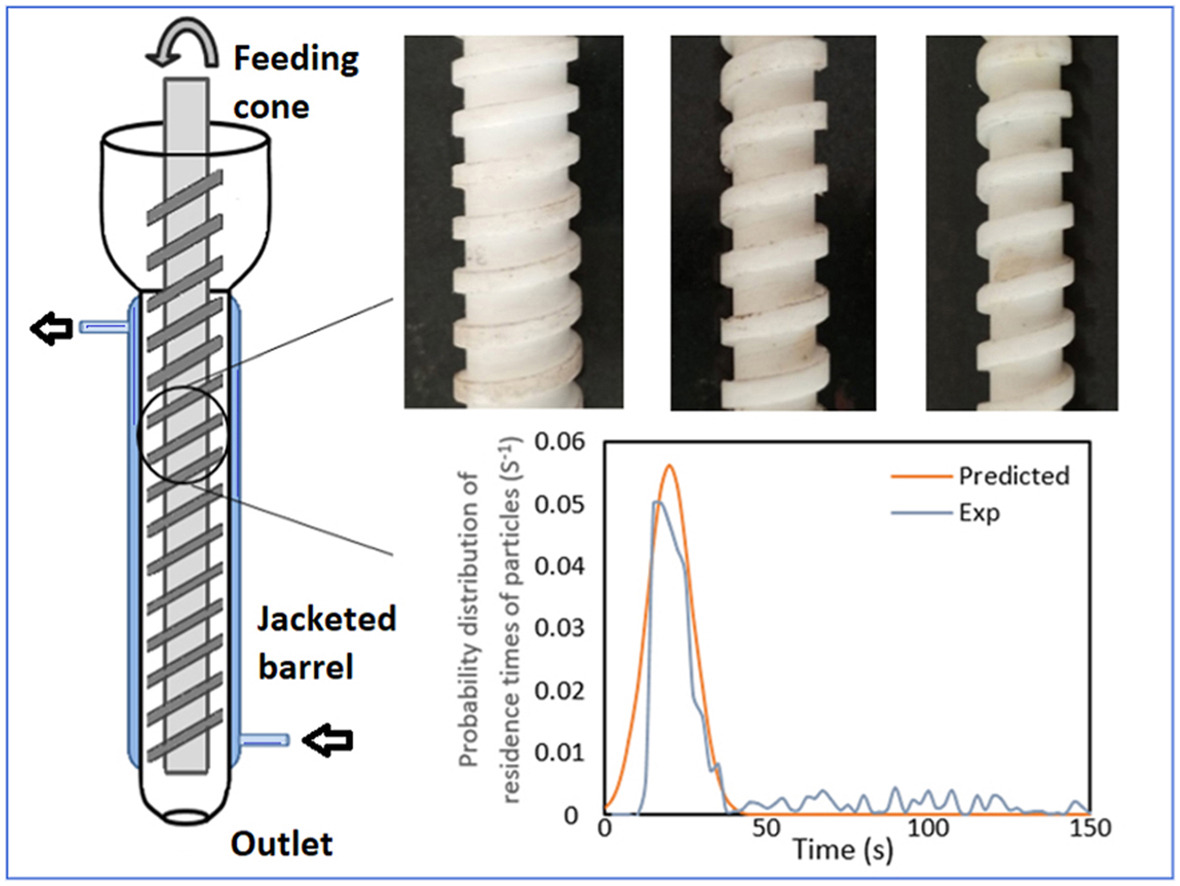
The use of single and twin-screw extruders for solid-phase reactions is a promising method to intensify a process in a more sustainable manner. In this manuscript, we report a detailed analysis of the residence time distribution (RTD) in vertical single-screw reactors. The results will help in the selection of the right screw design that would help achieve the desired residence time, which is necessary for a reaction to happen. Experiments were conducted in three vertical screw reactors (having fixed shaft diameter) with varying dimensions using granular free-flowing powders of sodium chloride and silica with a mean particle size of ∼25μm. RTD behavior was modeled using the radial particle velocities in the screw reactor's centrifugal field. Further, a method is proposed for estimating the axial dispersion coefficient of dry powders in such sheared flows using true and bulk densities of the powder and the screw shear rate. This dispersion coefficient is used in the axially dispersed plug flow model to describe the RTD behavior of screw reactors with acceptable accuracy. The theoretically predicted and experimentally obtained dispersion coefficients are found to be similar thereby confirming the suitability of the model.
Graphical abstract
Keywords
Single-screw extruder; Powder flow; Bulk density; Centrifugal field in screw reactor; Particle inertial number; Powder dispersion coefficient
文章导读