
期刊文章
过刊浏览
- Volumes 108-119 (2025)
-
Volumes 96-107 (2025)
-
Volume 107
Pages 1-376 (December 2025)
-
Volume 106
Pages 1-336 (November 2025)
-
Volume 105
Pages 1-356 (October 2025)
-
Volume 104
Pages 1-332 (September 2025)
-
Volume 103
Pages 1-314 (August 2025)
-
Volume 102
Pages 1-276 (July 2025)
-
Volume 101
Pages 1-166 (June 2025)
-
Volume 100
Pages 1-256 (May 2025)
-
Volume 99
Pages 1-242 (April 2025)
-
Volume 98
Pages 1-288 (March 2025)
-
Volume 97
Pages 1-256 (February 2025)
-
Volume 96
Pages 1-340 (January 2025)
-
Volume 107
-
Volumes 84-95 (2024)
-
Volume 95
Pages 1-392 (December 2024)
-
Volume 94
Pages 1-400 (November 2024)
-
Volume 93
Pages 1-376 (October 2024)
-
Volume 92
Pages 1-316 (September 2024)
-
Volume 91
Pages 1-378 (August 2024)
-
Volume 90
Pages 1-580 (July 2024)
-
Volume 89
Pages 1-278 (June 2024)
-
Volume 88
Pages 1-350 (May 2024)
-
Volume 87
Pages 1-338 (April 2024)
-
Volume 86
Pages 1-312 (March 2024)
-
Volume 85
Pages 1-334 (February 2024)
-
Volume 84
Pages 1-308 (January 2024)
-
Volume 95
-
Volumes 72-83 (2023)
-
Volume 83
Pages 1-258 (December 2023)
-
Volume 82
Pages 1-204 (November 2023)
-
Volume 81
Pages 1-188 (October 2023)
-
Volume 80
Pages 1-202 (September 2023)
-
Volume 79
Pages 1-172 (August 2023)
-
Volume 78
Pages 1-146 (July 2023)
-
Volume 77
Pages 1-152 (June 2023)
-
Volume 76
Pages 1-176 (May 2023)
-
Volume 75
Pages 1-228 (April 2023)
-
Volume 74
Pages 1-200 (March 2023)
-
Volume 73
Pages 1-138 (February 2023)
-
Volume 72
Pages 1-144 (January 2023)
-
Volume 83
-
Volumes 60-71 (2022)
-
Volume 71
Pages 1-108 (December 2022)
-
Volume 70
Pages 1-106 (November 2022)
-
Volume 69
Pages 1-122 (October 2022)
-
Volume 68
Pages 1-124 (September 2022)
-
Volume 67
Pages 1-102 (August 2022)
-
Volume 66
Pages 1-112 (July 2022)
-
Volume 65
Pages 1-138 (June 2022)
-
Volume 64
Pages 1-186 (May 2022)
-
Volume 63
Pages 1-124 (April 2022)
-
Volume 62
Pages 1-104 (March 2022)
-
Volume 61
Pages 1-120 (February 2022)
-
Volume 60
Pages 1-124 (January 2022)
-
Volume 71
- Volumes 54-59 (2021)
- Volumes 48-53 (2020)
- Volumes 42-47 (2019)
- Volumes 36-41 (2018)
- Volumes 30-35 (2017)
- Volumes 24-29 (2016)
- Volumes 18-23 (2015)
- Volumes 12-17 (2014)
- Volume 11 (2013)
- Volume 10 (2012)
- Volume 9 (2011)
- Volume 8 (2010)
- Volume 7 (2009)
- Volume 6 (2008)
- Volume 5 (2007)
- Volume 4 (2006)
- Volume 3 (2005)
- Volume 2 (2004)
- Volume 1 (2003)
Volume 107
Alhajj, M., & Aziz, M. (2025). Recent progress on anode materials and their preparation for use in sodium ion batteries. Particuology, 107, 339-374. https://doi.org/10.1016/j.partic.2025.10.017
Recent progress on anode materials and their preparation for use in sodium ion batteries
Mahmood Alhajj a b *, Madzlan Aziz a c *
a Chemistry Department, Faculty of Science, Universiti Teknologi Malaysia, Johor, Malaysia
b Physics Department and Laser Centre, ISI-SIR (CsNano), Faculty of Science, Universiti Teknologi Malaysia, Johor, Malaysia
c Advanced Membrane Technology Research Centre (AMTEC), Faculty of Energy and Chemical Engineering, Universiti Teknologi Malaysia, Johor, Malaysia
10.1016/j.partic.2025.10.017
Volume 107,
December 2025,
Pages 339-374
Received 16 September 2025, Revised 13 October 2025, Accepted 23 October 2025, Available online 1 November 2025, Version of Record 12 November 2025.
E-mail:
alhajjmahmood2021@gmail.com; madzlan@utm.my
Highlights
• Growing interest in SIBs as a low-cost alternative to LIBs due to lithium scarcity and rising costs is examined.
• Key limitations in anode performance of SIBs due to sluggish Na+ kinetics and large ionic radius are highlighted.
• The Na+ storage mechanisms and structural evolution of various anode material classes are comprehensively reviewed.
• Recent strategies employed to enhance the efficiency and stability of anode materials in SIBs are critically analyzed.
• The role of machine learning and AI in advancing battery research and its challenges in data and validation are addressed.
Abstract
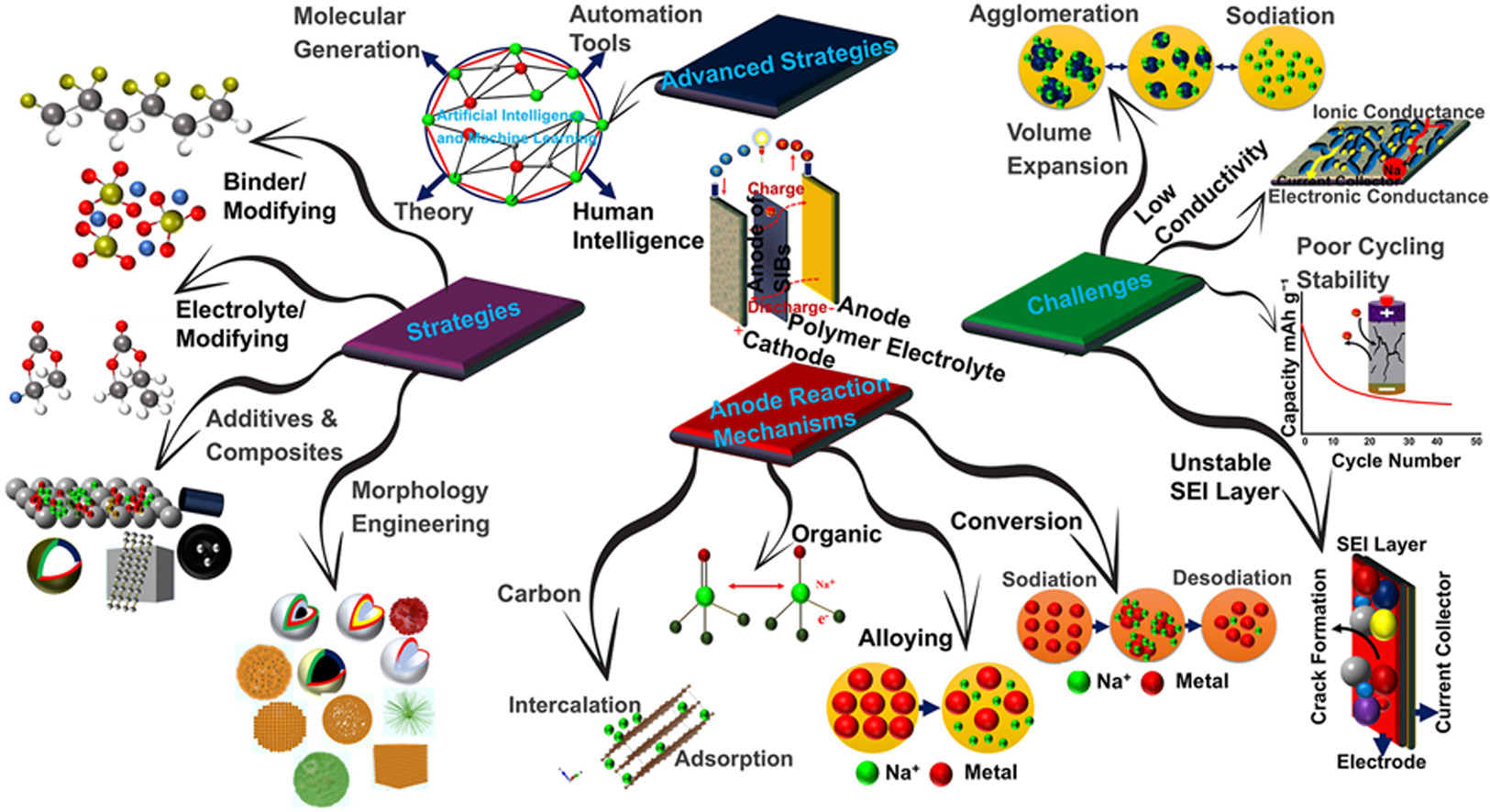
Rechargeable lithium-ion batteries (LIBs) are the dominant technology for secondary batteries due to their exceptional cycle life and superior energy density. However, for large-scale energy storage applications, sodium-ion batteries (SIBs) are considered a promising alternative owing to their abundant sodium resources, low cost, and relatively high energy density. SIBs display gorgeous application prospects as a superior alternative to extensively commercialized LIBs. Problems such as the low performance of suitable anode materials in large-scale SIBs, due to the large size and sluggish kinetics of Na+ have limited their development. So, further progress in SIBs performance is still needed in terms of fast-charging capability, cyclic stability, and power/energy densities. In this review, the latest progress in the preparation strategies and application challenges of SIBs is summarized, focusing on the fundamentals of the design principles and sodium storage mechanisms in various classes of anode materials including carbon-based, inorganic, organic, and MXene-derived systems. Structural and surface engineering techniques, electrochemical performance evaluation, machine learning (ML), and artificial intelligence (AI) are also discussed to elucidate ion storage mechanisms and accelerate anode material design for next-generation SIBs.
Graphical abstract
Keywords
Sodium ion batteries; Anode; Energy storage; Na-storage mechanism; Machine learning; Artificial intelligence
文章导读