
期刊文章
过刊浏览
- Volumes 108-119 (2025)
-
Volumes 96-107 (2025)
-
Volume 107
Pages 1-376 (December 2025)
-
Volume 106
Pages 1-336 (November 2025)
-
Volume 105
Pages 1-356 (October 2025)
-
Volume 104
Pages 1-332 (September 2025)
-
Volume 103
Pages 1-314 (August 2025)
-
Volume 102
Pages 1-276 (July 2025)
-
Volume 101
Pages 1-166 (June 2025)
-
Volume 100
Pages 1-256 (May 2025)
-
Volume 99
Pages 1-242 (April 2025)
-
Volume 98
Pages 1-288 (March 2025)
-
Volume 97
Pages 1-256 (February 2025)
-
Volume 96
Pages 1-340 (January 2025)
-
Volume 107
-
Volumes 84-95 (2024)
-
Volume 95
Pages 1-392 (December 2024)
-
Volume 94
Pages 1-400 (November 2024)
-
Volume 93
Pages 1-376 (October 2024)
-
Volume 92
Pages 1-316 (September 2024)
-
Volume 91
Pages 1-378 (August 2024)
-
Volume 90
Pages 1-580 (July 2024)
-
Volume 89
Pages 1-278 (June 2024)
-
Volume 88
Pages 1-350 (May 2024)
-
Volume 87
Pages 1-338 (April 2024)
-
Volume 86
Pages 1-312 (March 2024)
-
Volume 85
Pages 1-334 (February 2024)
-
Volume 84
Pages 1-308 (January 2024)
-
Volume 95
-
Volumes 72-83 (2023)
-
Volume 83
Pages 1-258 (December 2023)
-
Volume 82
Pages 1-204 (November 2023)
-
Volume 81
Pages 1-188 (October 2023)
-
Volume 80
Pages 1-202 (September 2023)
-
Volume 79
Pages 1-172 (August 2023)
-
Volume 78
Pages 1-146 (July 2023)
-
Volume 77
Pages 1-152 (June 2023)
-
Volume 76
Pages 1-176 (May 2023)
-
Volume 75
Pages 1-228 (April 2023)
-
Volume 74
Pages 1-200 (March 2023)
-
Volume 73
Pages 1-138 (February 2023)
-
Volume 72
Pages 1-144 (January 2023)
-
Volume 83
-
Volumes 60-71 (2022)
-
Volume 71
Pages 1-108 (December 2022)
-
Volume 70
Pages 1-106 (November 2022)
-
Volume 69
Pages 1-122 (October 2022)
-
Volume 68
Pages 1-124 (September 2022)
-
Volume 67
Pages 1-102 (August 2022)
-
Volume 66
Pages 1-112 (July 2022)
-
Volume 65
Pages 1-138 (June 2022)
-
Volume 64
Pages 1-186 (May 2022)
-
Volume 63
Pages 1-124 (April 2022)
-
Volume 62
Pages 1-104 (March 2022)
-
Volume 61
Pages 1-120 (February 2022)
-
Volume 60
Pages 1-124 (January 2022)
-
Volume 71
- Volumes 54-59 (2021)
- Volumes 48-53 (2020)
- Volumes 42-47 (2019)
- Volumes 36-41 (2018)
- Volumes 30-35 (2017)
- Volumes 24-29 (2016)
- Volumes 18-23 (2015)
- Volumes 12-17 (2014)
- Volume 11 (2013)
- Volume 10 (2012)
- Volume 9 (2011)
- Volume 8 (2010)
- Volume 7 (2009)
- Volume 6 (2008)
- Volume 5 (2007)
- Volume 4 (2006)
- Volume 3 (2005)
- Volume 2 (2004)
- Volume 1 (2003)
Volume 109
Shi, K., Hassanpour, A., Babaie, M., & Jabbari, M. (2026). Modelling of dry manufacturing of LFP cathode filaments with twin-screw extruder using the Discrete Element Method. Particuology, 109, 1-11. https://doi.org/10.1016/j.partic.2025.11.020
Modelling of dry manufacturing of LFP cathode filaments with twin-screw extruder using the Discrete Element Method (Open Access)
Kaize Shi a, Ali Hassanpour b, Meisam Babaie a, Masoud Jabbari a *
a School of Mechanical Engineering, University of Leeds, Leeds, LS2 9JT, UK
b School of Chemical and Process Engineering, University of Leeds, Leeds, LS2 9JT, UK
10.1016/j.partic.2025.11.020
Volume 109,
February 2026,
Pages 1-11
Received 24 September 2025, Revised 10 November 2025, Accepted 28 November 2025, Available online 11 December 2025, Version of Record 15 December 2025.
E-mail:
m.jabbari@leeds.ac.uk
Highlights
• DEM simulation of solvent-free (dry) electrode manufacturing.
• Investigation of process conditions on battery filament fabrication.
• Analysing pore-scale properties of filaments.
Abstract
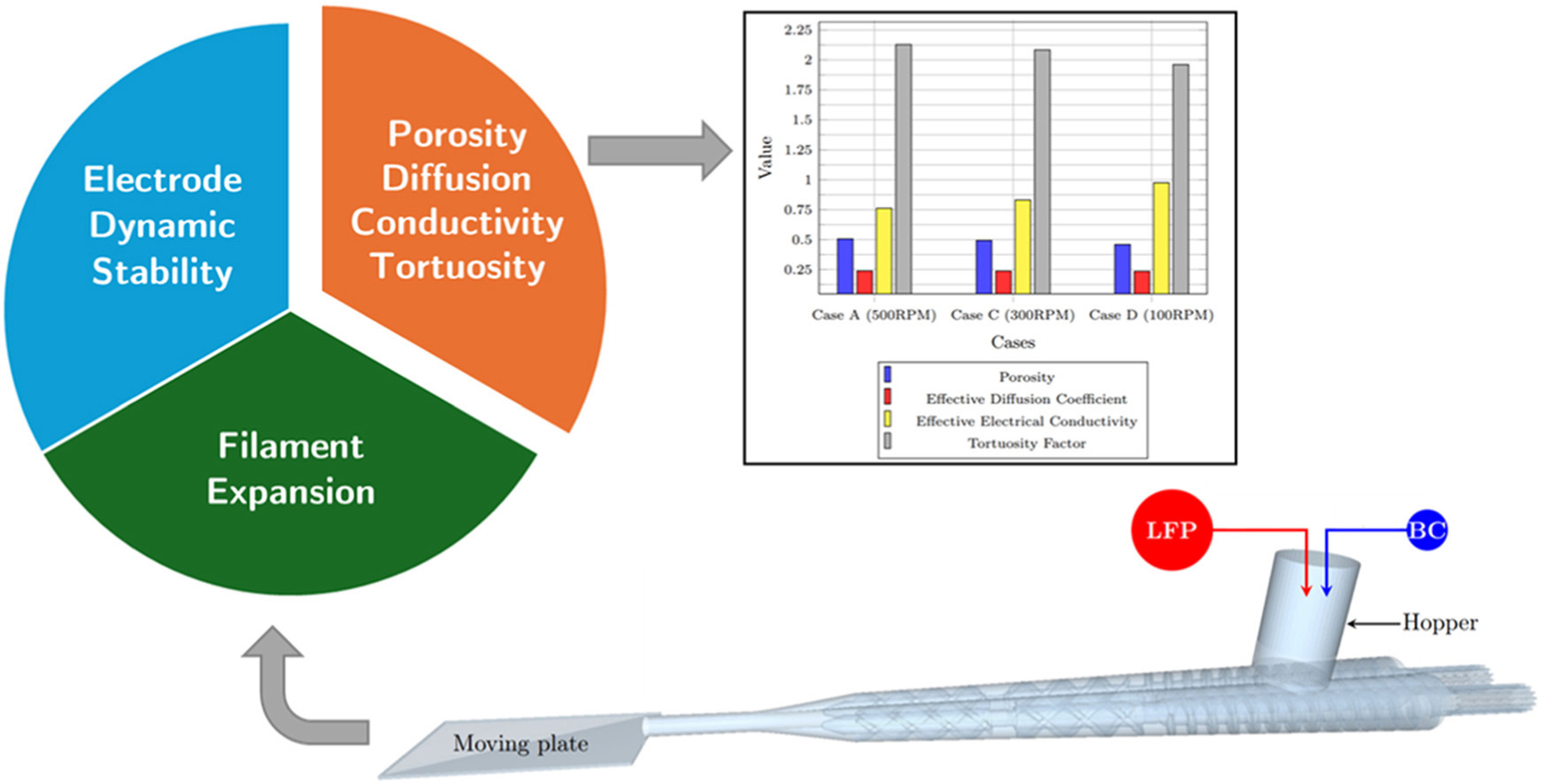
Material extrusion is a key step in the solvent-free fabrication of lithium-ion battery (LIB) electrodes, offering reduced costs and environmental impact compared to slurry-based methods. While discrete element method (DEM) based mesoscopic models have been used to study twin-screw extrusion, the microstructural characterisation of extrudates immediately after nozzle exit remains unexplored. In this study, a series of DEM simulations were conducted to perform a sensitivity analysis of the microstructure and electrochemical performance-related parameters of extruded electrode filaments by varying the feeding rate and feeding mode, screw rotational speed, and particle cohesion. Furthermore, this work addresses the previously unexamined phenomenon of filament expansion during extrusion. By introducing the Augmented Dickey-Fuller (ADF) method, the study also provides the first analysis of the temporal dynamic stability of filament quality during the dry electrode manufacturing extrusion process. The results show that increasing the screw speed from 100 to 500 RPM reduces porosity by 10 % and limits expansion, while lower speeds improve consistency in electrode quality. A novel approach to quantifying dynamic behaviour is proposed, offering insights for optimising solvent-free electrode manufacturing.
Graphical abstract
Keywords
Lithium-ion batteries; Dry manufacturing; Discrete element method; 3D printing; Twin-screw extruder
文章导读