
期刊文章
过刊浏览
- Volumes 108-119 (2025)
-
Volumes 96-107 (2025)
-
Volume 107
Pages 1-376 (December 2025)
-
Volume 106
Pages 1-336 (November 2025)
-
Volume 105
Pages 1-356 (October 2025)
-
Volume 104
Pages 1-332 (September 2025)
-
Volume 103
Pages 1-314 (August 2025)
-
Volume 102
Pages 1-276 (July 2025)
-
Volume 101
Pages 1-166 (June 2025)
-
Volume 100
Pages 1-256 (May 2025)
-
Volume 99
Pages 1-242 (April 2025)
-
Volume 98
Pages 1-288 (March 2025)
-
Volume 97
Pages 1-256 (February 2025)
-
Volume 96
Pages 1-340 (January 2025)
-
Volume 107
-
Volumes 84-95 (2024)
-
Volume 95
Pages 1-392 (December 2024)
-
Volume 94
Pages 1-400 (November 2024)
-
Volume 93
Pages 1-376 (October 2024)
-
Volume 92
Pages 1-316 (September 2024)
-
Volume 91
Pages 1-378 (August 2024)
-
Volume 90
Pages 1-580 (July 2024)
-
Volume 89
Pages 1-278 (June 2024)
-
Volume 88
Pages 1-350 (May 2024)
-
Volume 87
Pages 1-338 (April 2024)
-
Volume 86
Pages 1-312 (March 2024)
-
Volume 85
Pages 1-334 (February 2024)
-
Volume 84
Pages 1-308 (January 2024)
-
Volume 95
-
Volumes 72-83 (2023)
-
Volume 83
Pages 1-258 (December 2023)
-
Volume 82
Pages 1-204 (November 2023)
-
Volume 81
Pages 1-188 (October 2023)
-
Volume 80
Pages 1-202 (September 2023)
-
Volume 79
Pages 1-172 (August 2023)
-
Volume 78
Pages 1-146 (July 2023)
-
Volume 77
Pages 1-152 (June 2023)
-
Volume 76
Pages 1-176 (May 2023)
-
Volume 75
Pages 1-228 (April 2023)
-
Volume 74
Pages 1-200 (March 2023)
-
Volume 73
Pages 1-138 (February 2023)
-
Volume 72
Pages 1-144 (January 2023)
-
Volume 83
-
Volumes 60-71 (2022)
-
Volume 71
Pages 1-108 (December 2022)
-
Volume 70
Pages 1-106 (November 2022)
-
Volume 69
Pages 1-122 (October 2022)
-
Volume 68
Pages 1-124 (September 2022)
-
Volume 67
Pages 1-102 (August 2022)
-
Volume 66
Pages 1-112 (July 2022)
-
Volume 65
Pages 1-138 (June 2022)
-
Volume 64
Pages 1-186 (May 2022)
-
Volume 63
Pages 1-124 (April 2022)
-
Volume 62
Pages 1-104 (March 2022)
-
Volume 61
Pages 1-120 (February 2022)
-
Volume 60
Pages 1-124 (January 2022)
-
Volume 71
- Volumes 54-59 (2021)
- Volumes 48-53 (2020)
- Volumes 42-47 (2019)
- Volumes 36-41 (2018)
- Volumes 30-35 (2017)
- Volumes 24-29 (2016)
- Volumes 18-23 (2015)
- Volumes 12-17 (2014)
- Volume 11 (2013)
- Volume 10 (2012)
- Volume 9 (2011)
- Volume 8 (2010)
- Volume 7 (2009)
- Volume 6 (2008)
- Volume 5 (2007)
- Volume 4 (2006)
- Volume 3 (2005)
- Volume 2 (2004)
- Volume 1 (2003)
Volume 109
Li, B., Yang, L., Chen, X., Huang, C., & Wu, Y. (2026). Evaluation of effects of particle parameters on the particle bed in supercritical CO2 fractures using coupled CFD-DEM approach. Particuology, 109, 12-24. https://doi.org/10.1016/j.partic.2025.11.017
Evaluation of effects of particle parameters on the particle bed in supercritical CO2 fractures using coupled CFD-DEM approach
Bin Li, Lele Yang *, Xiaodong Chen, Chengyu Huang, Yue Wu
School of Civil Engineering and Transportation, South China University of Technology, Guangzhou, 510641, China
10.1016/j.partic.2025.11.017
Volume 109,
February 2026,
Pages 12-24
Received 19 October 2025, Revised 17 November 2025, Accepted 25 November 2025, Available online 4 December 2025, Version of Record 16 December 2025.
E-mail:
yanglele@scut.edu.cn
Highlights
• CFD-DEM model for SC-CO2-carrying particles is developed.
• The variation rule of SC-CO2 flow field in the fracture is investigated.
• The distribution pattern of particles in the SC-CO2 fracture is analyzed.
• The model provides a good technical support for SC-CO2 fracturing in deep wells.
Abstract
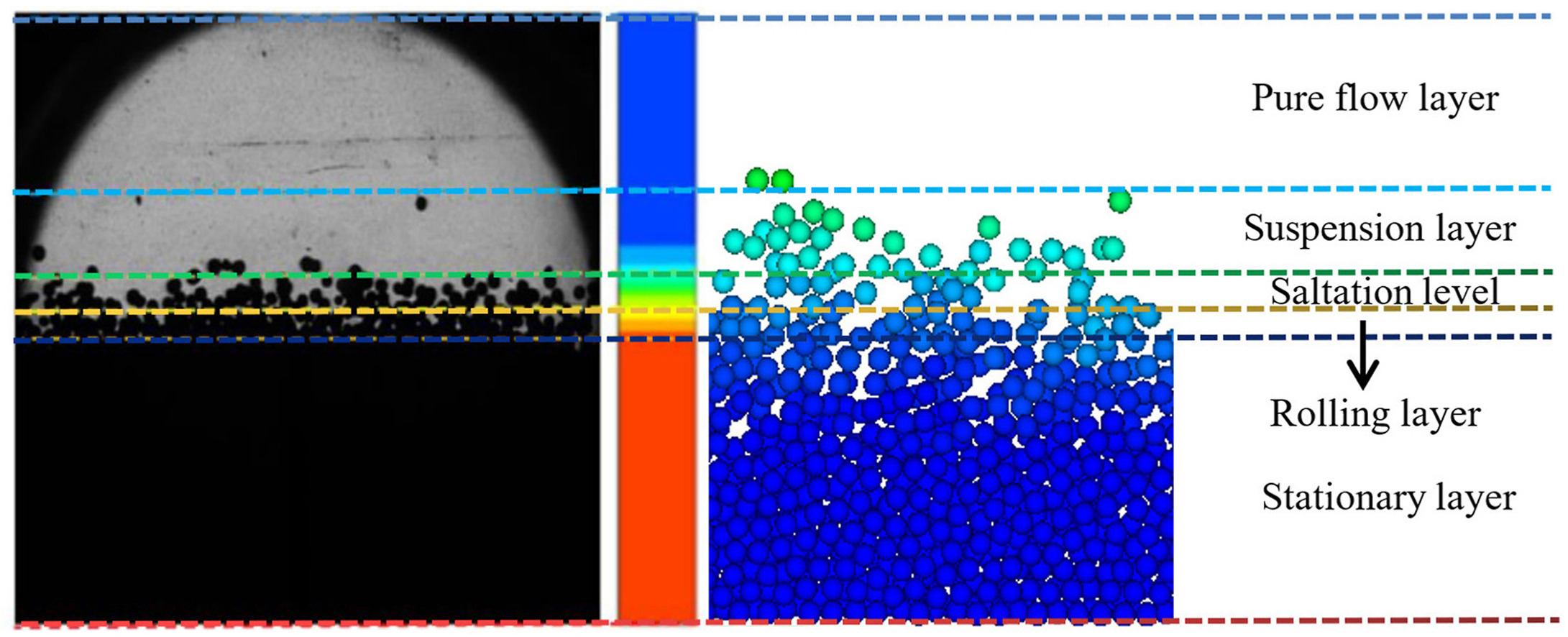
In this study, a coupled CFD–DEM framework incorporating heat transfer was established to elucidate the transport and deposition behavior of proppant particles in supercritical CO2 (SC-CO2) fracturing. A three-dimensional fracture-scale physical model was developed to investigate the effects of particle concentration, density, diameter, and non-sphericity on the evolution of the proppant bed. The simulations reveal that both the equilibrium height and length of the granular bed increase with particle concentration, exhibiting a near-linear dependence on the injected mass flux. As particle density rises, the bed height increases while the deposition front advances upstream, facilitating earlier bed formation. Increasing particle diameter from 0.4 mm to 1 mm produces pronounced morphological changes—larger particles form thicker, shorter beds, whereas smaller particles are more easily transported to distal fracture regions. Enhanced particle non-sphericity promotes the development of higher and wider beds due to increased mechanical interlocking and larger inter-particle voids, which strengthen flow-channel connectivity and potentially improve hydrocarbon recovery. The integrated thermal–hydrodynamic–granular analysis demonstrates that SC-CO2's temperature-dependent viscosity and density variations significantly modulate drag, lift, and buoyancy forces, jointly governing the self-organization and stability of proppant beds within fractures.
Graphical abstract
Keywords
CFD-DEM; SC-CO2; Particle bed; Hertz-Mindlin contact model
文章导读