
期刊文章
过刊浏览
- Volumes 108-119 (2025)
-
Volumes 96-107 (2025)
-
Volume 107
Pages 1-376 (December 2025)
-
Volume 106
Pages 1-336 (November 2025)
-
Volume 105
Pages 1-356 (October 2025)
-
Volume 104
Pages 1-332 (September 2025)
-
Volume 103
Pages 1-314 (August 2025)
-
Volume 102
Pages 1-276 (July 2025)
-
Volume 101
Pages 1-166 (June 2025)
-
Volume 100
Pages 1-256 (May 2025)
-
Volume 99
Pages 1-242 (April 2025)
-
Volume 98
Pages 1-288 (March 2025)
-
Volume 97
Pages 1-256 (February 2025)
-
Volume 96
Pages 1-340 (January 2025)
-
Volume 107
-
Volumes 84-95 (2024)
-
Volume 95
Pages 1-392 (December 2024)
-
Volume 94
Pages 1-400 (November 2024)
-
Volume 93
Pages 1-376 (October 2024)
-
Volume 92
Pages 1-316 (September 2024)
-
Volume 91
Pages 1-378 (August 2024)
-
Volume 90
Pages 1-580 (July 2024)
-
Volume 89
Pages 1-278 (June 2024)
-
Volume 88
Pages 1-350 (May 2024)
-
Volume 87
Pages 1-338 (April 2024)
-
Volume 86
Pages 1-312 (March 2024)
-
Volume 85
Pages 1-334 (February 2024)
-
Volume 84
Pages 1-308 (January 2024)
-
Volume 95
-
Volumes 72-83 (2023)
-
Volume 83
Pages 1-258 (December 2023)
-
Volume 82
Pages 1-204 (November 2023)
-
Volume 81
Pages 1-188 (October 2023)
-
Volume 80
Pages 1-202 (September 2023)
-
Volume 79
Pages 1-172 (August 2023)
-
Volume 78
Pages 1-146 (July 2023)
-
Volume 77
Pages 1-152 (June 2023)
-
Volume 76
Pages 1-176 (May 2023)
-
Volume 75
Pages 1-228 (April 2023)
-
Volume 74
Pages 1-200 (March 2023)
-
Volume 73
Pages 1-138 (February 2023)
-
Volume 72
Pages 1-144 (January 2023)
-
Volume 83
-
Volumes 60-71 (2022)
-
Volume 71
Pages 1-108 (December 2022)
-
Volume 70
Pages 1-106 (November 2022)
-
Volume 69
Pages 1-122 (October 2022)
-
Volume 68
Pages 1-124 (September 2022)
-
Volume 67
Pages 1-102 (August 2022)
-
Volume 66
Pages 1-112 (July 2022)
-
Volume 65
Pages 1-138 (June 2022)
-
Volume 64
Pages 1-186 (May 2022)
-
Volume 63
Pages 1-124 (April 2022)
-
Volume 62
Pages 1-104 (March 2022)
-
Volume 61
Pages 1-120 (February 2022)
-
Volume 60
Pages 1-124 (January 2022)
-
Volume 71
- Volumes 54-59 (2021)
- Volumes 48-53 (2020)
- Volumes 42-47 (2019)
- Volumes 36-41 (2018)
- Volumes 30-35 (2017)
- Volumes 24-29 (2016)
- Volumes 18-23 (2015)
- Volumes 12-17 (2014)
- Volume 11 (2013)
- Volume 10 (2012)
- Volume 9 (2011)
- Volume 8 (2010)
- Volume 7 (2009)
- Volume 6 (2008)
- Volume 5 (2007)
- Volume 4 (2006)
- Volume 3 (2005)
- Volume 2 (2004)
- Volume 1 (2003)
Volume 109
Barua, S., Bin Rahim, M. Z., & Liu, Q. (2026). Multi-objective optimisation of dual inlet cyclone separator using response surface methodology. Particuology, 109, 45-58. https://doi.org/10.1016/j.partic.2025.12.004
Multi-objective optimisation of dual inlet cyclone separator using response surface methodology (Open Access)
Saikat Barua a, Mohammad Zulafif Bin Rahim a, Qingqing Liu b *
a Faculty of Mechanical and Manufacturing Engineering, Universiti Tun Hussein Onn Malaysia, Malaysia
b Michael W. Hall School of Mechanical Engineering, Mississippi State University, USA
10.1016/j.partic.2025.12.004
Volume 109,
February 2026,
Pages 45-58
Received 18 September 2025, Revised 24 November 2025, Accepted 4 December 2025, Available online 10 December 2025, Version of Record 19 December 2025.
E-mail:
qliu@me.msstate.edu
Highlights
• Dual inlet cyclone separator optimised using CFD and response surface methodology.
• Six key geometric parameters analysed for efficiency and pressure drop effects.
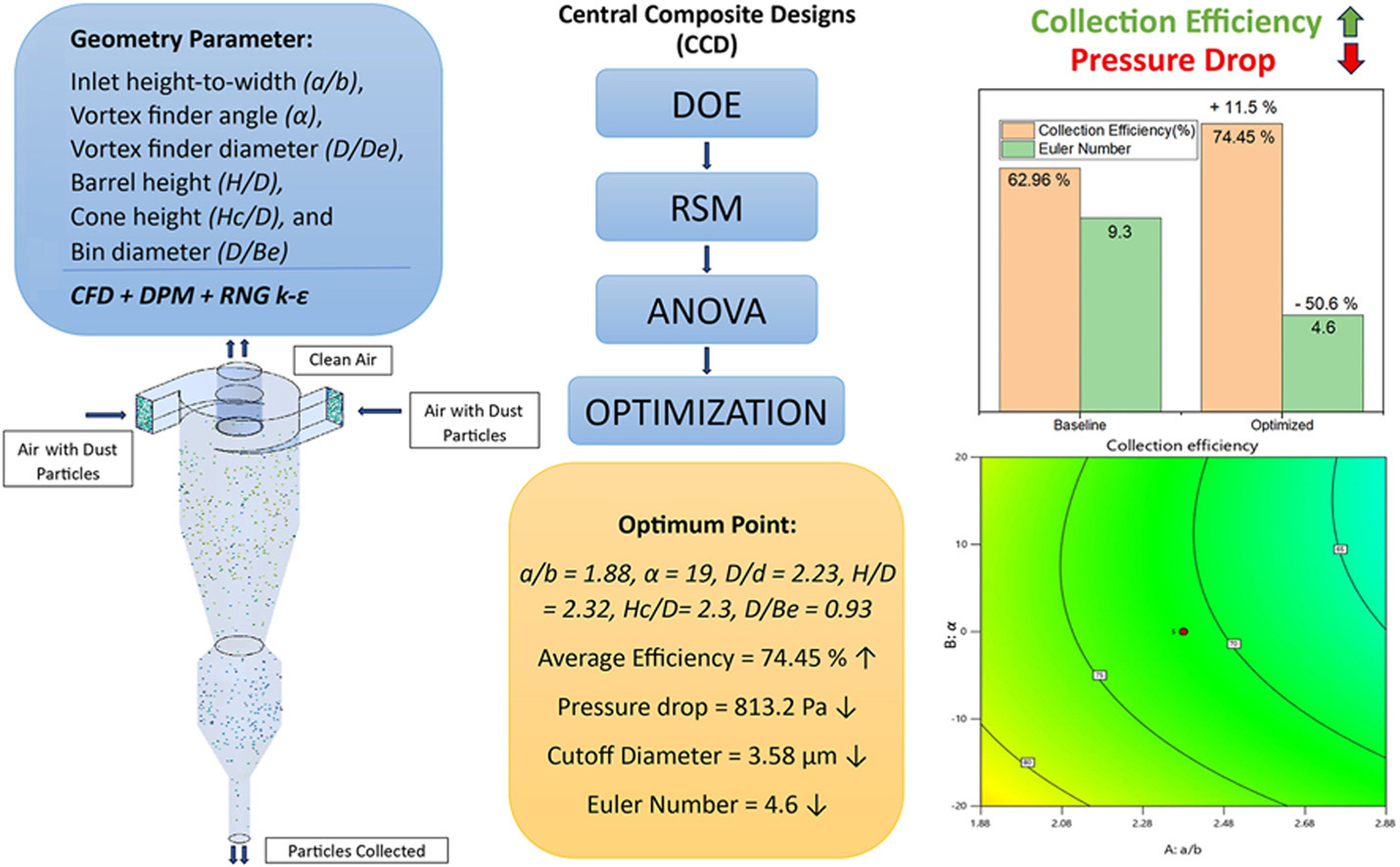
• Optimised design improves collection efficiency by 11.5 % and cuts pressure drop.
• Euler number reduced by 50.96 %, cutoff diameter lowered by 16.15 %.
• Statistical model validated with CFD, prediction errors within acceptable range.
Abstract
Given the growing emphasis on sustainable industrial practices and regulatory constraints on particulate emissions, enhancing cyclone separator performance remains a critical area of research for ensuring the high-efficient solid-gas separation with minimal energy penalties. This study presents a comprehensive numerical investigation and multi-objective optimisation of a dual-inlet cyclone separator to enhance the particle collection efficiency while minimizing the pressure drop. The Eulerian-Lagrangian approach is employed using the RNG k – ε turbulence modelling, coupled with the Discrete Phase Model for particle tracking. Key geometric parameters, including the inlet height to width, vortex finder angle, vortex finder diameter, barrel height, cone height, and bin diameter, are systematically varied to analyse their effects on the cyclone performance. Two optimal factors are tested among the three most significant factors at once to evaluate their combined effects on the collection efficiency and the pressure drop. Results indicate that the optimised cyclone design improves average collection efficiency by 11.5 % across particle sizes, reduces the Euler number by 50.96 %, and lowers the particle cut-off diameter by 16.15 %, while maintaining a balanced trade-off with the pressure drop. The prediction errors for the pressure drop and the collection efficiency are within acceptable limits at 11 % and 3.5 %, respectively. The improved geometry strengthens the tangential flow and moderates the peak axial velocity, resulting in a more effective centrifugal separation for fine particles.
Graphical abstract
Keywords
Cyclone separator; Collection efficiency; Discrete phase model; Multi-objective optimisation
文章导读