
期刊文章
过刊浏览
- Volumes 108-119 (2025)
-
Volumes 96-107 (2025)
-
Volume 107
Pages 1-376 (December 2025)
-
Volume 106
Pages 1-336 (November 2025)
-
Volume 105
Pages 1-356 (October 2025)
-
Volume 104
Pages 1-332 (September 2025)
-
Volume 103
Pages 1-314 (August 2025)
-
Volume 102
Pages 1-276 (July 2025)
-
Volume 101
Pages 1-166 (June 2025)
-
Volume 100
Pages 1-256 (May 2025)
-
Volume 99
Pages 1-242 (April 2025)
-
Volume 98
Pages 1-288 (March 2025)
-
Volume 97
Pages 1-256 (February 2025)
-
Volume 96
Pages 1-340 (January 2025)
-
Volume 107
-
Volumes 84-95 (2024)
-
Volume 95
Pages 1-392 (December 2024)
-
Volume 94
Pages 1-400 (November 2024)
-
Volume 93
Pages 1-376 (October 2024)
-
Volume 92
Pages 1-316 (September 2024)
-
Volume 91
Pages 1-378 (August 2024)
-
Volume 90
Pages 1-580 (July 2024)
-
Volume 89
Pages 1-278 (June 2024)
-
Volume 88
Pages 1-350 (May 2024)
-
Volume 87
Pages 1-338 (April 2024)
-
Volume 86
Pages 1-312 (March 2024)
-
Volume 85
Pages 1-334 (February 2024)
-
Volume 84
Pages 1-308 (January 2024)
-
Volume 95
-
Volumes 72-83 (2023)
-
Volume 83
Pages 1-258 (December 2023)
-
Volume 82
Pages 1-204 (November 2023)
-
Volume 81
Pages 1-188 (October 2023)
-
Volume 80
Pages 1-202 (September 2023)
-
Volume 79
Pages 1-172 (August 2023)
-
Volume 78
Pages 1-146 (July 2023)
-
Volume 77
Pages 1-152 (June 2023)
-
Volume 76
Pages 1-176 (May 2023)
-
Volume 75
Pages 1-228 (April 2023)
-
Volume 74
Pages 1-200 (March 2023)
-
Volume 73
Pages 1-138 (February 2023)
-
Volume 72
Pages 1-144 (January 2023)
-
Volume 83
-
Volumes 60-71 (2022)
-
Volume 71
Pages 1-108 (December 2022)
-
Volume 70
Pages 1-106 (November 2022)
-
Volume 69
Pages 1-122 (October 2022)
-
Volume 68
Pages 1-124 (September 2022)
-
Volume 67
Pages 1-102 (August 2022)
-
Volume 66
Pages 1-112 (July 2022)
-
Volume 65
Pages 1-138 (June 2022)
-
Volume 64
Pages 1-186 (May 2022)
-
Volume 63
Pages 1-124 (April 2022)
-
Volume 62
Pages 1-104 (March 2022)
-
Volume 61
Pages 1-120 (February 2022)
-
Volume 60
Pages 1-124 (January 2022)
-
Volume 71
- Volumes 54-59 (2021)
- Volumes 48-53 (2020)
- Volumes 42-47 (2019)
- Volumes 36-41 (2018)
- Volumes 30-35 (2017)
- Volumes 24-29 (2016)
- Volumes 18-23 (2015)
- Volumes 12-17 (2014)
- Volume 11 (2013)
- Volume 10 (2012)
- Volume 9 (2011)
- Volume 8 (2010)
- Volume 7 (2009)
- Volume 6 (2008)
- Volume 5 (2007)
- Volume 4 (2006)
- Volume 3 (2005)
- Volume 2 (2004)
- Volume 1 (2003)
Volume 109
Wang, J., Wu, B., Xue, Y., Jing, H., & Cui, X. (2026). Numerical investigation of lunar dust particle deposition in human terminal alveoli. Particuology, 109, 75-85.
https://doi.org/10.1016/j.partic.2025.11.015
Numerical investigation of lunar dust particle deposition in human terminal alveoli
Jintao Wang a, Bin Wu b c, Yuan Xue b c, Hao Jing a, Xinguang Cui a c *
a School of Aerospace Engineering, Huazhong University of Science and Technology, Wuhan, 430070, China
b China Astronaut Research and Training Center, Beijing, 102200, China
c State Key Laboratory of Space Medicine, Bejing, 102200, China
10.1016/j.partic.2025.11.015
Volume 109,
February 2026,
Pages 75-85
Received 8 July 2025, Revised 1 November 2025, Accepted 13 November 2025, Available online 27 November 2025, Version of Record 20 December 2025.
E-mail:
xinguang_cui@hust.edu.cn; xinguang_cui@mail.hust.edu.cn
Highlights
• The LD deposition is determined by activity levels, body posture, and its size.
• Parameter β characterizes DF of LD particles at varying activity levels.
• Body postures notably affect the deposition characteristics of LD particles.
• Deposition fraction of LD particles can be predicted using the equation developed by this work.
Abstract
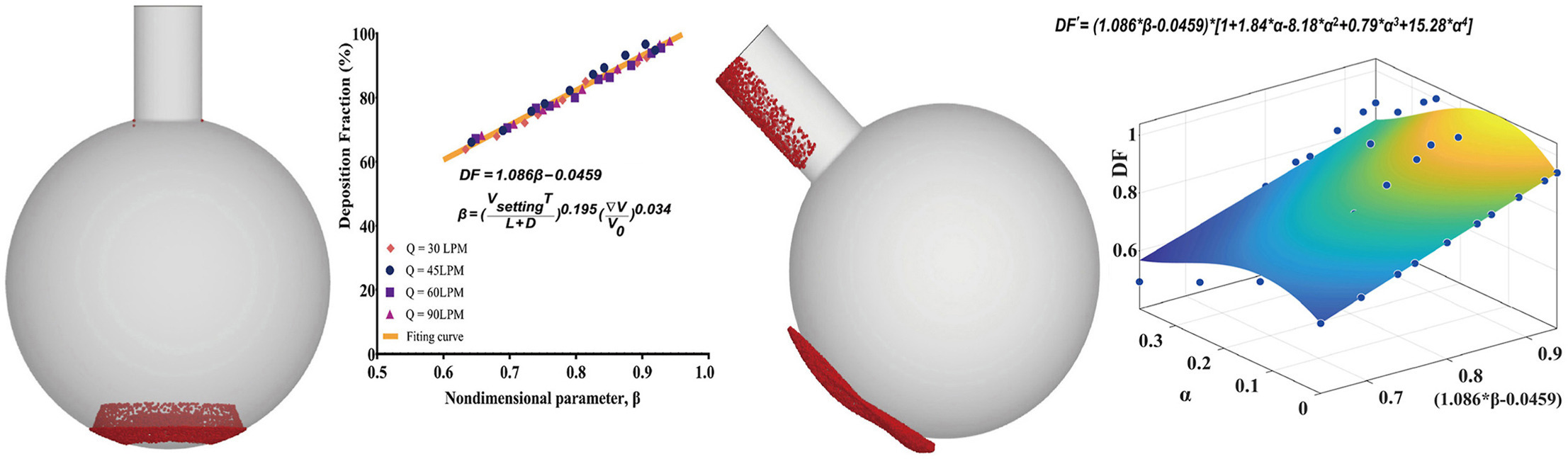
To ensure the health and safety of astronauts during future manned lunar missions, it is critical to understand the transport and deposition of lunar dust (LD) particles in the terminal alveoli. This study employs computational fluid dynamics (CFD) to investigate the deposition characteristics of LD particles, considering factors such as particle size, activity intensity, and body posture. The key findings are: (1) The deposition characteristics of LD particles differ significantly across various activity intensities, with higher activity levels resulting in earlier onset and shorter duration of deposition. (2) The distributions and rates of deposited particles on the alveolar wall vary with different body postures. Specifically, transitioning from a head-up to a head-down posture leads to a reduction of 4.51 times in deposition time. (3) A predictive equation has been developed that effectively estimates LD particle deposition in the terminal alveoli by accounting for particle size, activity level, and body posture. In conclusion, LD particles display diverse deposition characteristics in the terminal alveoli, which can be accurately predicted using an appropriate fitting equation. The findings of this study may significantly enhance astronaut safety and well-being during future manned space exploration missions.
Graphical abstract
Keywords
Terminal alveoli; Lunar dust; Particle deposition; Numerical simulation
文章导读