
期刊文章
过刊浏览
- Volumes 108-119 (2025)
-
Volumes 96-107 (2025)
-
Volume 107
Pages 1-376 (December 2025)
-
Volume 106
Pages 1-336 (November 2025)
-
Volume 105
Pages 1-356 (October 2025)
-
Volume 104
Pages 1-332 (September 2025)
-
Volume 103
Pages 1-314 (August 2025)
-
Volume 102
Pages 1-276 (July 2025)
-
Volume 101
Pages 1-166 (June 2025)
-
Volume 100
Pages 1-256 (May 2025)
-
Volume 99
Pages 1-242 (April 2025)
-
Volume 98
Pages 1-288 (March 2025)
-
Volume 97
Pages 1-256 (February 2025)
-
Volume 96
Pages 1-340 (January 2025)
-
Volume 107
-
Volumes 84-95 (2024)
-
Volume 95
Pages 1-392 (December 2024)
-
Volume 94
Pages 1-400 (November 2024)
-
Volume 93
Pages 1-376 (October 2024)
-
Volume 92
Pages 1-316 (September 2024)
-
Volume 91
Pages 1-378 (August 2024)
-
Volume 90
Pages 1-580 (July 2024)
-
Volume 89
Pages 1-278 (June 2024)
-
Volume 88
Pages 1-350 (May 2024)
-
Volume 87
Pages 1-338 (April 2024)
-
Volume 86
Pages 1-312 (March 2024)
-
Volume 85
Pages 1-334 (February 2024)
-
Volume 84
Pages 1-308 (January 2024)
-
Volume 95
-
Volumes 72-83 (2023)
-
Volume 83
Pages 1-258 (December 2023)
-
Volume 82
Pages 1-204 (November 2023)
-
Volume 81
Pages 1-188 (October 2023)
-
Volume 80
Pages 1-202 (September 2023)
-
Volume 79
Pages 1-172 (August 2023)
-
Volume 78
Pages 1-146 (July 2023)
-
Volume 77
Pages 1-152 (June 2023)
-
Volume 76
Pages 1-176 (May 2023)
-
Volume 75
Pages 1-228 (April 2023)
-
Volume 74
Pages 1-200 (March 2023)
-
Volume 73
Pages 1-138 (February 2023)
-
Volume 72
Pages 1-144 (January 2023)
-
Volume 83
-
Volumes 60-71 (2022)
-
Volume 71
Pages 1-108 (December 2022)
-
Volume 70
Pages 1-106 (November 2022)
-
Volume 69
Pages 1-122 (October 2022)
-
Volume 68
Pages 1-124 (September 2022)
-
Volume 67
Pages 1-102 (August 2022)
-
Volume 66
Pages 1-112 (July 2022)
-
Volume 65
Pages 1-138 (June 2022)
-
Volume 64
Pages 1-186 (May 2022)
-
Volume 63
Pages 1-124 (April 2022)
-
Volume 62
Pages 1-104 (March 2022)
-
Volume 61
Pages 1-120 (February 2022)
-
Volume 60
Pages 1-124 (January 2022)
-
Volume 71
- Volumes 54-59 (2021)
- Volumes 48-53 (2020)
- Volumes 42-47 (2019)
- Volumes 36-41 (2018)
- Volumes 30-35 (2017)
- Volumes 24-29 (2016)
- Volumes 18-23 (2015)
- Volumes 12-17 (2014)
- Volume 11 (2013)
- Volume 10 (2012)
- Volume 9 (2011)
- Volume 8 (2010)
- Volume 7 (2009)
- Volume 6 (2008)
- Volume 5 (2007)
- Volume 4 (2006)
- Volume 3 (2005)
- Volume 2 (2004)
- Volume 1 (2003)
Volume 110
Ma, Y., Yuan, X., Yewale, A., & Benyahia, B. (2026). Recent advances in the digital transformation of crystallization process development and operation: Synergy between model- and AI-driven strategies. Particuology, 110, 223-253. https://doi.org/10.1016/j.partic.2026.01.014
Recent advances in the digital transformation of crystallization process development and operation: Synergy between model- and AI-driven strategies (Open Access)
Yiming Ma, Xuming Yuan, Ashish Yewale, Brahim Benyahia *
Department of Chemical Engineering, Loughborough University, Leicestershire, LE113TU, United Kingdom
10.1016/j.partic.2026.01.014
Volume 110,
March 2026,
Pages 223-253
Received 15 October 2025, Revised 16 January 2026, Accepted 17 January 2026, Available online 23 January 2026, Version of Record 3 February 2026.
E-mail:
b.benyahia@lboro.ac.uk
Highlights
• Reviews digital strategies for managing the multiscale complexity of crystallization processes.
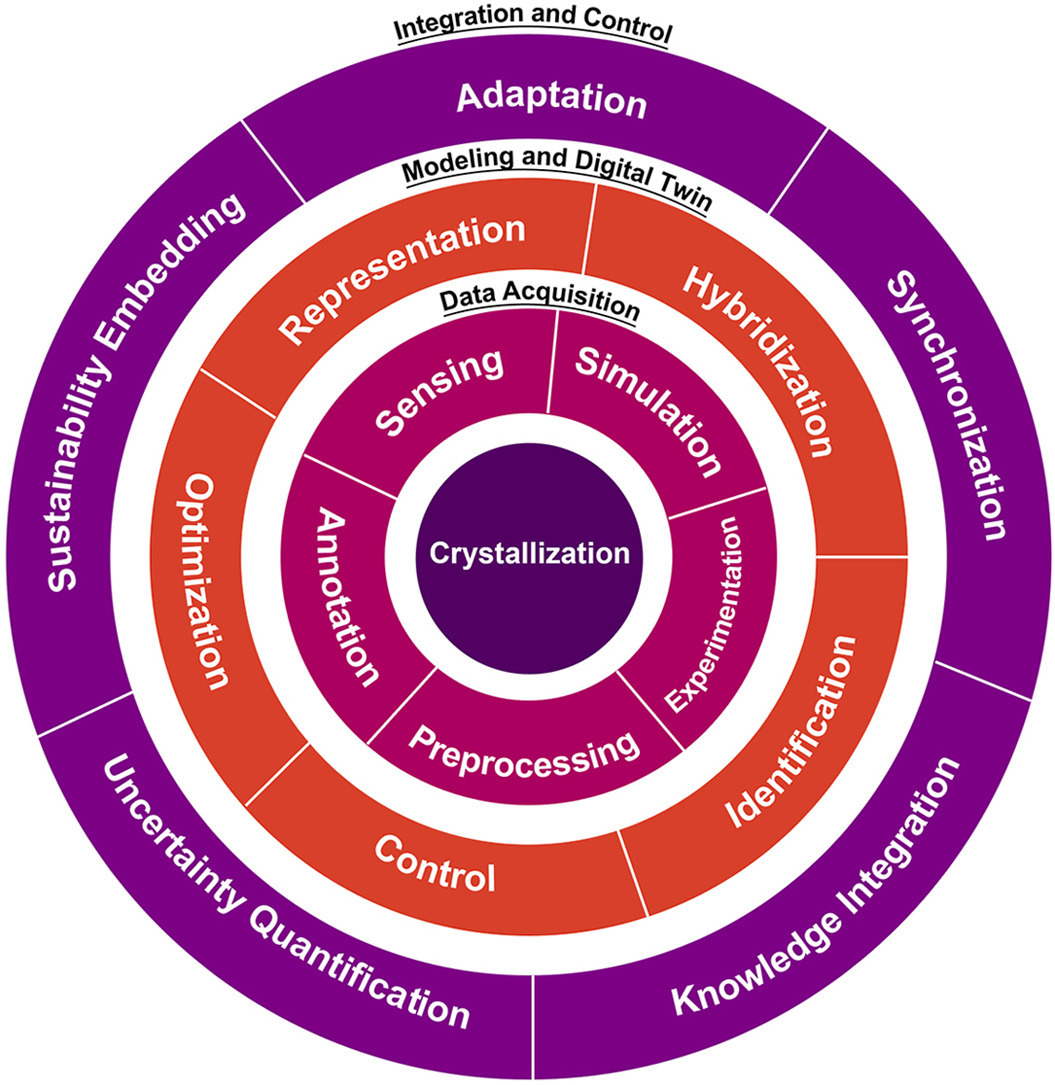
• Outlines a sequential workflow from data acquisition to modeling and closed-loop control.
• Compare mechanistic, data-driven, and hybrid modeling approaches for modeling crystallization dynamics and process behavior.
• Highlights emerging trends in digital twins, process design, and real-time optimization.
Abstract
Crystallization plays a critical role across multiple industries, determining key particulate product attributes such as purity, particle size distribution, morphology, and polymorphic form. The multiscale nature of this process, encompassing molecular interactions, phase transitions, and transport phenomena, imposes high levels complexity on the design and control of systems in which particle characteristics govern performance. Digital strategies, including emerging AI-driven approaches, are increasingly recognized as powerful tools for managing multiscale complexity, reducing inherent uncertainties, and enhancing process development. This review aims to explore recent advances and critically analyze how digital methods can be applied at each stage of process development. The discussion begins with data acquisition and augmentation, including synthetic data generation, model-based experimental design, and rigorous data preprocessing and validation. This is followed by the modeling strategies tailored to specific design and operation objectives, including mechanistic, data-driven, and hybrid approaches for predicting crystallization dynamics and particulate properties. Finally, recent control and optimization solutions are discussed, focusing on model-based and adaptive algorithms for open and closed-loop strategies. The review concludes with a forward-looking perspective on emerging trends, highlighting the integration of digital twins, real-time optimization, and sustainability metrics which together are expected to enable intelligent, resilient, and sustainability-aligned crystallization systems capable of meeting future industrial and regulatory requirements.
Graphical abstract
Keywords
Digital design; Crystallization; Data-driven; Machine learning; Process control; Sustainability
文章导读