
期刊文章
过刊浏览
- Volumes 108-119 (2025)
-
Volumes 96-107 (2025)
-
Volume 107
Pages 1-376 (December 2025)
-
Volume 106
Pages 1-336 (November 2025)
-
Volume 105
Pages 1-356 (October 2025)
-
Volume 104
Pages 1-332 (September 2025)
-
Volume 103
Pages 1-314 (August 2025)
-
Volume 102
Pages 1-276 (July 2025)
-
Volume 101
Pages 1-166 (June 2025)
-
Volume 100
Pages 1-256 (May 2025)
-
Volume 99
Pages 1-242 (April 2025)
-
Volume 98
Pages 1-288 (March 2025)
-
Volume 97
Pages 1-256 (February 2025)
-
Volume 96
Pages 1-340 (January 2025)
-
Volume 107
-
Volumes 84-95 (2024)
-
Volume 95
Pages 1-392 (December 2024)
-
Volume 94
Pages 1-400 (November 2024)
-
Volume 93
Pages 1-376 (October 2024)
-
Volume 92
Pages 1-316 (September 2024)
-
Volume 91
Pages 1-378 (August 2024)
-
Volume 90
Pages 1-580 (July 2024)
-
Volume 89
Pages 1-278 (June 2024)
-
Volume 88
Pages 1-350 (May 2024)
-
Volume 87
Pages 1-338 (April 2024)
-
Volume 86
Pages 1-312 (March 2024)
-
Volume 85
Pages 1-334 (February 2024)
-
Volume 84
Pages 1-308 (January 2024)
-
Volume 95
-
Volumes 72-83 (2023)
-
Volume 83
Pages 1-258 (December 2023)
-
Volume 82
Pages 1-204 (November 2023)
-
Volume 81
Pages 1-188 (October 2023)
-
Volume 80
Pages 1-202 (September 2023)
-
Volume 79
Pages 1-172 (August 2023)
-
Volume 78
Pages 1-146 (July 2023)
-
Volume 77
Pages 1-152 (June 2023)
-
Volume 76
Pages 1-176 (May 2023)
-
Volume 75
Pages 1-228 (April 2023)
-
Volume 74
Pages 1-200 (March 2023)
-
Volume 73
Pages 1-138 (February 2023)
-
Volume 72
Pages 1-144 (January 2023)
-
Volume 83
-
Volumes 60-71 (2022)
-
Volume 71
Pages 1-108 (December 2022)
-
Volume 70
Pages 1-106 (November 2022)
-
Volume 69
Pages 1-122 (October 2022)
-
Volume 68
Pages 1-124 (September 2022)
-
Volume 67
Pages 1-102 (August 2022)
-
Volume 66
Pages 1-112 (July 2022)
-
Volume 65
Pages 1-138 (June 2022)
-
Volume 64
Pages 1-186 (May 2022)
-
Volume 63
Pages 1-124 (April 2022)
-
Volume 62
Pages 1-104 (March 2022)
-
Volume 61
Pages 1-120 (February 2022)
-
Volume 60
Pages 1-124 (January 2022)
-
Volume 71
- Volumes 54-59 (2021)
- Volumes 48-53 (2020)
- Volumes 42-47 (2019)
- Volumes 36-41 (2018)
- Volumes 30-35 (2017)
- Volumes 24-29 (2016)
- Volumes 18-23 (2015)
- Volumes 12-17 (2014)
- Volume 11 (2013)
- Volume 10 (2012)
- Volume 9 (2011)
- Volume 8 (2010)
- Volume 7 (2009)
- Volume 6 (2008)
- Volume 5 (2007)
- Volume 4 (2006)
- Volume 3 (2005)
- Volume 2 (2004)
- Volume 1 (2003)
Volume 110
Alkadhem, A. M., Al Majed, H., Mohamed, H. O., Tsotsas, E., & Castaño, P. (2026). Aggregation kinetics of technical catalysts in a spray-fluidized bed. Particuology, 110, 63-74. https://doi.org/10.1016/j.partic.2026.01.005
Aggregation kinetics of technical catalysts in a spray-fluidized bed
Ali M. Alkadhem, Hani Al Majed, Hend Omar Mohamed, Evangelos Tsotsas, Pedro Castaño *
a Multiscale Reaction Engineering, KAUST Catalysis Center (KCC), King Abdullah University of Science and Technology (KAUST), Thuwal, 23955-6900, Saudi Arabia
b Computer, Electrical and Mathematical Sciences and Engineering, King Abdullah University of Science and Technology (KAUST), Thuwal, 23955-6900, Saudi Arabia
c Thermal Process Engineering, Otto von Guericke University, Universitätsplatz 2, 39106, Magdeburg, Germany
d Chemical Engineering Program, Physical Science and Engineering (PSE) Division, King Abdullah University of Science and Technology, Saudi Arabia
10.1016/j.partic.2026.01.005
Volume 110,
March 2026,
Pages 63-74
Received 1 October 2025, Revised 15 December 2025, Accepted 5 January 2026, Available online 14 January 2026, Version of Record 22 January 2026.
E-mail:
pedro.castano@kaust.edu.sa
Highlights
• Catalyst particle growth in a bottom spray–fluidized bed (Wurster) was modeled.
• Two modeling approaches were used: population balance (PBE) and machine learning.
• Single-pathway PBE was insufficient to describe complex early-stage aggregation.
• Two-pathway PBE captured early- and late-stage growth.
• The collision efficiencies provided granulation mechanism insights.
Abstract
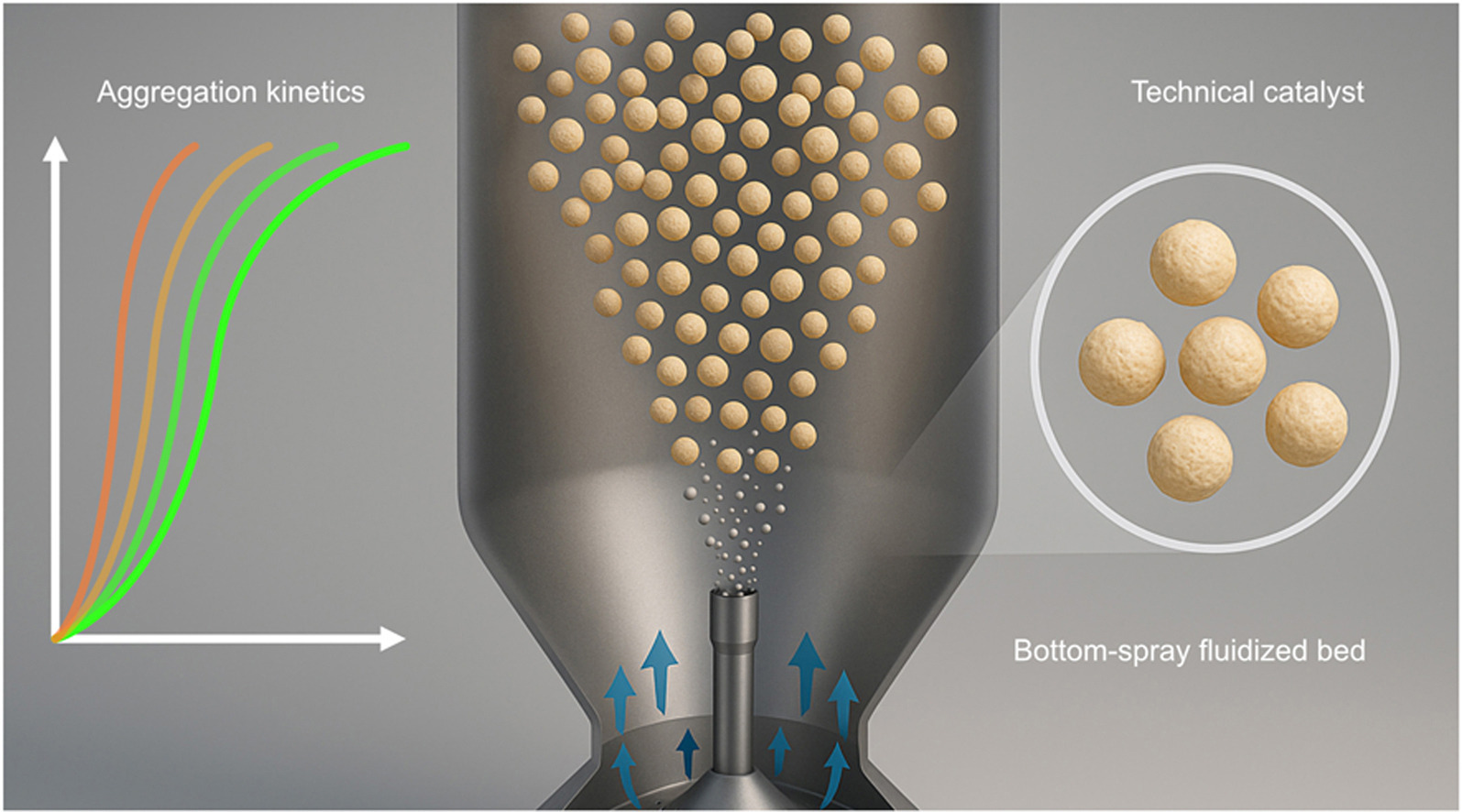
Size enlargement control and modeling in fluidized beds are crucial in the pharmaceutical and food industries but remain underdeveloped for technical catalyst formulation and shaping. This work uses different modeling approaches to understand aggregation kinetics: single- and two-pathway population balance equation (PBE) modeling and machine learning. These models are trained on a large dataset of experimental results from a bottom spray-fluidized bed, using realistic technical catalyst conditions and ingredients: ZSM-5 zeolite, bentonite, and alumina. Our optimized model is based on a two-pathway PBE with two distinct collision efficiencies for early- and late-stage growth dynamics across nucleation, seed formation, seed aggregation, and layered growth. With this model, we discuss the granulation and agglomeration dynamics of realistic technical catalysts and study the controlled shaping of several case studies with tailored morphologies (50, 100, and 200 μm pellets) under optimized conditions (i.e., maximum yield within the desired particle range) as validation.
Graphical abstract
Keywords
Granulation; Wurster agglomeration; Technical catalyst; Population balance equation (PBE); Multi-mechanistic PBE
文章导读