
期刊文章
过刊浏览
- Volumes 108-119 (2025)
-
Volumes 96-107 (2025)
-
Volume 107
Pages 1-376 (December 2025)
-
Volume 106
Pages 1-336 (November 2025)
-
Volume 105
Pages 1-356 (October 2025)
-
Volume 104
Pages 1-332 (September 2025)
-
Volume 103
Pages 1-314 (August 2025)
-
Volume 102
Pages 1-276 (July 2025)
-
Volume 101
Pages 1-166 (June 2025)
-
Volume 100
Pages 1-256 (May 2025)
-
Volume 99
Pages 1-242 (April 2025)
-
Volume 98
Pages 1-288 (March 2025)
-
Volume 97
Pages 1-256 (February 2025)
-
Volume 96
Pages 1-340 (January 2025)
-
Volume 107
-
Volumes 84-95 (2024)
-
Volume 95
Pages 1-392 (December 2024)
-
Volume 94
Pages 1-400 (November 2024)
-
Volume 93
Pages 1-376 (October 2024)
-
Volume 92
Pages 1-316 (September 2024)
-
Volume 91
Pages 1-378 (August 2024)
-
Volume 90
Pages 1-580 (July 2024)
-
Volume 89
Pages 1-278 (June 2024)
-
Volume 88
Pages 1-350 (May 2024)
-
Volume 87
Pages 1-338 (April 2024)
-
Volume 86
Pages 1-312 (March 2024)
-
Volume 85
Pages 1-334 (February 2024)
-
Volume 84
Pages 1-308 (January 2024)
-
Volume 95
-
Volumes 72-83 (2023)
-
Volume 83
Pages 1-258 (December 2023)
-
Volume 82
Pages 1-204 (November 2023)
-
Volume 81
Pages 1-188 (October 2023)
-
Volume 80
Pages 1-202 (September 2023)
-
Volume 79
Pages 1-172 (August 2023)
-
Volume 78
Pages 1-146 (July 2023)
-
Volume 77
Pages 1-152 (June 2023)
-
Volume 76
Pages 1-176 (May 2023)
-
Volume 75
Pages 1-228 (April 2023)
-
Volume 74
Pages 1-200 (March 2023)
-
Volume 73
Pages 1-138 (February 2023)
-
Volume 72
Pages 1-144 (January 2023)
-
Volume 83
-
Volumes 60-71 (2022)
-
Volume 71
Pages 1-108 (December 2022)
-
Volume 70
Pages 1-106 (November 2022)
-
Volume 69
Pages 1-122 (October 2022)
-
Volume 68
Pages 1-124 (September 2022)
-
Volume 67
Pages 1-102 (August 2022)
-
Volume 66
Pages 1-112 (July 2022)
-
Volume 65
Pages 1-138 (June 2022)
-
Volume 64
Pages 1-186 (May 2022)
-
Volume 63
Pages 1-124 (April 2022)
-
Volume 62
Pages 1-104 (March 2022)
-
Volume 61
Pages 1-120 (February 2022)
-
Volume 60
Pages 1-124 (January 2022)
-
Volume 71
- Volumes 54-59 (2021)
- Volumes 48-53 (2020)
- Volumes 42-47 (2019)
- Volumes 36-41 (2018)
- Volumes 30-35 (2017)
- Volumes 24-29 (2016)
- Volumes 18-23 (2015)
- Volumes 12-17 (2014)
- Volume 11 (2013)
- Volume 10 (2012)
- Volume 9 (2011)
- Volume 8 (2010)
- Volume 7 (2009)
- Volume 6 (2008)
- Volume 5 (2007)
- Volume 4 (2006)
- Volume 3 (2005)
- Volume 2 (2004)
- Volume 1 (2003)
Volume 110
Oueslati, W. (2026). Quantitative structure-property relationships in montmorillonite: Decoupling crystalline coherence from cation exchange capacity through advanced SAXS analysis. Particuology, 110, 75-95. https://doi.org/10.1016/j.partic.2026.01.010
Quantitative structure-property relationships in montmorillonite: Decoupling crystalline coherence from cation exchange capacity through advanced SAXS analysis
Walid Oueslati *
a LR19ES20: Ressources, Materials and Ecosystem (RME), Faculty of Sciences of Bizerte, University of Carthage, Bizerte, 7021, Tunisia
b Physics Department, Faculty of Sciences of Bizerte, University of Carthage, Bizerte, 7021, Tunisia
10.1016/j.partic.2026.01.010
Volume 110,
March 2026,
Pages 75-95
Received 12 November 2025, Revised 30 December 2025, Accepted 8 January 2026, Available online 16 January 2026, Version of Record 22 January 2026.
E-mail:
walidoueslati@ymail.com; walid.oueslati@fsb.ucar.tn
Highlights
• Advanced SAXS analysis was applied to montmorillonite samples with controlled defect densities.
• Quantitative extraction of structural parameters (domain size, microstrain, Δd001, FWHM) enabled defect mapping at the nanoscale.
• Strong linear correlations (R2 = 0.69–0.87) were established between SAXS descriptors and cation exchange capacity (CEC).
• Defect-induced structural disorder enhances interlayer accessibility and electrostatic functionality.
• Combined SAXS–CEC framework provides a predictive model linking nanoscale structure to macroscopic reactivity in clays.
Abstract
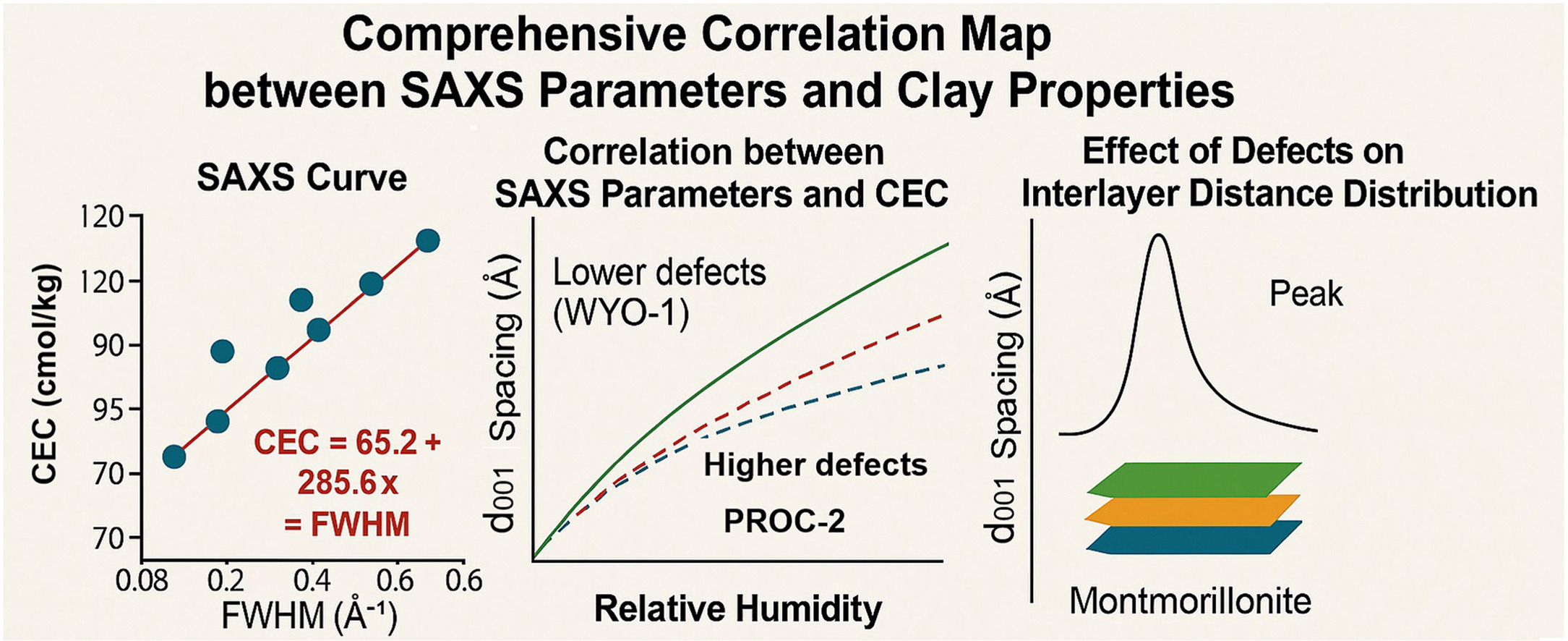
Montmorillonite's variable cation exchange capacity (CEC) contradicts the assumption that structural order enhances reactivity. While primary CEC originates from isomorphic substitutions, defect-induced structural degradation enhances CEC through dual pathways: direct creation of edge sites (55 % of enhancement) and indirect effects via increased specific surface area (45 %). We employ integrated SAXS techniques—pair distribution function, Warren-Averbach analysis, and Porod scattering—to establish quantitative structure-CEC relationships. Well-ordered samples exhibit coherent domain sizes of 85 Å, microstrain of 1.2 %, and CEC of 76.2 cmol/kg. Severely degraded samples show domain sizes of 28 Å (67 % reduction), microstrain of 4.5 % (3.8-fold increase), and enhanced CEC of 118.9 cmol/kg (56 % increase). PDF analysis reveals that long-range layer correlations decay from 45 to 18 Å (60 % reduction). Warren-Averbach decomposition demonstrates a transition from size-dominated (78 % contribution) to strain-dominated broadening (69 %), with crossover at 40 % CEC enhancement corresponding to domain sizes of ∼40 Å. Porod analysis (calibrated against glassy carbon standard) demonstrates 2.3 × increase in specific surface area (28–68 m2/g) with interface fractal dimensions evolving from 2.1 (smooth) to 2.7 (rough). Path analysis confirms that defect-induced edge sites contribute 70–80 % of the CEC enhancement, with the remainder attributed to enhanced interlayer accessibility via structural disorder. The established correlations (R2 > 0.87) between SAXS-derived structural descriptors and CEC enable predictive modeling and rational optimization of montmorillonite processing for targeted applications in environmental remediation, catalysis, and advanced functional materials.
Graphical abstract
Keywords
Montmorillonite; Small-angle X-ray scattering; Crystal defect; Cation exchange capacity; Warren-Averbach analysis; Structure-property relationship
文章导读