
期刊文章
过刊浏览
- Volumes 108-119 (2025)
-
Volumes 96-107 (2025)
-
Volume 107
Pages 1-376 (December 2025)
-
Volume 106
Pages 1-336 (November 2025)
-
Volume 105
Pages 1-356 (October 2025)
-
Volume 104
Pages 1-332 (September 2025)
-
Volume 103
Pages 1-314 (August 2025)
-
Volume 102
Pages 1-276 (July 2025)
-
Volume 101
Pages 1-166 (June 2025)
-
Volume 100
Pages 1-256 (May 2025)
-
Volume 99
Pages 1-242 (April 2025)
-
Volume 98
Pages 1-288 (March 2025)
-
Volume 97
Pages 1-256 (February 2025)
-
Volume 96
Pages 1-340 (January 2025)
-
Volume 107
-
Volumes 84-95 (2024)
-
Volume 95
Pages 1-392 (December 2024)
-
Volume 94
Pages 1-400 (November 2024)
-
Volume 93
Pages 1-376 (October 2024)
-
Volume 92
Pages 1-316 (September 2024)
-
Volume 91
Pages 1-378 (August 2024)
-
Volume 90
Pages 1-580 (July 2024)
-
Volume 89
Pages 1-278 (June 2024)
-
Volume 88
Pages 1-350 (May 2024)
-
Volume 87
Pages 1-338 (April 2024)
-
Volume 86
Pages 1-312 (March 2024)
-
Volume 85
Pages 1-334 (February 2024)
-
Volume 84
Pages 1-308 (January 2024)
-
Volume 95
-
Volumes 72-83 (2023)
-
Volume 83
Pages 1-258 (December 2023)
-
Volume 82
Pages 1-204 (November 2023)
-
Volume 81
Pages 1-188 (October 2023)
-
Volume 80
Pages 1-202 (September 2023)
-
Volume 79
Pages 1-172 (August 2023)
-
Volume 78
Pages 1-146 (July 2023)
-
Volume 77
Pages 1-152 (June 2023)
-
Volume 76
Pages 1-176 (May 2023)
-
Volume 75
Pages 1-228 (April 2023)
-
Volume 74
Pages 1-200 (March 2023)
-
Volume 73
Pages 1-138 (February 2023)
-
Volume 72
Pages 1-144 (January 2023)
-
Volume 83
-
Volumes 60-71 (2022)
-
Volume 71
Pages 1-108 (December 2022)
-
Volume 70
Pages 1-106 (November 2022)
-
Volume 69
Pages 1-122 (October 2022)
-
Volume 68
Pages 1-124 (September 2022)
-
Volume 67
Pages 1-102 (August 2022)
-
Volume 66
Pages 1-112 (July 2022)
-
Volume 65
Pages 1-138 (June 2022)
-
Volume 64
Pages 1-186 (May 2022)
-
Volume 63
Pages 1-124 (April 2022)
-
Volume 62
Pages 1-104 (March 2022)
-
Volume 61
Pages 1-120 (February 2022)
-
Volume 60
Pages 1-124 (January 2022)
-
Volume 71
- Volumes 54-59 (2021)
- Volumes 48-53 (2020)
- Volumes 42-47 (2019)
- Volumes 36-41 (2018)
- Volumes 30-35 (2017)
- Volumes 24-29 (2016)
- Volumes 18-23 (2015)
- Volumes 12-17 (2014)
- Volume 11 (2013)
- Volume 10 (2012)
- Volume 9 (2011)
- Volume 8 (2010)
- Volume 7 (2009)
- Volume 6 (2008)
- Volume 5 (2007)
- Volume 4 (2006)
- Volume 3 (2005)
- Volume 2 (2004)
- Volume 1 (2003)
Volume 110
Scolari, S., Mombelli, D., Dall’Osto, G., & Mapelli, C. (2026). Feasibility study on use of Arabic gum as alternative to corn starch in bonding self-reducing briquettes made by integrated cycle by-products. Particuology, 110, 96-108. https://doi.org/10.1016/j.partic.2026.01.008
Feasibility study on use of Arabic gum as alternative to corn starch in bonding self-reducing briquettes made by integrated cycle by-products (Open Access)
Sara Scolari *, Davide Mombelli, Gianluca Dall’Osto, Carlo Mapelli
Politecnico di Milano, Dipartimento di Meccanica, Via La Masa 1, 20156, Milano, Italy
10.1016/j.partic.2026.01.008
Volume 110,
March 2026,
Pages 96-108
Received 23 October 2025, Revised 19 December 2025, Accepted 10 January 2026, Available online 16 January 2026, Version of Record 22 January 2026.
E-mail:
sara.scolari@polimi.it
Highlights
• Arabic gum improves fine-particle briquette strength via better densification.
• Coarse-particle briquettes lose impact resistance when bonded with Arabic gum.
• Fine BFS with Arabic gum shows higher reduction degree due to better contact.
• Recycled Arabic gum solution matches natural binder in briquette performance.
Abstract
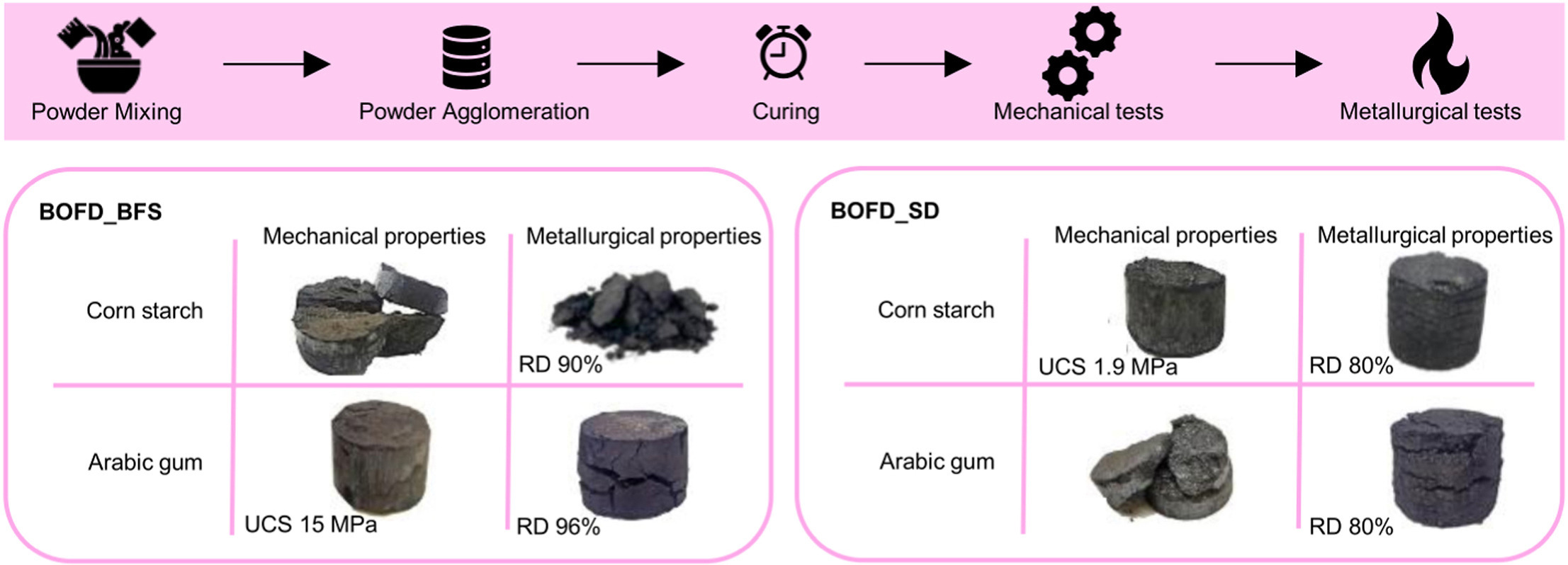
The selection of a suitable binder is crucial to ensure efficient powder agglomeration and high mechanical stability of briquettes. In ironmaking and steelmaking, binders must have low silica, low ash, high environmental sustainability, and compatibility with furnace lining and slag. Gelatinized corn starch has shown good performance with several residues (e.g., jarosite, red mud, mill scale), but it has not provided consistent results when used with integrated steel-plant by-products. This study investigated the possibility of replacing corn starch with Arabic gum, analyzing briquettes produced from basic oxygen furnace dust combined with two reducing agents: blast furnace sludge (BFS) and secondary dust (SD). Arabic gum improved impact resistance index of BFS-containing agglomerates reaching IRI of 1000 (125 with starch), due to better particle arrangement and densification. The resulting lower porosity (34.3 % Vs 39.3 %) enhanced contact between carbon and iron oxides, raising the reduction degree to 90 % (86 % with starch). Moreover, the denser microstructure limited the swelling phenomenon observed in starch-bound briquettes during thermal treatment. In contrast, the use of SD as the reducing agent resulted in a coarser particle size, leading to a heterogeneous distribution during the mixing process with Arabic gum. This corresponded to a decrease in mechanical stability, with the briquettes surviving 5 drops compared to 10 with starch. Despite this drawback, the degree of reduction remained largely unaffected at 1200 °C.
Graphical abstract
Keywords
Agglomeration; Arabic gum; Starch; Integrated steel plant; By-product
文章导读