
期刊文章
过刊浏览
- Volumes 108-119 (2025)
-
Volumes 96-107 (2025)
-
Volume 107
Pages 1-376 (December 2025)
-
Volume 106
Pages 1-336 (November 2025)
-
Volume 105
Pages 1-356 (October 2025)
-
Volume 104
Pages 1-332 (September 2025)
-
Volume 103
Pages 1-314 (August 2025)
-
Volume 102
Pages 1-276 (July 2025)
-
Volume 101
Pages 1-166 (June 2025)
-
Volume 100
Pages 1-256 (May 2025)
-
Volume 99
Pages 1-242 (April 2025)
-
Volume 98
Pages 1-288 (March 2025)
-
Volume 97
Pages 1-256 (February 2025)
-
Volume 96
Pages 1-340 (January 2025)
-
Volume 107
-
Volumes 84-95 (2024)
-
Volume 95
Pages 1-392 (December 2024)
-
Volume 94
Pages 1-400 (November 2024)
-
Volume 93
Pages 1-376 (October 2024)
-
Volume 92
Pages 1-316 (September 2024)
-
Volume 91
Pages 1-378 (August 2024)
-
Volume 90
Pages 1-580 (July 2024)
-
Volume 89
Pages 1-278 (June 2024)
-
Volume 88
Pages 1-350 (May 2024)
-
Volume 87
Pages 1-338 (April 2024)
-
Volume 86
Pages 1-312 (March 2024)
-
Volume 85
Pages 1-334 (February 2024)
-
Volume 84
Pages 1-308 (January 2024)
-
Volume 95
-
Volumes 72-83 (2023)
-
Volume 83
Pages 1-258 (December 2023)
-
Volume 82
Pages 1-204 (November 2023)
-
Volume 81
Pages 1-188 (October 2023)
-
Volume 80
Pages 1-202 (September 2023)
-
Volume 79
Pages 1-172 (August 2023)
-
Volume 78
Pages 1-146 (July 2023)
-
Volume 77
Pages 1-152 (June 2023)
-
Volume 76
Pages 1-176 (May 2023)
-
Volume 75
Pages 1-228 (April 2023)
-
Volume 74
Pages 1-200 (March 2023)
-
Volume 73
Pages 1-138 (February 2023)
-
Volume 72
Pages 1-144 (January 2023)
-
Volume 83
-
Volumes 60-71 (2022)
-
Volume 71
Pages 1-108 (December 2022)
-
Volume 70
Pages 1-106 (November 2022)
-
Volume 69
Pages 1-122 (October 2022)
-
Volume 68
Pages 1-124 (September 2022)
-
Volume 67
Pages 1-102 (August 2022)
-
Volume 66
Pages 1-112 (July 2022)
-
Volume 65
Pages 1-138 (June 2022)
-
Volume 64
Pages 1-186 (May 2022)
-
Volume 63
Pages 1-124 (April 2022)
-
Volume 62
Pages 1-104 (March 2022)
-
Volume 61
Pages 1-120 (February 2022)
-
Volume 60
Pages 1-124 (January 2022)
-
Volume 71
- Volumes 54-59 (2021)
- Volumes 48-53 (2020)
- Volumes 42-47 (2019)
- Volumes 36-41 (2018)
- Volumes 30-35 (2017)
- Volumes 24-29 (2016)
- Volumes 18-23 (2015)
- Volumes 12-17 (2014)
- Volume 11 (2013)
- Volume 10 (2012)
- Volume 9 (2011)
- Volume 8 (2010)
- Volume 7 (2009)
- Volume 6 (2008)
- Volume 5 (2007)
- Volume 4 (2006)
- Volume 3 (2005)
- Volume 2 (2004)
- Volume 1 (2003)
Volume 110
Li, Y., Luo, G., Wang, S., You, L., & Wang, H. (2026). One-dimensional unsteady modeling of drying and devolatilization of coal particles under pressurized oxy-fuel conditions in fluidized beds. Particuology, 110, 109-121. https://doi.org/10.1016/j.partic.2026.01.012
One-dimensional unsteady modeling of drying and devolatilization of coal particles under pressurized oxy-fuel conditions in fluidized beds
Yanhong Li, Guosheng Luo, Shijie Wang, Lina You, Haochen Wang *
a Chongqing New Guidance Intelligent Technology Research Institute Co., Ltd, China
b Graduate Business School, UCSI University, Kuala Lumpur, Malaysia
c Chemistry and Chemical Engineering, Southeast University, Nanjing, 210096, China
d College of Chemistry, Beijing University of Chemical Technology, Beijing, 100029, China
10.1016/j.partic.2026.01.012
Volume 110,
March 2026,
Pages 109-121
Received 20 May 2025, Revised 22 December 2025, Accepted 6 January 2026, Available online 20 January 2026, Version of Record 29 January 2026.
E-mail:
lunwenpaper888@163.com
Highlights
• Explored atmospheric effects on coal devolatilization in pressurized fluidized beds.
• Specific heat, heat transfer, density/size, and moisture influence particle drying.
• Model predicts devolatilization in pressurized oxygen combustion with <20 % error.
Abstract
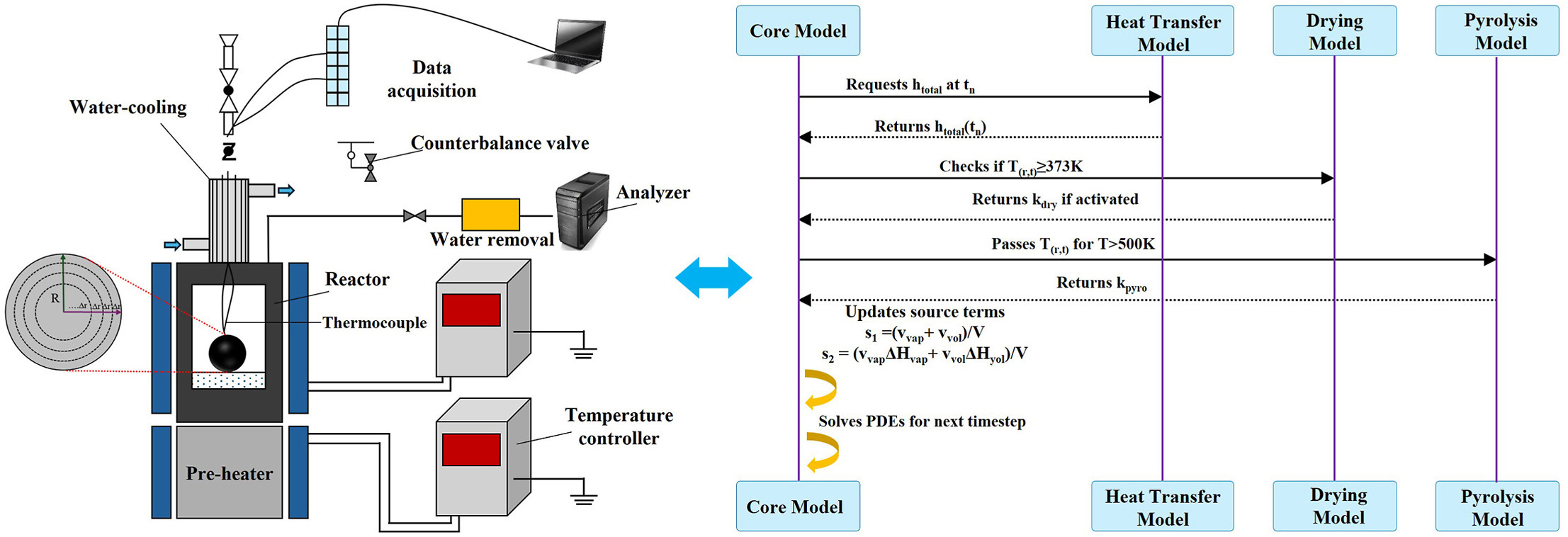
This study develops a one-dimensional unsteady model to simulate the drying and devolatilization of large coal particles (4–12 mm) under pressurized oxy-fuel conditions in fluidized beds. The model reveals that devolatilization time scales quadratically with particle diameter (t ∝ dp2), confirming heat conduction as the rate-limiting step. Increased system pressure significantly shortens drying and devolatilization times by up to 18 % and 31 %, respectively, but also amplifies intra-particle temperature gradients. Under identical operating conditions, differences between O2/CO2 and O2/N2 atmospheres were marginal (<5 %). Model predictions agree with experimental measurements within 20 % deviation. The results provide operational guidance for pressurized fluidized bed combustors, emphasizing the strong influence of particle size and pressure on process efficiency and heat transfer limitations, while also highlighting their implications for energy efficiency improvement, emission reduction, and the advancement of environmentally sustainable combustion technologies.
Graphical abstract
Keywords
Gas-solid fluidized bed; Coal combustion; Impurity removal; Carbon reduction; Sustainable energy development
文章导读