
期刊文章
过刊浏览
- Volumes 108-119 (2025)
-
Volumes 96-107 (2025)
-
Volume 107
Pages 1-376 (December 2025)
-
Volume 106
Pages 1-336 (November 2025)
-
Volume 105
Pages 1-356 (October 2025)
-
Volume 104
Pages 1-332 (September 2025)
-
Volume 103
Pages 1-314 (August 2025)
-
Volume 102
Pages 1-276 (July 2025)
-
Volume 101
Pages 1-166 (June 2025)
-
Volume 100
Pages 1-256 (May 2025)
-
Volume 99
Pages 1-242 (April 2025)
-
Volume 98
Pages 1-288 (March 2025)
-
Volume 97
Pages 1-256 (February 2025)
-
Volume 96
Pages 1-340 (January 2025)
-
Volume 107
-
Volumes 84-95 (2024)
-
Volume 95
Pages 1-392 (December 2024)
-
Volume 94
Pages 1-400 (November 2024)
-
Volume 93
Pages 1-376 (October 2024)
-
Volume 92
Pages 1-316 (September 2024)
-
Volume 91
Pages 1-378 (August 2024)
-
Volume 90
Pages 1-580 (July 2024)
-
Volume 89
Pages 1-278 (June 2024)
-
Volume 88
Pages 1-350 (May 2024)
-
Volume 87
Pages 1-338 (April 2024)
-
Volume 86
Pages 1-312 (March 2024)
-
Volume 85
Pages 1-334 (February 2024)
-
Volume 84
Pages 1-308 (January 2024)
-
Volume 95
-
Volumes 72-83 (2023)
-
Volume 83
Pages 1-258 (December 2023)
-
Volume 82
Pages 1-204 (November 2023)
-
Volume 81
Pages 1-188 (October 2023)
-
Volume 80
Pages 1-202 (September 2023)
-
Volume 79
Pages 1-172 (August 2023)
-
Volume 78
Pages 1-146 (July 2023)
-
Volume 77
Pages 1-152 (June 2023)
-
Volume 76
Pages 1-176 (May 2023)
-
Volume 75
Pages 1-228 (April 2023)
-
Volume 74
Pages 1-200 (March 2023)
-
Volume 73
Pages 1-138 (February 2023)
-
Volume 72
Pages 1-144 (January 2023)
-
Volume 83
-
Volumes 60-71 (2022)
-
Volume 71
Pages 1-108 (December 2022)
-
Volume 70
Pages 1-106 (November 2022)
-
Volume 69
Pages 1-122 (October 2022)
-
Volume 68
Pages 1-124 (September 2022)
-
Volume 67
Pages 1-102 (August 2022)
-
Volume 66
Pages 1-112 (July 2022)
-
Volume 65
Pages 1-138 (June 2022)
-
Volume 64
Pages 1-186 (May 2022)
-
Volume 63
Pages 1-124 (April 2022)
-
Volume 62
Pages 1-104 (March 2022)
-
Volume 61
Pages 1-120 (February 2022)
-
Volume 60
Pages 1-124 (January 2022)
-
Volume 71
- Volumes 54-59 (2021)
- Volumes 48-53 (2020)
- Volumes 42-47 (2019)
- Volumes 36-41 (2018)
- Volumes 30-35 (2017)
- Volumes 24-29 (2016)
- Volumes 18-23 (2015)
- Volumes 12-17 (2014)
- Volume 11 (2013)
- Volume 10 (2012)
- Volume 9 (2011)
- Volume 8 (2010)
- Volume 7 (2009)
- Volume 6 (2008)
- Volume 5 (2007)
- Volume 4 (2006)
- Volume 3 (2005)
- Volume 2 (2004)
- Volume 1 (2003)
Volume 110
Saraei, S. H., & Peters, B. (2026). Challenging the physical origin of tumbling in idealized settling of two spherical particles. Particuology, 110, 131-143. https://doi.org/10.1016/j.partic.2026.01.006
Challenging the physical origin of tumbling in idealized settling of two spherical particles
Sina Hassanzadeh Saraei *, Bernhard Peters
a Department of Engineering, University of Luxembourg, Luxembourg
b Faculty of Civil Engineering, Vilnius Gediminas Technical University, Lithuania
10.1016/j.partic.2026.01.006
Volume 110,
March 2026,
Pages 131-143
Received 24 October 2025, Revised 27 November 2025, Accepted 5 January 2026, Available online 20 January 2026, Version of Record 29 January 2026.
E-mail:
sina.hassanzadeh@uni.lu; Bernhard.Peters@uni.lu; bernhard-josef.peters@vilniustech.lt
Highlights
• Applying a fully resolved CFD-DEM model to consider interaction between fluid and particles.
• Determining key parameters affecting the tumbling of spherical particles.
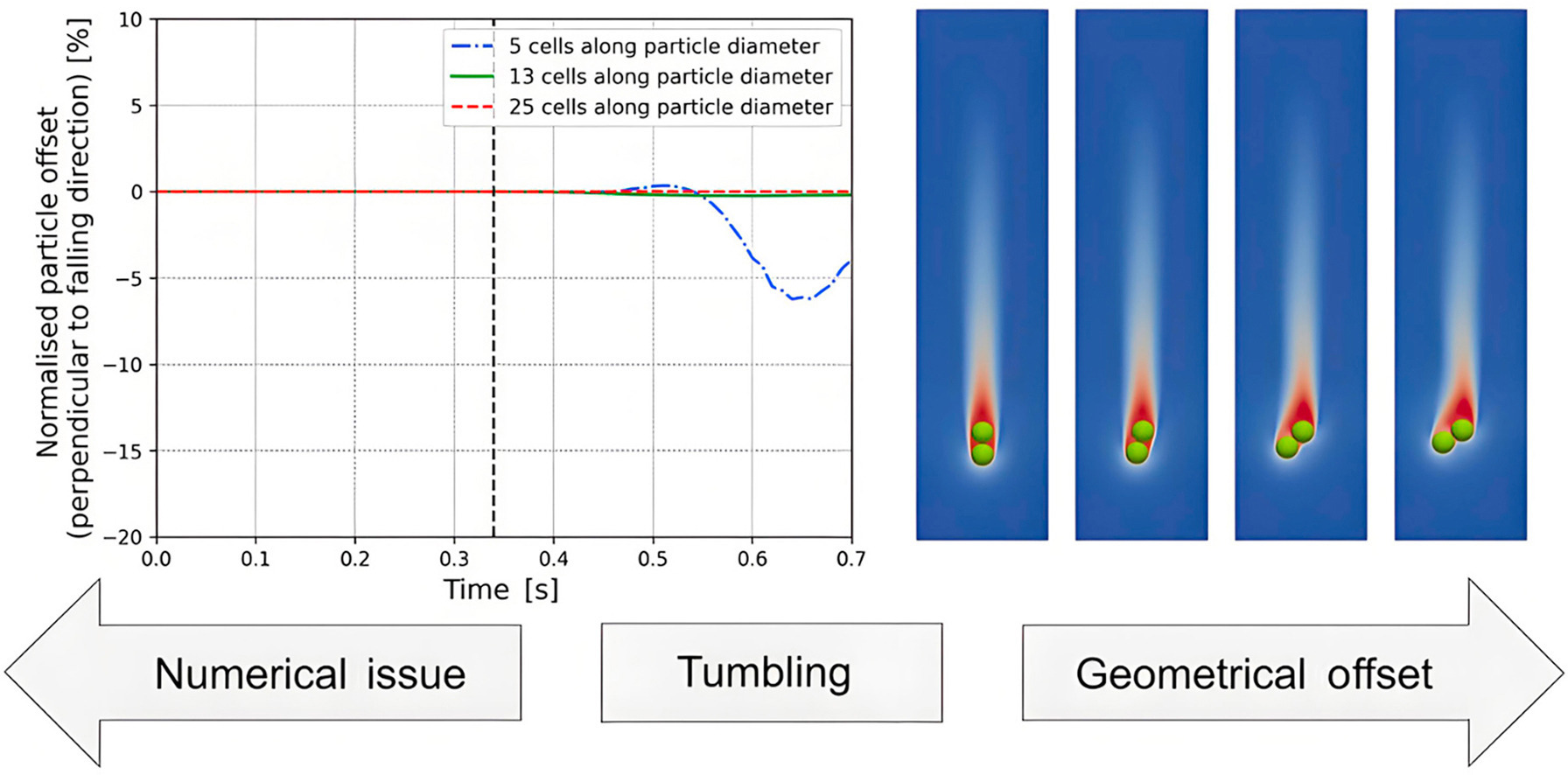
• Concluding that symmetrical falling of spherical particles could not initiate tumbling.
• Discovering that tumbling in case without initial geometrical offset is a numerical issue rather than a physical phenomenon.
Abstract
The drafting, kissing, and tumbling (DKT) behavior of falling spherical particles is widely used to validate CFD–DEM models. Although many studies report tumbling in idealized systems with spherical particles, the physical origin of this motion remains unclear, especially when the density difference between the particles and the fluid is small. In this work, we revisit the classic DKT configuration using a fully resolved CFD–DEM model based on the immersed boundary method. Our analysis systematically examines whether the observed tumbling is a genuine physical phenomenon or a numerical artifact. Our results indicate that, in the absence of real world imperfections such as surface roughness or shape irregularities, tumbling is primarily caused by numerical errors rather than inherent flow instabilities. This finding challenges the conventional interpretation of DKT as a purely physical benchmark and highlights the need for caution when using tumbling to validate CFD–DEM models. By distinguishing numerical artifacts from physical effects, this study provides new guidance for model validation and has important implications for extending CFD–DEM to dense particle systems.
Graphical abstract
Keywords
Computational fluid dynamics; Discrete element method; Immersed boundary method; Tumbling
文章导读