
期刊文章
过刊浏览
- Volumes 108-119 (2025)
-
Volumes 96-107 (2025)
-
Volume 107
Pages 1-376 (December 2025)
-
Volume 106
Pages 1-336 (November 2025)
-
Volume 105
Pages 1-356 (October 2025)
-
Volume 104
Pages 1-332 (September 2025)
-
Volume 103
Pages 1-314 (August 2025)
-
Volume 102
Pages 1-276 (July 2025)
-
Volume 101
Pages 1-166 (June 2025)
-
Volume 100
Pages 1-256 (May 2025)
-
Volume 99
Pages 1-242 (April 2025)
-
Volume 98
Pages 1-288 (March 2025)
-
Volume 97
Pages 1-256 (February 2025)
-
Volume 96
Pages 1-340 (January 2025)
-
Volume 107
-
Volumes 84-95 (2024)
-
Volume 95
Pages 1-392 (December 2024)
-
Volume 94
Pages 1-400 (November 2024)
-
Volume 93
Pages 1-376 (October 2024)
-
Volume 92
Pages 1-316 (September 2024)
-
Volume 91
Pages 1-378 (August 2024)
-
Volume 90
Pages 1-580 (July 2024)
-
Volume 89
Pages 1-278 (June 2024)
-
Volume 88
Pages 1-350 (May 2024)
-
Volume 87
Pages 1-338 (April 2024)
-
Volume 86
Pages 1-312 (March 2024)
-
Volume 85
Pages 1-334 (February 2024)
-
Volume 84
Pages 1-308 (January 2024)
-
Volume 95
-
Volumes 72-83 (2023)
-
Volume 83
Pages 1-258 (December 2023)
-
Volume 82
Pages 1-204 (November 2023)
-
Volume 81
Pages 1-188 (October 2023)
-
Volume 80
Pages 1-202 (September 2023)
-
Volume 79
Pages 1-172 (August 2023)
-
Volume 78
Pages 1-146 (July 2023)
-
Volume 77
Pages 1-152 (June 2023)
-
Volume 76
Pages 1-176 (May 2023)
-
Volume 75
Pages 1-228 (April 2023)
-
Volume 74
Pages 1-200 (March 2023)
-
Volume 73
Pages 1-138 (February 2023)
-
Volume 72
Pages 1-144 (January 2023)
-
Volume 83
-
Volumes 60-71 (2022)
-
Volume 71
Pages 1-108 (December 2022)
-
Volume 70
Pages 1-106 (November 2022)
-
Volume 69
Pages 1-122 (October 2022)
-
Volume 68
Pages 1-124 (September 2022)
-
Volume 67
Pages 1-102 (August 2022)
-
Volume 66
Pages 1-112 (July 2022)
-
Volume 65
Pages 1-138 (June 2022)
-
Volume 64
Pages 1-186 (May 2022)
-
Volume 63
Pages 1-124 (April 2022)
-
Volume 62
Pages 1-104 (March 2022)
-
Volume 61
Pages 1-120 (February 2022)
-
Volume 60
Pages 1-124 (January 2022)
-
Volume 71
- Volumes 54-59 (2021)
- Volumes 48-53 (2020)
- Volumes 42-47 (2019)
- Volumes 36-41 (2018)
- Volumes 30-35 (2017)
- Volumes 24-29 (2016)
- Volumes 18-23 (2015)
- Volumes 12-17 (2014)
- Volume 11 (2013)
- Volume 10 (2012)
- Volume 9 (2011)
- Volume 8 (2010)
- Volume 7 (2009)
- Volume 6 (2008)
- Volume 5 (2007)
- Volume 4 (2006)
- Volume 3 (2005)
- Volume 2 (2004)
- Volume 1 (2003)
Volume 110
Xiao, Y., Xu, W., Li, A., Han, Y., Zhao, Y., Xi, X., & Zhang, R. (2026). Non-local propagation of dynamic fluctuations in granular discharge: A wave correlation analysis. Particuology, 110, 144-153. https://doi.org/10.1016/j.partic.2026.01.018
Non-local propagation of dynamic fluctuations in granular discharge: A wave correlation analysis
Yawen Xiao a b *, Wanda Xu a, Anqi Li c, Yanlong Han c, Yanqin Zhao a, Xiaobo Xi a b, Ruihong Zhang a b
a School of Mechanical Engineering, Yangzhou University, Yangzhou, 225127, China
b Jiangsu Engineering Center for Modern Agricultural Machinery and Agronomy Technology, Yangzhou, 225127, China
c College of Engineering, Northeast Agricultural University, Harbin, 150030, China
10.1016/j.partic.2026.01.018
Volume 110,
March 2026,
Pages 144-153
Received 3 September 2025, Revised 17 December 2025, Accepted 14 January 2026, Available online 23 January 2026, Version of Record 30 January 2026.
E-mail:
Yawenxyw@yzu.edu.cn
Highlights
• DCCA was proposed to characterize fluctuation characteristics during discharge process.
• The fluctuation patterns along both radial and axial directions of silo were analyzed.
• The temporal-scale and spatial-scale correlations of wave propagation were investigated.
• Discharge fluctuations exhibit significant dependencies across both temporal and spatial scales.
Abstract
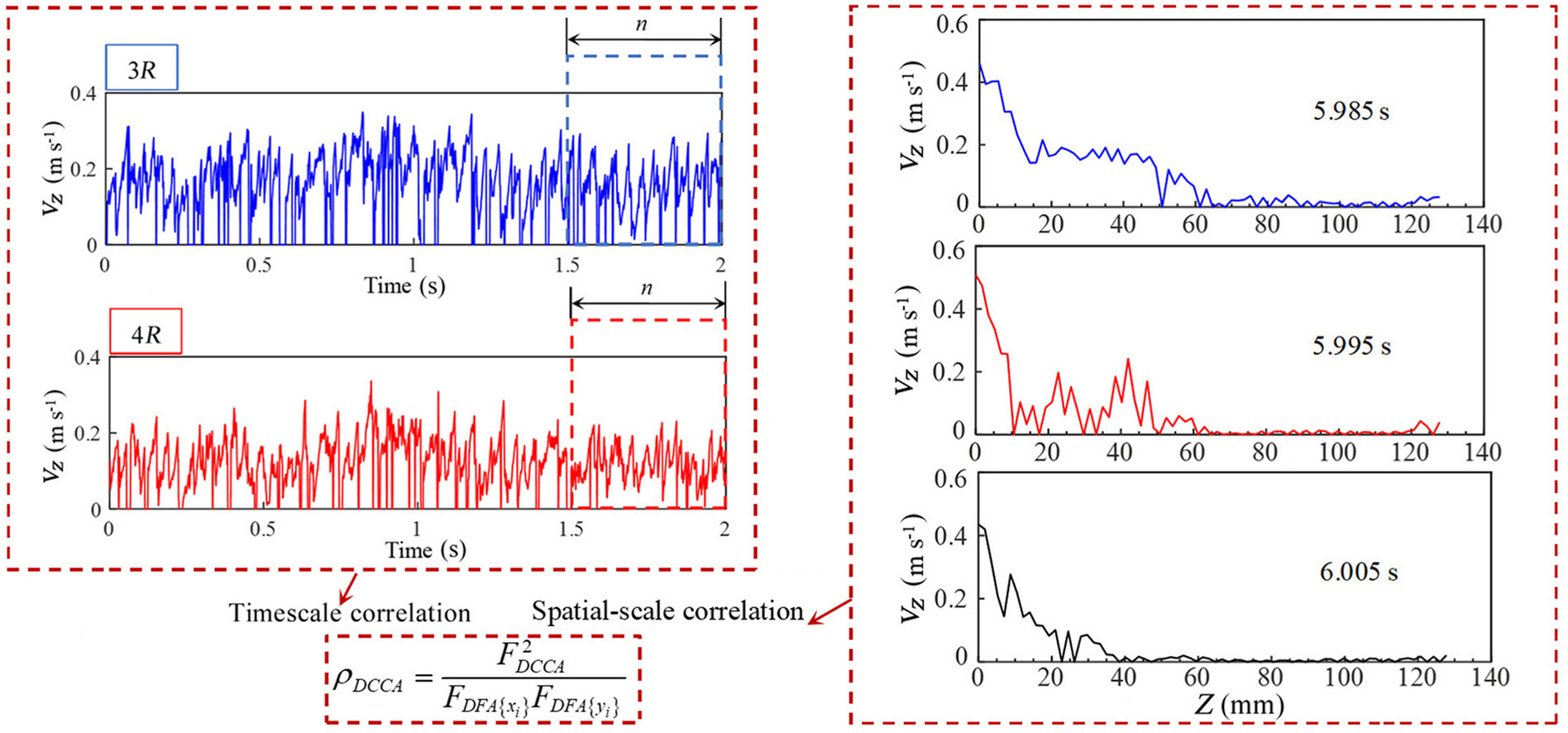
Understanding dynamic fluctuations in granular discharge is critical for addressing stability challenges in dense granular systems, which are central to industrial processes and natural phenomena. This study combines discrete element method (DEM) simulations with detrended cross-correlation analysis (DCCA) to quantitatively investigate the non-local propagation of dynamic fluctuations in both axial and radial directions. Results demonstrate that axial fluctuations exhibit scale-dependent temporal correlations, stabilizing at 1.5 s near the silo outlet and 1 s at higher positions, with a characteristic spatial wavelength of approximately 10 particle diameters. In contrast, radial fluctuations show weaker correlations, marked by anti-phase patterns across shear layers, while correlations strengthen with axial elevation due to enhanced collective particle motion. Dead zones near the outlet further influence radial spatial-scale correlations, reducing their intensity at higher elevations. This DCCA-based correlation analysis thus establishes a quantitative, single-parameter framework for characterizing fluctuation propagation in such complex, multi-source regimes. These findings provide a methodological basis for the quantitative analysis of fluctuation dynamics and offer quantifiable benchmarks for assessing discharge stability.
Graphical abstract
Keywords
Dynamic fluctuations; Granular discharge; Detrended cross-correlation analysis; Timescale correlation; Spatial-scale correlation
文章导读