
期刊文章
过刊浏览
- Volumes 108-119 (2025)
-
Volumes 96-107 (2025)
-
Volume 107
Pages 1-376 (December 2025)
-
Volume 106
Pages 1-336 (November 2025)
-
Volume 105
Pages 1-356 (October 2025)
-
Volume 104
Pages 1-332 (September 2025)
-
Volume 103
Pages 1-314 (August 2025)
-
Volume 102
Pages 1-276 (July 2025)
-
Volume 101
Pages 1-166 (June 2025)
-
Volume 100
Pages 1-256 (May 2025)
-
Volume 99
Pages 1-242 (April 2025)
-
Volume 98
Pages 1-288 (March 2025)
-
Volume 97
Pages 1-256 (February 2025)
-
Volume 96
Pages 1-340 (January 2025)
-
Volume 107
-
Volumes 84-95 (2024)
-
Volume 95
Pages 1-392 (December 2024)
-
Volume 94
Pages 1-400 (November 2024)
-
Volume 93
Pages 1-376 (October 2024)
-
Volume 92
Pages 1-316 (September 2024)
-
Volume 91
Pages 1-378 (August 2024)
-
Volume 90
Pages 1-580 (July 2024)
-
Volume 89
Pages 1-278 (June 2024)
-
Volume 88
Pages 1-350 (May 2024)
-
Volume 87
Pages 1-338 (April 2024)
-
Volume 86
Pages 1-312 (March 2024)
-
Volume 85
Pages 1-334 (February 2024)
-
Volume 84
Pages 1-308 (January 2024)
-
Volume 95
-
Volumes 72-83 (2023)
-
Volume 83
Pages 1-258 (December 2023)
-
Volume 82
Pages 1-204 (November 2023)
-
Volume 81
Pages 1-188 (October 2023)
-
Volume 80
Pages 1-202 (September 2023)
-
Volume 79
Pages 1-172 (August 2023)
-
Volume 78
Pages 1-146 (July 2023)
-
Volume 77
Pages 1-152 (June 2023)
-
Volume 76
Pages 1-176 (May 2023)
-
Volume 75
Pages 1-228 (April 2023)
-
Volume 74
Pages 1-200 (March 2023)
-
Volume 73
Pages 1-138 (February 2023)
-
Volume 72
Pages 1-144 (January 2023)
-
Volume 83
-
Volumes 60-71 (2022)
-
Volume 71
Pages 1-108 (December 2022)
-
Volume 70
Pages 1-106 (November 2022)
-
Volume 69
Pages 1-122 (October 2022)
-
Volume 68
Pages 1-124 (September 2022)
-
Volume 67
Pages 1-102 (August 2022)
-
Volume 66
Pages 1-112 (July 2022)
-
Volume 65
Pages 1-138 (June 2022)
-
Volume 64
Pages 1-186 (May 2022)
-
Volume 63
Pages 1-124 (April 2022)
-
Volume 62
Pages 1-104 (March 2022)
-
Volume 61
Pages 1-120 (February 2022)
-
Volume 60
Pages 1-124 (January 2022)
-
Volume 71
- Volumes 54-59 (2021)
- Volumes 48-53 (2020)
- Volumes 42-47 (2019)
- Volumes 36-41 (2018)
- Volumes 30-35 (2017)
- Volumes 24-29 (2016)
- Volumes 18-23 (2015)
- Volumes 12-17 (2014)
- Volume 11 (2013)
- Volume 10 (2012)
- Volume 9 (2011)
- Volume 8 (2010)
- Volume 7 (2009)
- Volume 6 (2008)
- Volume 5 (2007)
- Volume 4 (2006)
- Volume 3 (2005)
- Volume 2 (2004)
- Volume 1 (2003)
Volume 110
Jiang, X., Wu, T., Wu, Y., Wang, X., & Peng, J. (2026). Gas nozzle-assisted cluster regulations using dynamic cluster structure-dependent drag model in fluidized bed risers. Particuology, 110, 165-179. https://doi.org/10.1016/j.partic.2026.01.016
Gas nozzle-assisted cluster regulations using dynamic cluster structure-dependent drag model in fluidized bed risers
Xiaoxue Jiang a b *, Tao Wu a, You Wu a, Xiaobing Wang a, Jiayu Peng a
a School of Petroleum and Natural Gas Engineering, Changzhou University, Changzhou, 213000, China
b School of Energy Science & Engineering, Harbin Institute of Technology, Harbin, 150001, China
10.1016/j.partic.2026.01.016
Volume 110,
March 2026,
Pages 165-179
Received 20 November 2025, Revised 31 December 2025, Accepted 13 January 2026, Available online 23 January 2026, Version of Record 30 January 2026.
E-mail:
jiangxiaoxue@cczu.edu.cn
Highlights
• The criterion distinguishing homogeneous flow from heterogeneous flow is proposed.
• The cluster characteristics are compared at three different gas jets directions.
• Inlet, dense, jet, transition, mixing and exit regions exist along riser height.
• The cluster diameters decreased with increasing jet gas velocities for upward gas jets.
Abstract
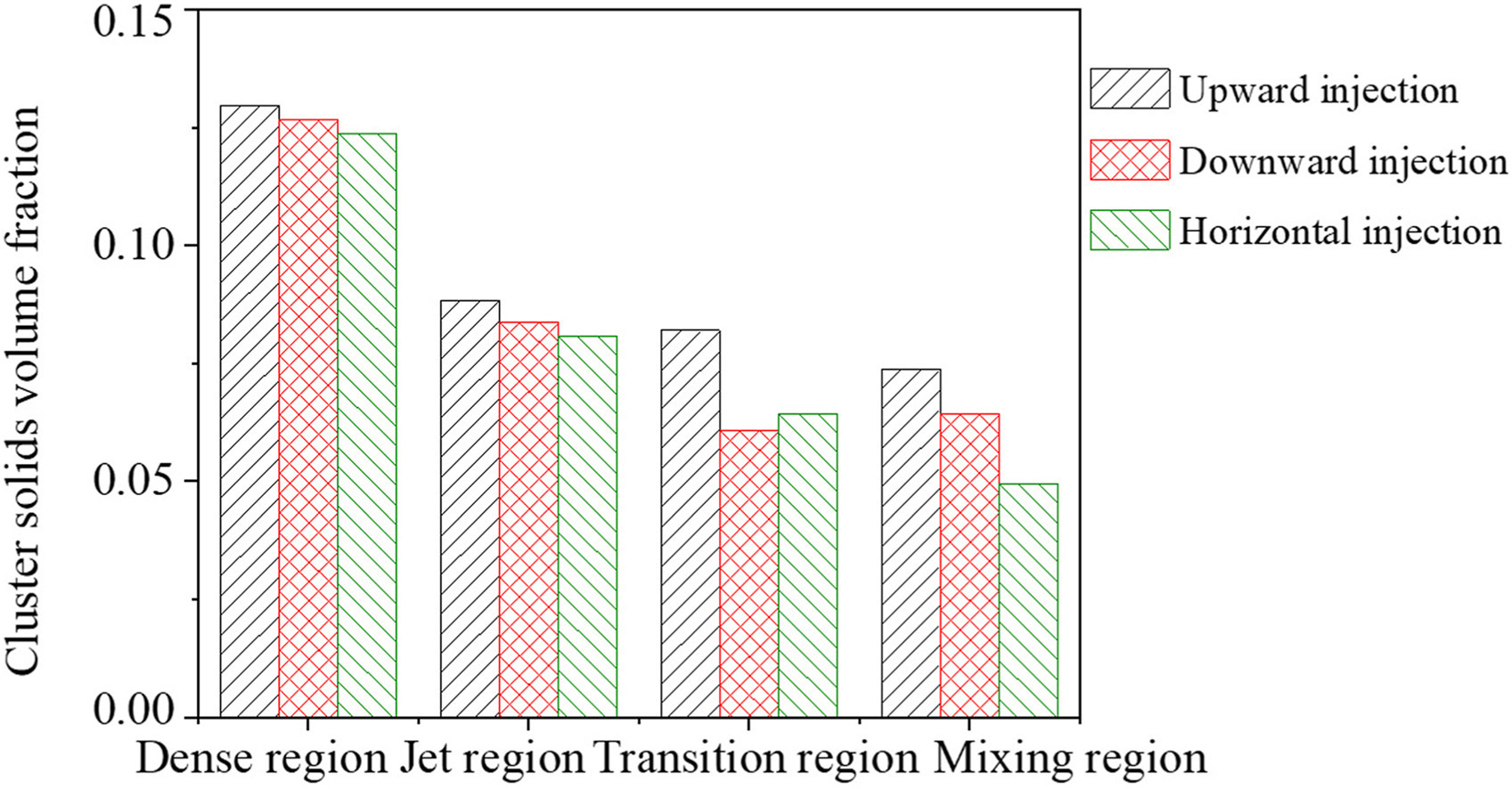
Cluster characteristics in gas-nozzle-assisted risers were predicted via a computational criterion and dynamic cluster structure-dependent drag model. The effect of three different nozzle directions, including inclined upward gas nozzles, horizontal gas nozzles, and inclined downward gas nozzles, was simulated to study lateral and axial distributions of clusters. Different regions were found along riser height, including transition and mixing regions, in terms of the variation of solid volume fractions. In the transition and mixing regions, downward gas injection resulted in the smallest cluster diameters and velocities, while upward injection produced the largest. The cluster solid volume fractions and existence time fractions were larger for the upward gas jets (0.0916 and 0.347) than those for the horizontal (0.0761 and 0.203) and downward gas jets (0.0813 and 0.234). The cluster diameters and solid volume fractions of clusters decreased from 0.00883 m to 0.00831 m and from 0.078 to 0.069, respectively, while the velocities of clusters increased from 2.176 to 2.867 m/s with increasing jet gas velocities from 100 to 140 m/s for upward gas jets in the riser.
Graphical abstract
Keywords
Nozzle-assisted riser; Cluster regulation; Computational criterion; Drag model; Fluidized bed
文章导读