
期刊文章
过刊浏览
- Volumes 108-119 (2025)
-
Volumes 96-107 (2025)
-
Volume 107
Pages 1-376 (December 2025)
-
Volume 106
Pages 1-336 (November 2025)
-
Volume 105
Pages 1-356 (October 2025)
-
Volume 104
Pages 1-332 (September 2025)
-
Volume 103
Pages 1-314 (August 2025)
-
Volume 102
Pages 1-276 (July 2025)
-
Volume 101
Pages 1-166 (June 2025)
-
Volume 100
Pages 1-256 (May 2025)
-
Volume 99
Pages 1-242 (April 2025)
-
Volume 98
Pages 1-288 (March 2025)
-
Volume 97
Pages 1-256 (February 2025)
-
Volume 96
Pages 1-340 (January 2025)
-
Volume 107
-
Volumes 84-95 (2024)
-
Volume 95
Pages 1-392 (December 2024)
-
Volume 94
Pages 1-400 (November 2024)
-
Volume 93
Pages 1-376 (October 2024)
-
Volume 92
Pages 1-316 (September 2024)
-
Volume 91
Pages 1-378 (August 2024)
-
Volume 90
Pages 1-580 (July 2024)
-
Volume 89
Pages 1-278 (June 2024)
-
Volume 88
Pages 1-350 (May 2024)
-
Volume 87
Pages 1-338 (April 2024)
-
Volume 86
Pages 1-312 (March 2024)
-
Volume 85
Pages 1-334 (February 2024)
-
Volume 84
Pages 1-308 (January 2024)
-
Volume 95
-
Volumes 72-83 (2023)
-
Volume 83
Pages 1-258 (December 2023)
-
Volume 82
Pages 1-204 (November 2023)
-
Volume 81
Pages 1-188 (October 2023)
-
Volume 80
Pages 1-202 (September 2023)
-
Volume 79
Pages 1-172 (August 2023)
-
Volume 78
Pages 1-146 (July 2023)
-
Volume 77
Pages 1-152 (June 2023)
-
Volume 76
Pages 1-176 (May 2023)
-
Volume 75
Pages 1-228 (April 2023)
-
Volume 74
Pages 1-200 (March 2023)
-
Volume 73
Pages 1-138 (February 2023)
-
Volume 72
Pages 1-144 (January 2023)
-
Volume 83
-
Volumes 60-71 (2022)
-
Volume 71
Pages 1-108 (December 2022)
-
Volume 70
Pages 1-106 (November 2022)
-
Volume 69
Pages 1-122 (October 2022)
-
Volume 68
Pages 1-124 (September 2022)
-
Volume 67
Pages 1-102 (August 2022)
-
Volume 66
Pages 1-112 (July 2022)
-
Volume 65
Pages 1-138 (June 2022)
-
Volume 64
Pages 1-186 (May 2022)
-
Volume 63
Pages 1-124 (April 2022)
-
Volume 62
Pages 1-104 (March 2022)
-
Volume 61
Pages 1-120 (February 2022)
-
Volume 60
Pages 1-124 (January 2022)
-
Volume 71
- Volumes 54-59 (2021)
- Volumes 48-53 (2020)
- Volumes 42-47 (2019)
- Volumes 36-41 (2018)
- Volumes 30-35 (2017)
- Volumes 24-29 (2016)
- Volumes 18-23 (2015)
- Volumes 12-17 (2014)
- Volume 11 (2013)
- Volume 10 (2012)
- Volume 9 (2011)
- Volume 8 (2010)
- Volume 7 (2009)
- Volume 6 (2008)
- Volume 5 (2007)
- Volume 4 (2006)
- Volume 3 (2005)
- Volume 2 (2004)
- Volume 1 (2003)
Volume 110
Kim, J., & Aziz, M. (2026). Morphological constants of porous media to predict effective properties for electrochemical devices. Particuology, 110, 180-194. https://doi.org/10.1016/j.partic.2026.01.017
Morphological constants of porous media to predict effective properties for electrochemical devices (Open Access)
Jaeyeon Kim a b, Muhammad Aziz a b *
a Department of Mechanical Engineering, The University of Tokyo, 7-3-1, Hongo, Bunkyo City, 113-8656, Tokyo, Japan
b Institute of Industrial Science, The University of Tokyo, 4-6-1 Komaba, Meguro City, 153-8505, Tokyo, Japan
10.1016/j.partic.2026.01.017
Volume 110,
March 2026,
Pages 180-194
Received 28 July 2025, Revised 21 December 2025, Accepted 16 January 2026, Available online 23 January 2026, Version of Record 30 January 2026.
E-mail:
maziz@iis.u-tokyo.ac.jp
Highlights
• Morphology-dependent transport in 3D porous media is computationally assessed.
• Porous structures mimic granular, fibrous, and foam-like electrochemical morphologies.
• Structural metrics are quantified and empirically correlated with porosity.
• Transport properties are evaluated via finite difference and Lattice Boltzmann methods.
• Empirical models enable accurate prediction of conductivity, diffusivity, and permeability.
Abstract
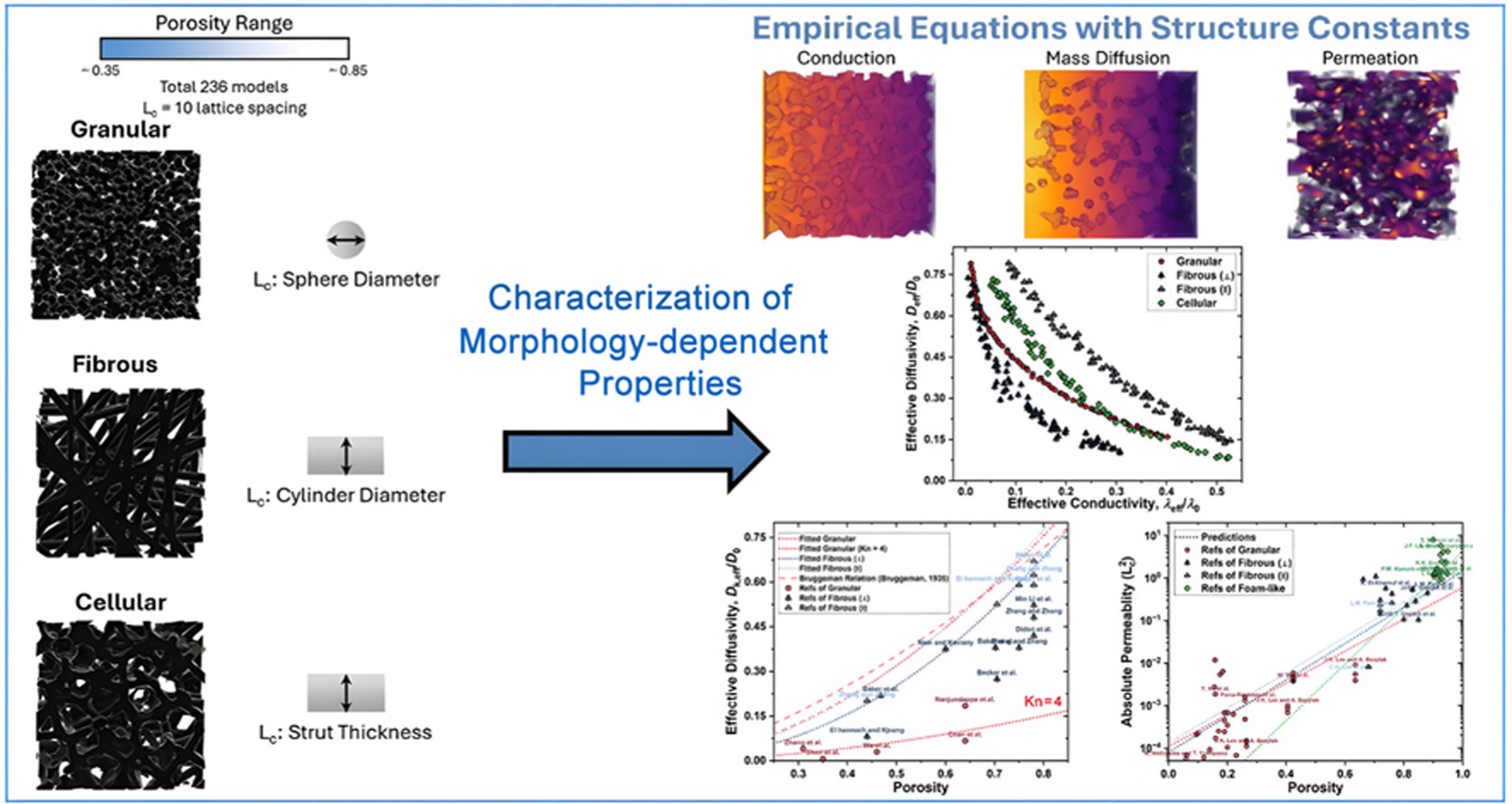
A comprehensive investigation into the morphology-dependent transport behaviors of porous media is presented in this study. Three-dimensional porous structures representing granular, fibrous, and cellular (foam-like) morphologies, commonly employed in electrochemical devices, were computationally generated and characterized across a porosity range of 0.35–0.85. Structural metrics, including specific surface area, mean pore size, tortuosity, and constrictivity, were quantified and predicted via empirical equations. Transport phenomena, including electrical/thermal conduction, mass diffusion, and permeation, were simulated and quantified using finite-difference and lattice-Boltzmann methods. Results reveal that the properties are significantly governed by both porous morphology and porosity. Empirical correlations that incorporate morphological constants and porosity accurately predict effective properties (e.g., conductivity, diffusivity, and permeability). The proposed morphological constants enable simplified yet accurate predictions of key functional properties, validated against experimental and numerical literature data. This framework provides a practical basis for morphology-driven optimization of porous media across various applications, where simultaneous transport through both solid and pore phases is critical, such as in electrochemistry.
Graphical abstract
Keywords
Porous media morphology; Effective transport properties; Kozeny-Carman equation; Bruggeman relation; Lattice Boltzmann method; Flow maldistribution index
文章导读