
期刊文章
过刊浏览
- Volumes 108-119 (2025)
-
Volumes 96-107 (2025)
-
Volume 107
Pages 1-376 (December 2025)
-
Volume 106
Pages 1-336 (November 2025)
-
Volume 105
Pages 1-356 (October 2025)
-
Volume 104
Pages 1-332 (September 2025)
-
Volume 103
Pages 1-314 (August 2025)
-
Volume 102
Pages 1-276 (July 2025)
-
Volume 101
Pages 1-166 (June 2025)
-
Volume 100
Pages 1-256 (May 2025)
-
Volume 99
Pages 1-242 (April 2025)
-
Volume 98
Pages 1-288 (March 2025)
-
Volume 97
Pages 1-256 (February 2025)
-
Volume 96
Pages 1-340 (January 2025)
-
Volume 107
-
Volumes 84-95 (2024)
-
Volume 95
Pages 1-392 (December 2024)
-
Volume 94
Pages 1-400 (November 2024)
-
Volume 93
Pages 1-376 (October 2024)
-
Volume 92
Pages 1-316 (September 2024)
-
Volume 91
Pages 1-378 (August 2024)
-
Volume 90
Pages 1-580 (July 2024)
-
Volume 89
Pages 1-278 (June 2024)
-
Volume 88
Pages 1-350 (May 2024)
-
Volume 87
Pages 1-338 (April 2024)
-
Volume 86
Pages 1-312 (March 2024)
-
Volume 85
Pages 1-334 (February 2024)
-
Volume 84
Pages 1-308 (January 2024)
-
Volume 95
-
Volumes 72-83 (2023)
-
Volume 83
Pages 1-258 (December 2023)
-
Volume 82
Pages 1-204 (November 2023)
-
Volume 81
Pages 1-188 (October 2023)
-
Volume 80
Pages 1-202 (September 2023)
-
Volume 79
Pages 1-172 (August 2023)
-
Volume 78
Pages 1-146 (July 2023)
-
Volume 77
Pages 1-152 (June 2023)
-
Volume 76
Pages 1-176 (May 2023)
-
Volume 75
Pages 1-228 (April 2023)
-
Volume 74
Pages 1-200 (March 2023)
-
Volume 73
Pages 1-138 (February 2023)
-
Volume 72
Pages 1-144 (January 2023)
-
Volume 83
-
Volumes 60-71 (2022)
-
Volume 71
Pages 1-108 (December 2022)
-
Volume 70
Pages 1-106 (November 2022)
-
Volume 69
Pages 1-122 (October 2022)
-
Volume 68
Pages 1-124 (September 2022)
-
Volume 67
Pages 1-102 (August 2022)
-
Volume 66
Pages 1-112 (July 2022)
-
Volume 65
Pages 1-138 (June 2022)
-
Volume 64
Pages 1-186 (May 2022)
-
Volume 63
Pages 1-124 (April 2022)
-
Volume 62
Pages 1-104 (March 2022)
-
Volume 61
Pages 1-120 (February 2022)
-
Volume 60
Pages 1-124 (January 2022)
-
Volume 71
- Volumes 54-59 (2021)
- Volumes 48-53 (2020)
- Volumes 42-47 (2019)
- Volumes 36-41 (2018)
- Volumes 30-35 (2017)
- Volumes 24-29 (2016)
- Volumes 18-23 (2015)
- Volumes 12-17 (2014)
- Volume 11 (2013)
- Volume 10 (2012)
- Volume 9 (2011)
- Volume 8 (2010)
- Volume 7 (2009)
- Volume 6 (2008)
- Volume 5 (2007)
- Volume 4 (2006)
- Volume 3 (2005)
- Volume 2 (2004)
- Volume 1 (2003)
Volume 110
Petrova, T. M., Fachikova, D., & Hristov, J. (2026). A magnetically assisted particle bed performance for mass transfer: Copper recovery from aqueous solution by cementation. Particuology, 110, 195-210. https://doi.org/10.1016/j.partic.2026.01.013
A magnetically assisted particle bed performance for mass transfer: Copper recovery from aqueous solution by cementation
Tanya M. Petrova a, Dimka Fachikova b, Jordan Hristov c *
a Institute of Catalysis, Bulgarian Academy of Sciences, 1113, Sofia, Bulgaria
b Department of Inorganic Technology and Corrosion, University of Chemical Technology and Metallurgy, Sofia, Bulgaria
c Department of Chemical Engineering, University of Chemical Technology and Metallurgy, Sofia, Bulgaria
10.1016/j.partic.2026.01.013
Volume 110,
March 2026,
Pages 195-210
Received 20 June 2025, Revised 5 November 2025, Accepted 12 January 2026, Available online 22 January 2026, Version of Record 30 January 2026.
E-mail:
jordan.hristov@mail.bg; jyh@uctm.edu
Highlights
• Magnetically assisted beds in an axial magnetic field are applied for copper removal by cementation in one-pass and recirculation flow modes.
• The cementation process is considered from a general point of view as a surface-controlled mass transfer operation in packed beds with variable structures.
• Copper recovery from aqueous solutions has been evaluated by the process efficiency and correlated to both the particle Reynolds number and the Rosensweig number.
• This allows the creation of a link to the well-known relationships for packed bed mass transfer through the Scherwood number.
• Copper cementation was analyzed in different particle bed structures created in an axial magnetic field under a simultaneous action of the fluid flow.
Abstract
Results of experiments on iron cementation of copper from aqueous solutions in magnetically controlled particle beds are presented in this study. The Helmholtz pair's axial magnetic field was employed. Despite the particle bed structures created for cementation, an increase in fluid flow rate results in a decrease in external mass transfer resistance, which raises copper recovery. In a typical fixed bed with constant fluid velocity, the field intensity significantly increases the copper recovery.
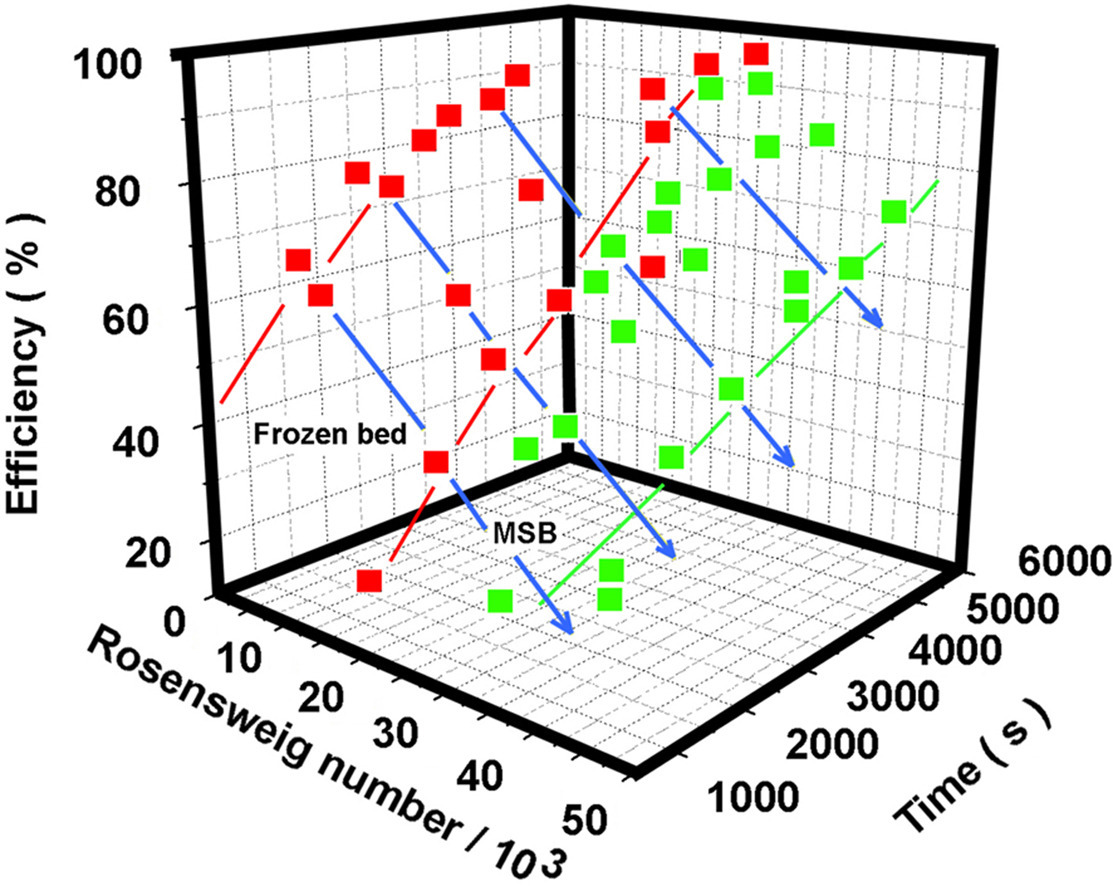
When iron is utilized as a particle bed in column operation, the bed structures play a significant part in the cementation process's effective operation. The mass transfer coefficients and separation efficiencies of the frozen beds (using the Magnetization LAST mode) and the moderately enlarged magnetically stabilized beds (MSB) are nearly comparable. Nonetheless, the frozen beds outperform MSB at modest particle Reynolds and Rosensweig numbers in the one-pass flow mode (no recirculation), while MSB is more suitable for long-time operations with flow recirculations.
Graphical abstract
Keywords
Copper cementation; Aqueous solutions; Magnetic field
文章导读