
期刊文章
过刊浏览
- Volumes 108-119 (2025)
-
Volumes 96-107 (2025)
-
Volume 107
Pages 1-376 (December 2025)
-
Volume 106
Pages 1-336 (November 2025)
-
Volume 105
Pages 1-356 (October 2025)
-
Volume 104
Pages 1-332 (September 2025)
-
Volume 103
Pages 1-314 (August 2025)
-
Volume 102
Pages 1-276 (July 2025)
-
Volume 101
Pages 1-166 (June 2025)
-
Volume 100
Pages 1-256 (May 2025)
-
Volume 99
Pages 1-242 (April 2025)
-
Volume 98
Pages 1-288 (March 2025)
-
Volume 97
Pages 1-256 (February 2025)
-
Volume 96
Pages 1-340 (January 2025)
-
Volume 107
-
Volumes 84-95 (2024)
-
Volume 95
Pages 1-392 (December 2024)
-
Volume 94
Pages 1-400 (November 2024)
-
Volume 93
Pages 1-376 (October 2024)
-
Volume 92
Pages 1-316 (September 2024)
-
Volume 91
Pages 1-378 (August 2024)
-
Volume 90
Pages 1-580 (July 2024)
-
Volume 89
Pages 1-278 (June 2024)
-
Volume 88
Pages 1-350 (May 2024)
-
Volume 87
Pages 1-338 (April 2024)
-
Volume 86
Pages 1-312 (March 2024)
-
Volume 85
Pages 1-334 (February 2024)
-
Volume 84
Pages 1-308 (January 2024)
-
Volume 95
-
Volumes 72-83 (2023)
-
Volume 83
Pages 1-258 (December 2023)
-
Volume 82
Pages 1-204 (November 2023)
-
Volume 81
Pages 1-188 (October 2023)
-
Volume 80
Pages 1-202 (September 2023)
-
Volume 79
Pages 1-172 (August 2023)
-
Volume 78
Pages 1-146 (July 2023)
-
Volume 77
Pages 1-152 (June 2023)
-
Volume 76
Pages 1-176 (May 2023)
-
Volume 75
Pages 1-228 (April 2023)
-
Volume 74
Pages 1-200 (March 2023)
-
Volume 73
Pages 1-138 (February 2023)
-
Volume 72
Pages 1-144 (January 2023)
-
Volume 83
-
Volumes 60-71 (2022)
-
Volume 71
Pages 1-108 (December 2022)
-
Volume 70
Pages 1-106 (November 2022)
-
Volume 69
Pages 1-122 (October 2022)
-
Volume 68
Pages 1-124 (September 2022)
-
Volume 67
Pages 1-102 (August 2022)
-
Volume 66
Pages 1-112 (July 2022)
-
Volume 65
Pages 1-138 (June 2022)
-
Volume 64
Pages 1-186 (May 2022)
-
Volume 63
Pages 1-124 (April 2022)
-
Volume 62
Pages 1-104 (March 2022)
-
Volume 61
Pages 1-120 (February 2022)
-
Volume 60
Pages 1-124 (January 2022)
-
Volume 71
- Volumes 54-59 (2021)
- Volumes 48-53 (2020)
- Volumes 42-47 (2019)
- Volumes 36-41 (2018)
- Volumes 30-35 (2017)
- Volumes 24-29 (2016)
- Volumes 18-23 (2015)
- Volumes 12-17 (2014)
- Volume 11 (2013)
- Volume 10 (2012)
- Volume 9 (2011)
- Volume 8 (2010)
- Volume 7 (2009)
- Volume 6 (2008)
- Volume 5 (2007)
- Volume 4 (2006)
- Volume 3 (2005)
- Volume 2 (2004)
- Volume 1 (2003)
Volume 110
Yu, F., Cui, D., Liu, R., Zhang, Y., & Zhou, G. (2026). Effects of container geometry on the packing structures of trilobed particles. Particuology, 110, 211-222. https://doi.org/10.1016/j.partic.2026.01.011
Effects of container geometry on the packing structures of trilobed particles
Fuhai Yu a *, Dongling Cui a, Ruiqiu Liu a, Yun Zhang c d *, Guangzheng Zhou b *
a School of Chemistry, Chemical Engineering and Materials, Jining University, Qufu, 273155, China
b Beijing Key Laboratory of Enze Biomass and Fine Chemicals, College of New Materials and Chemical Engineering, Beijing Institute of Petrochemical Technology, Beijing, 102617, China
c College of Chemical Engineering and Materials, Shandong University of Aeronautics, Binzhou, 256600, China
d Shandong Key Laboratory of Industrial Software for Chemical Process Simulation and Optimization, Qingdao 266042, China
10.1016/j.partic.2026.01.011
Volume 110,
March 2026,
Pages 211-222
Received 22 October 2025, Revised 6 January 2026, Accepted 12 January 2026, Available online 19 January 2026, Version of Record 30 January 2026.
E-mail:
antony1987@126.com; yzhang802@163.com; zhouguangzheng@bitp.edu.cn
Highlights
• A hybrid multi-sphere and exact contact detection approach is developed for trilobes.
• Effects of container geometry are explored for the packing densification of trilobes.
• Packing density is related to not the degree of crystallization but the arrangement of clusters of distinct orientations.
Abstract
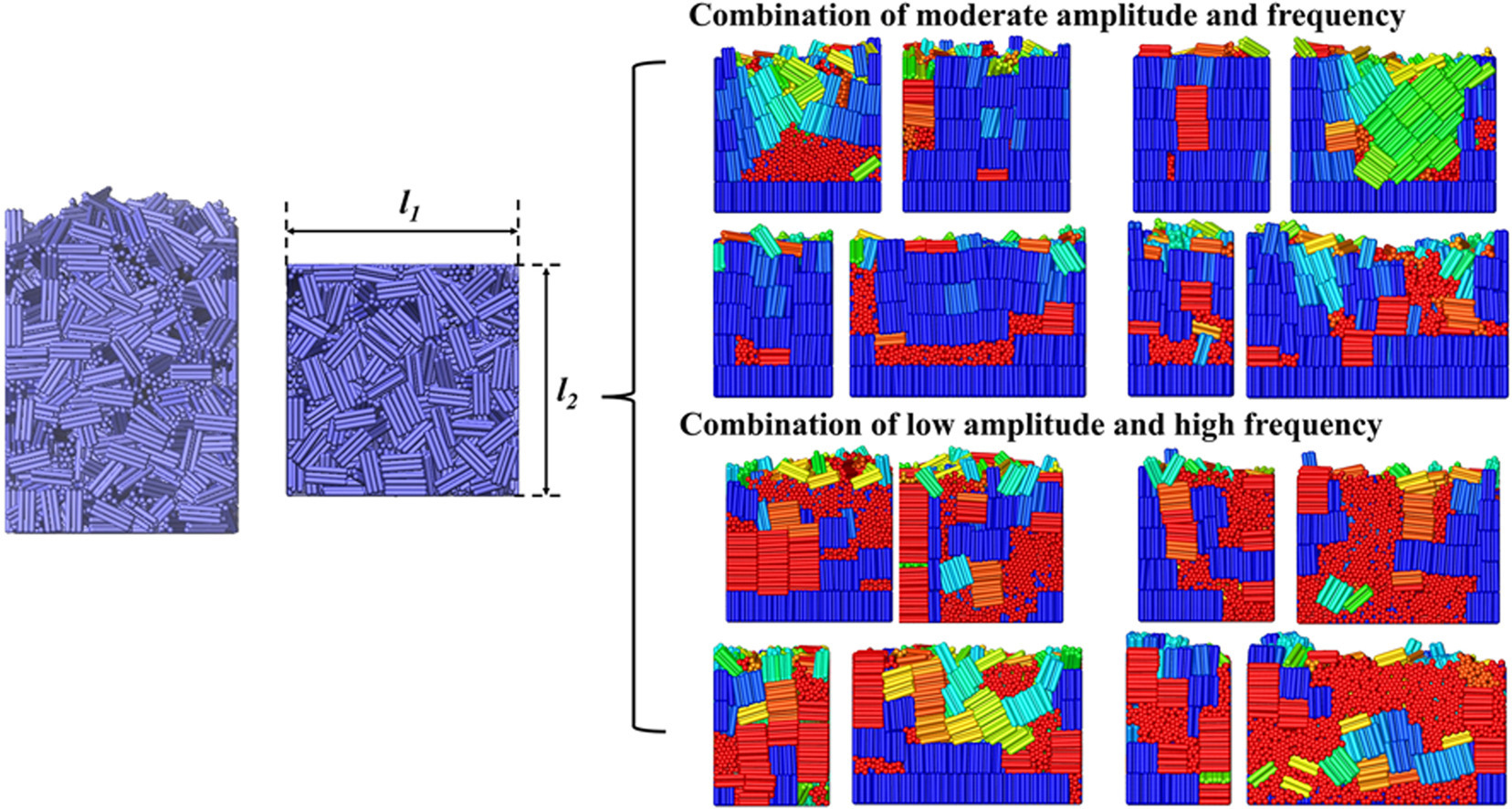
The packing densification of trilobes in rectangular containers of varying aspect ratios is systematically investigated using a geometrically exact contact detection algorithm combined with the multi-sphere method. Packing structures are analyzed in terms of overall density, spatial packing density distribution, radial distribution function, and densification mechanisms. Under mechanical vibration, two preferential particle orientations are identified. At low vibration amplitudes, spatial confinement in the bottom layer restricts rearrangement of trilobes, resulting in partial vertical alignment while many particles remain parallel to the container base. At higher amplitudes, increased mobility facilitates extensive reorientation and structural reconfiguration of trilobes, allowing nearly all trilobes near the bottom aligning vertically. In rectangular containers, trilobes predominantly adopt orientations either parallel or perpendicular to the container base, forming granular beds composed of ordered clusters of distinct orientations. The crystallization process is prohibited by the joint effects of the two distinct preferential orientations and the strong interlockings between trilobed particles and a random close packing of trilobed particles is formed in the containers. Notably, the overall packing density is not determined by the degree of crystallization but by the spatial arrangements of clusters of distinct orientations which is not sensitive to the geometry of the rectangular containers; granular beds consisting of ordered clusters with relatively low nematic order parameters can achieve higher global packing densities.
Graphical abstract
Keywords
Packing densification; Discrete element method; Container shapes; Mechanical vibration; Trilobes
文章导读