
期刊文章
过刊浏览
- Volumes 108-119 (2025)
-
Volumes 96-107 (2025)
-
Volume 107
Pages 1-376 (December 2025)
-
Volume 106
Pages 1-336 (November 2025)
-
Volume 105
Pages 1-356 (October 2025)
-
Volume 104
Pages 1-332 (September 2025)
-
Volume 103
Pages 1-314 (August 2025)
-
Volume 102
Pages 1-276 (July 2025)
-
Volume 101
Pages 1-166 (June 2025)
-
Volume 100
Pages 1-256 (May 2025)
-
Volume 99
Pages 1-242 (April 2025)
-
Volume 98
Pages 1-288 (March 2025)
-
Volume 97
Pages 1-256 (February 2025)
-
Volume 96
Pages 1-340 (January 2025)
-
Volume 107
-
Volumes 84-95 (2024)
-
Volume 95
Pages 1-392 (December 2024)
-
Volume 94
Pages 1-400 (November 2024)
-
Volume 93
Pages 1-376 (October 2024)
-
Volume 92
Pages 1-316 (September 2024)
-
Volume 91
Pages 1-378 (August 2024)
-
Volume 90
Pages 1-580 (July 2024)
-
Volume 89
Pages 1-278 (June 2024)
-
Volume 88
Pages 1-350 (May 2024)
-
Volume 87
Pages 1-338 (April 2024)
-
Volume 86
Pages 1-312 (March 2024)
-
Volume 85
Pages 1-334 (February 2024)
-
Volume 84
Pages 1-308 (January 2024)
-
Volume 95
-
Volumes 72-83 (2023)
-
Volume 83
Pages 1-258 (December 2023)
-
Volume 82
Pages 1-204 (November 2023)
-
Volume 81
Pages 1-188 (October 2023)
-
Volume 80
Pages 1-202 (September 2023)
-
Volume 79
Pages 1-172 (August 2023)
-
Volume 78
Pages 1-146 (July 2023)
-
Volume 77
Pages 1-152 (June 2023)
-
Volume 76
Pages 1-176 (May 2023)
-
Volume 75
Pages 1-228 (April 2023)
-
Volume 74
Pages 1-200 (March 2023)
-
Volume 73
Pages 1-138 (February 2023)
-
Volume 72
Pages 1-144 (January 2023)
-
Volume 83
-
Volumes 60-71 (2022)
-
Volume 71
Pages 1-108 (December 2022)
-
Volume 70
Pages 1-106 (November 2022)
-
Volume 69
Pages 1-122 (October 2022)
-
Volume 68
Pages 1-124 (September 2022)
-
Volume 67
Pages 1-102 (August 2022)
-
Volume 66
Pages 1-112 (July 2022)
-
Volume 65
Pages 1-138 (June 2022)
-
Volume 64
Pages 1-186 (May 2022)
-
Volume 63
Pages 1-124 (April 2022)
-
Volume 62
Pages 1-104 (March 2022)
-
Volume 61
Pages 1-120 (February 2022)
-
Volume 60
Pages 1-124 (January 2022)
-
Volume 71
- Volumes 54-59 (2021)
- Volumes 48-53 (2020)
- Volumes 42-47 (2019)
- Volumes 36-41 (2018)
- Volumes 30-35 (2017)
- Volumes 24-29 (2016)
- Volumes 18-23 (2015)
- Volumes 12-17 (2014)
- Volume 11 (2013)
- Volume 10 (2012)
- Volume 9 (2011)
- Volume 8 (2010)
- Volume 7 (2009)
- Volume 6 (2008)
- Volume 5 (2007)
- Volume 4 (2006)
- Volume 3 (2005)
- Volume 2 (2004)
- Volume 1 (2003)
Volume 110
Ding, S., Zheng, Q., Chu, K., Yang, R., & Yu, A. (2026). Effects of friction and cohesion on the pressure dip of granular pile. Particuology, 110, 254-268. https://doi.org/10.1016/j.partic.2026.01.020
Effects of friction and cohesion on the pressure dip of granular pile (Open Access)
Shengqiao Ding a b, Qijun Zheng b d *, Kaiwei Chu c, Runyu Yang e, Aibing Yu a b f *
a School of Energy and Environment, Southeast University, Nanjing, 210096, China
b Southeast University-Monash University Joint Research Institute, Southeast University, Suzhou, 215123, China
c School of Qilu Transportation, Shandong University, Jinan, 250061, China
d Department of Mechanical & Aerospace Engineering, Monash University, Melbourne, VIC, 3800, Australia
e School of Materials Science and Engineering, UNSW Sydney, NSW, 2052, Australia
f Centre for Smart Process Engineering, Great Bay University, Dongguan, China
10.1016/j.partic.2026.01.020
Volume 110,
March 2026,
Pages 254-268
Received 1 December 2025, Revised 7 January 2026, Accepted 15 January 2026, Available online 28 January 2026, Version of Record 4 February 2026.
E-mail:
Qijun.Zheng@monash.edu; aibing.yu@gbu.edu.cn
Highlights
• Pressure profile beneath granular piles is measured using load cells and DEM simulations.
• Increasing basal roughness progressively weakens and eventually eliminates the central pressure dip.
• Interparticle cohesion suppresses the pressure dip by altering force transmission within granular piles.
Abstract
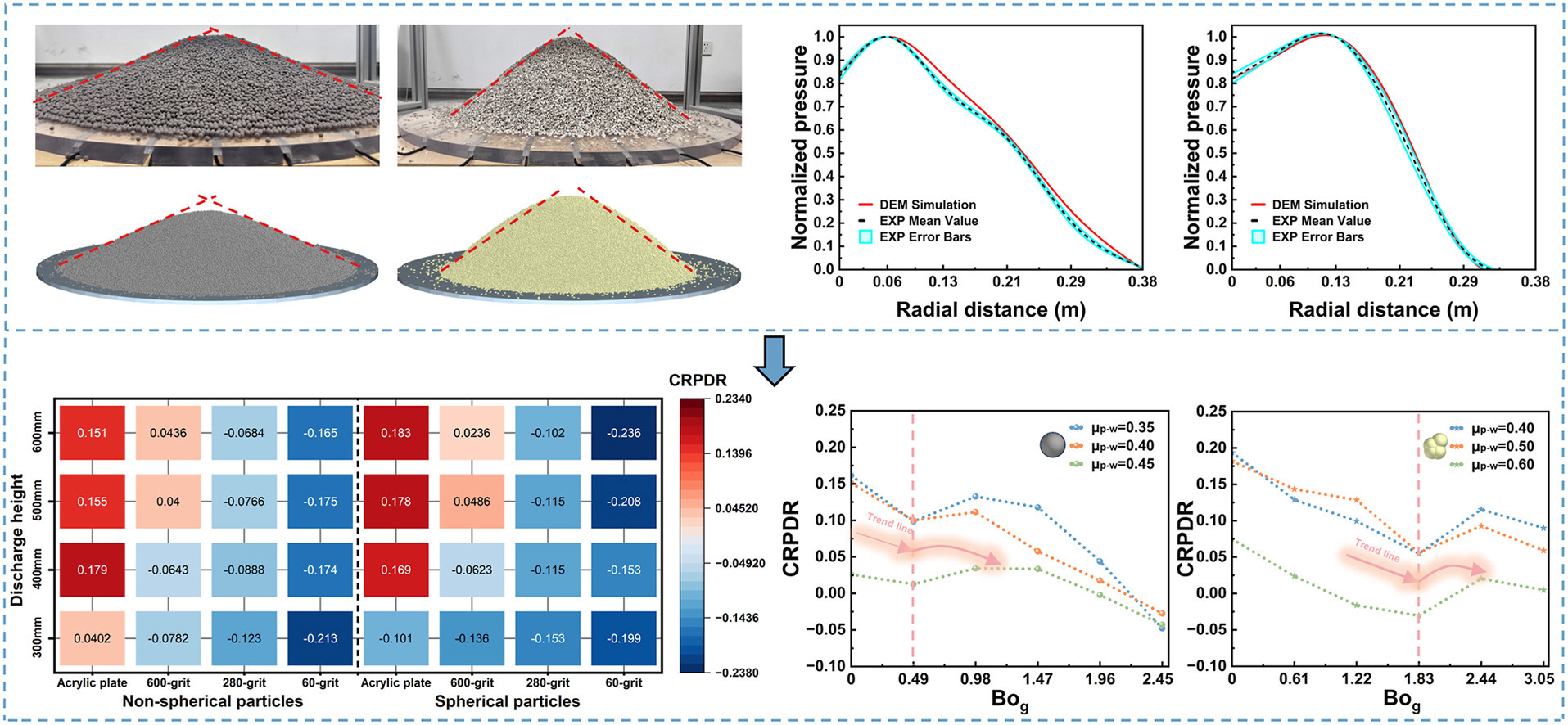
The anomalous pressure dip beneath granular piles presents an enduring challenge in granular mechanics, arising from a complex interplay of deposition history and particle properties. This study systematically investigates the roles of basal friction, interparticle cohesion (quantified by the granular Bond number), and particle shape on this phenomenon. Combining load-cell experiments with Discrete Element Method simulations for both spherical and non-spherical clinoptilolite particles, we demonstrate that the pressure dip diminishes and ultimately vanishes as basal roughness increases. This trend is markedly more pronounced for non-spherical particles. Furthermore, while interparticle cohesion significantly increases the angle of repose, it systematically reduces the magnitude of the pressure dip, an effect quantified by a Center Relative Pressure Deviation Ratio. Our findings suggest that the pressure dip emerges under a critical balance between particle rearrangement and stress transmission, underscoring the decisive roles of boundary constraints and bulk flowability.
Graphical abstract
Keywords
Pressure dip; Basal friction; Interparticle adhesion; Granular bond number; DEM; Granular pile
文章导读