
期刊文章
过刊浏览
- Volumes 108-119 (2025)
-
Volumes 96-107 (2025)
-
Volume 107
Pages 1-376 (December 2025)
-
Volume 106
Pages 1-336 (November 2025)
-
Volume 105
Pages 1-356 (October 2025)
-
Volume 104
Pages 1-332 (September 2025)
-
Volume 103
Pages 1-314 (August 2025)
-
Volume 102
Pages 1-276 (July 2025)
-
Volume 101
Pages 1-166 (June 2025)
-
Volume 100
Pages 1-256 (May 2025)
-
Volume 99
Pages 1-242 (April 2025)
-
Volume 98
Pages 1-288 (March 2025)
-
Volume 97
Pages 1-256 (February 2025)
-
Volume 96
Pages 1-340 (January 2025)
-
Volume 107
-
Volumes 84-95 (2024)
-
Volume 95
Pages 1-392 (December 2024)
-
Volume 94
Pages 1-400 (November 2024)
-
Volume 93
Pages 1-376 (October 2024)
-
Volume 92
Pages 1-316 (September 2024)
-
Volume 91
Pages 1-378 (August 2024)
-
Volume 90
Pages 1-580 (July 2024)
-
Volume 89
Pages 1-278 (June 2024)
-
Volume 88
Pages 1-350 (May 2024)
-
Volume 87
Pages 1-338 (April 2024)
-
Volume 86
Pages 1-312 (March 2024)
-
Volume 85
Pages 1-334 (February 2024)
-
Volume 84
Pages 1-308 (January 2024)
-
Volume 95
-
Volumes 72-83 (2023)
-
Volume 83
Pages 1-258 (December 2023)
-
Volume 82
Pages 1-204 (November 2023)
-
Volume 81
Pages 1-188 (October 2023)
-
Volume 80
Pages 1-202 (September 2023)
-
Volume 79
Pages 1-172 (August 2023)
-
Volume 78
Pages 1-146 (July 2023)
-
Volume 77
Pages 1-152 (June 2023)
-
Volume 76
Pages 1-176 (May 2023)
-
Volume 75
Pages 1-228 (April 2023)
-
Volume 74
Pages 1-200 (March 2023)
-
Volume 73
Pages 1-138 (February 2023)
-
Volume 72
Pages 1-144 (January 2023)
-
Volume 83
-
Volumes 60-71 (2022)
-
Volume 71
Pages 1-108 (December 2022)
-
Volume 70
Pages 1-106 (November 2022)
-
Volume 69
Pages 1-122 (October 2022)
-
Volume 68
Pages 1-124 (September 2022)
-
Volume 67
Pages 1-102 (August 2022)
-
Volume 66
Pages 1-112 (July 2022)
-
Volume 65
Pages 1-138 (June 2022)
-
Volume 64
Pages 1-186 (May 2022)
-
Volume 63
Pages 1-124 (April 2022)
-
Volume 62
Pages 1-104 (March 2022)
-
Volume 61
Pages 1-120 (February 2022)
-
Volume 60
Pages 1-124 (January 2022)
-
Volume 71
- Volumes 54-59 (2021)
- Volumes 48-53 (2020)
- Volumes 42-47 (2019)
- Volumes 36-41 (2018)
- Volumes 30-35 (2017)
- Volumes 24-29 (2016)
- Volumes 18-23 (2015)
- Volumes 12-17 (2014)
- Volume 11 (2013)
- Volume 10 (2012)
- Volume 9 (2011)
- Volume 8 (2010)
- Volume 7 (2009)
- Volume 6 (2008)
- Volume 5 (2007)
- Volume 4 (2006)
- Volume 3 (2005)
- Volume 2 (2004)
- Volume 1 (2003)
Volume 110
Li, C., Diao, Z., Cheng, Y., Shan, B., Xu, Q., Wang, X., & Zhang, F. (2026). Efficient numerical method for solving multidimensional population balance equations in batch cooling crystallization. Particuology, 110, 310-319. https://doi.org/10.1016/j.partic.2026.01.024
Efficient numerical method for solving multidimensional population balance equations in batch cooling crystallization
Chuan Li a, Zimu Diao a, Yongyan Cheng b, Baoming Shan a, Qilei Xu a *, Xuezhong Wang c d, Fangkun Zhang a *
a College of Automation and Electronic Engineering, Qingdao University of Science & Technology, Qingdao, 266061, China
b Qilu Pharmaceutical Co., Ltd., Jinan, 250100, China
c School of Chemical and Process Engineering, University of Leeds, Leeds, LS2 9JT, United Kingdom
d Centre for Pharmaceutical and Crystallization Process Systems Engineering, School of Chemical Engineering, Bejing Institute of Petrochemical Technology, Beijing, 102617, China
10.1016/j.partic.2026.01.024
Volume 110,
March 2026,
Pages 310-319
Received 9 October 2025, Revised 11 January 2026, Accepted 17 January 2026, Available online 30 January 2026, Version of Record 6 February 2026.
E-mail:
xuqilei@qust.edu.cn; f.k.zhang@qust.edu.cn
Highlights
• Proposed a numerical method for solving multidimensional PBEs with fourth-order accuracy in both space and time.
• Computational cost is significantly reduced while maintaining precision and stability.
• Four cases involving growth and nucleation verify the method's performance.
• It overcomes sharp CSD gradients and transient dynamics issues common in other methods.
Abstract
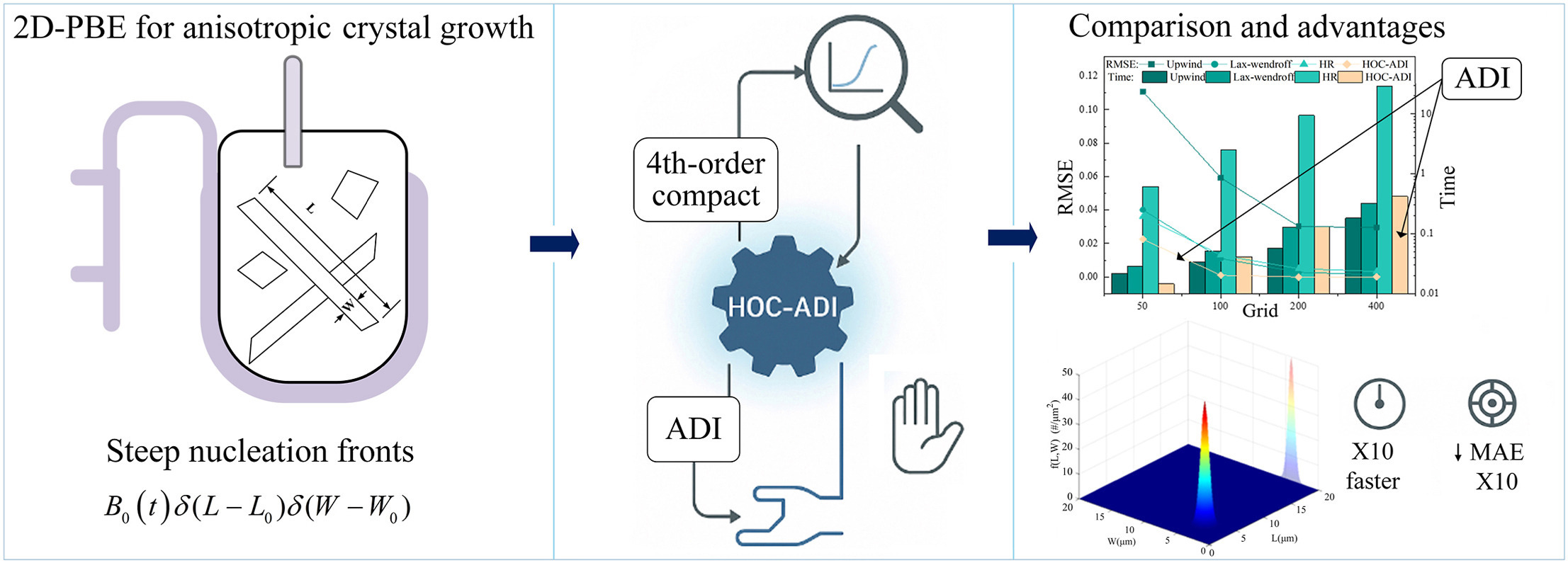
The efficient numerical solution of the multi-dimensional population balance models is still a hot topic and a challenging problem in crystallization. To address this issue, we develop a high-efficiency, high-accuracy scheme for two-dimensional PBEs, which integrates high-order compact difference discretization with an alternating-direction implicit strategy. The multidimensional solution problem was decomposed into two one-dimensional implicit systems to reduce computational complexity and suppress numerical dissipation. This proposed method can achieve fourth-order accuracy in space and time while circumventing stability constraints of explicit schemes by integrating compact fourth-order spatial discretization with alternating direction implicit time integration. Four cases were used to verify the performance by considering crystal size-independent growth, dependent growth, and nucleation in crystallization processes. The proposed method demonstrated superior accuracy and efficiency compared to the high-resolution finite volume method and high-order compact difference. In addition, stability and convergence analyses further confirm its robustness, particularly in capturing transient nucleation dynamics and steep gradients. This work is of great value and significance for modeling and optimal crystallization process control.
Graphical abstract
Keywords
Population balance equation; Crystallization; High-order compact difference; Numerical dissipation; Alternating direction implicit method
文章导读