
期刊文章
过刊浏览
- Volumes 108-119 (2025)
-
Volumes 96-107 (2025)
-
Volume 107
Pages 1-376 (December 2025)
-
Volume 106
Pages 1-336 (November 2025)
-
Volume 105
Pages 1-356 (October 2025)
-
Volume 104
Pages 1-332 (September 2025)
-
Volume 103
Pages 1-314 (August 2025)
-
Volume 102
Pages 1-276 (July 2025)
-
Volume 101
Pages 1-166 (June 2025)
-
Volume 100
Pages 1-256 (May 2025)
-
Volume 99
Pages 1-242 (April 2025)
-
Volume 98
Pages 1-288 (March 2025)
-
Volume 97
Pages 1-256 (February 2025)
-
Volume 96
Pages 1-340 (January 2025)
-
Volume 107
-
Volumes 84-95 (2024)
-
Volume 95
Pages 1-392 (December 2024)
-
Volume 94
Pages 1-400 (November 2024)
-
Volume 93
Pages 1-376 (October 2024)
-
Volume 92
Pages 1-316 (September 2024)
-
Volume 91
Pages 1-378 (August 2024)
-
Volume 90
Pages 1-580 (July 2024)
-
Volume 89
Pages 1-278 (June 2024)
-
Volume 88
Pages 1-350 (May 2024)
-
Volume 87
Pages 1-338 (April 2024)
-
Volume 86
Pages 1-312 (March 2024)
-
Volume 85
Pages 1-334 (February 2024)
-
Volume 84
Pages 1-308 (January 2024)
-
Volume 95
-
Volumes 72-83 (2023)
-
Volume 83
Pages 1-258 (December 2023)
-
Volume 82
Pages 1-204 (November 2023)
-
Volume 81
Pages 1-188 (October 2023)
-
Volume 80
Pages 1-202 (September 2023)
-
Volume 79
Pages 1-172 (August 2023)
-
Volume 78
Pages 1-146 (July 2023)
-
Volume 77
Pages 1-152 (June 2023)
-
Volume 76
Pages 1-176 (May 2023)
-
Volume 75
Pages 1-228 (April 2023)
-
Volume 74
Pages 1-200 (March 2023)
-
Volume 73
Pages 1-138 (February 2023)
-
Volume 72
Pages 1-144 (January 2023)
-
Volume 83
-
Volumes 60-71 (2022)
-
Volume 71
Pages 1-108 (December 2022)
-
Volume 70
Pages 1-106 (November 2022)
-
Volume 69
Pages 1-122 (October 2022)
-
Volume 68
Pages 1-124 (September 2022)
-
Volume 67
Pages 1-102 (August 2022)
-
Volume 66
Pages 1-112 (July 2022)
-
Volume 65
Pages 1-138 (June 2022)
-
Volume 64
Pages 1-186 (May 2022)
-
Volume 63
Pages 1-124 (April 2022)
-
Volume 62
Pages 1-104 (March 2022)
-
Volume 61
Pages 1-120 (February 2022)
-
Volume 60
Pages 1-124 (January 2022)
-
Volume 71
- Volumes 54-59 (2021)
- Volumes 48-53 (2020)
- Volumes 42-47 (2019)
- Volumes 36-41 (2018)
- Volumes 30-35 (2017)
- Volumes 24-29 (2016)
- Volumes 18-23 (2015)
- Volumes 12-17 (2014)
- Volume 11 (2013)
- Volume 10 (2012)
- Volume 9 (2011)
- Volume 8 (2010)
- Volume 7 (2009)
- Volume 6 (2008)
- Volume 5 (2007)
- Volume 4 (2006)
- Volume 3 (2005)
- Volume 2 (2004)
- Volume 1 (2003)
Volume 110
Fukada, T., Karte, G., & Pröll, T. (2026). Effect of drag and friction models for the numerical prediction of particle mixing in Geldart Type B fluidized beds. Particuology, 110, 320-330. https://doi.org/10.1016/j.partic.2025.12.015
Effect of drag and friction models for the numerical prediction of particle mixing in Geldart Type B fluidized beds
Toshiaki Fukada a *, Gregor Karte b, Tobias Pröll b
a Central Research Institute of Electric Power Industry, 2-6-1 Nagasaka, Yokosuka-shi, Kanagawa, 2400196, Japan
b Institute of Chemical and Energy Engineering, BOKU University, Muthgasse 107/I, A-1190, Vienna, Austria
10.1016/j.partic.2025.12.015
Volume 110,
March 2026,
Pages 320-330
Received 29 June 2025, Revised 26 November 2025, Accepted 18 December 2025, Available online 3 January 2026, Version of Record 6 February 2026.
E-mail:
t-fukada@criepi.denken.or.jp
Highlights
• The frictional stress model contributes to the mixing prediction when combined with the heterogeneous drag model.
• The drag model selection influences the probability density function of volume fraction rather than the bed height.
• The effects of the models increase as the fluidization number decreases.
Abstract
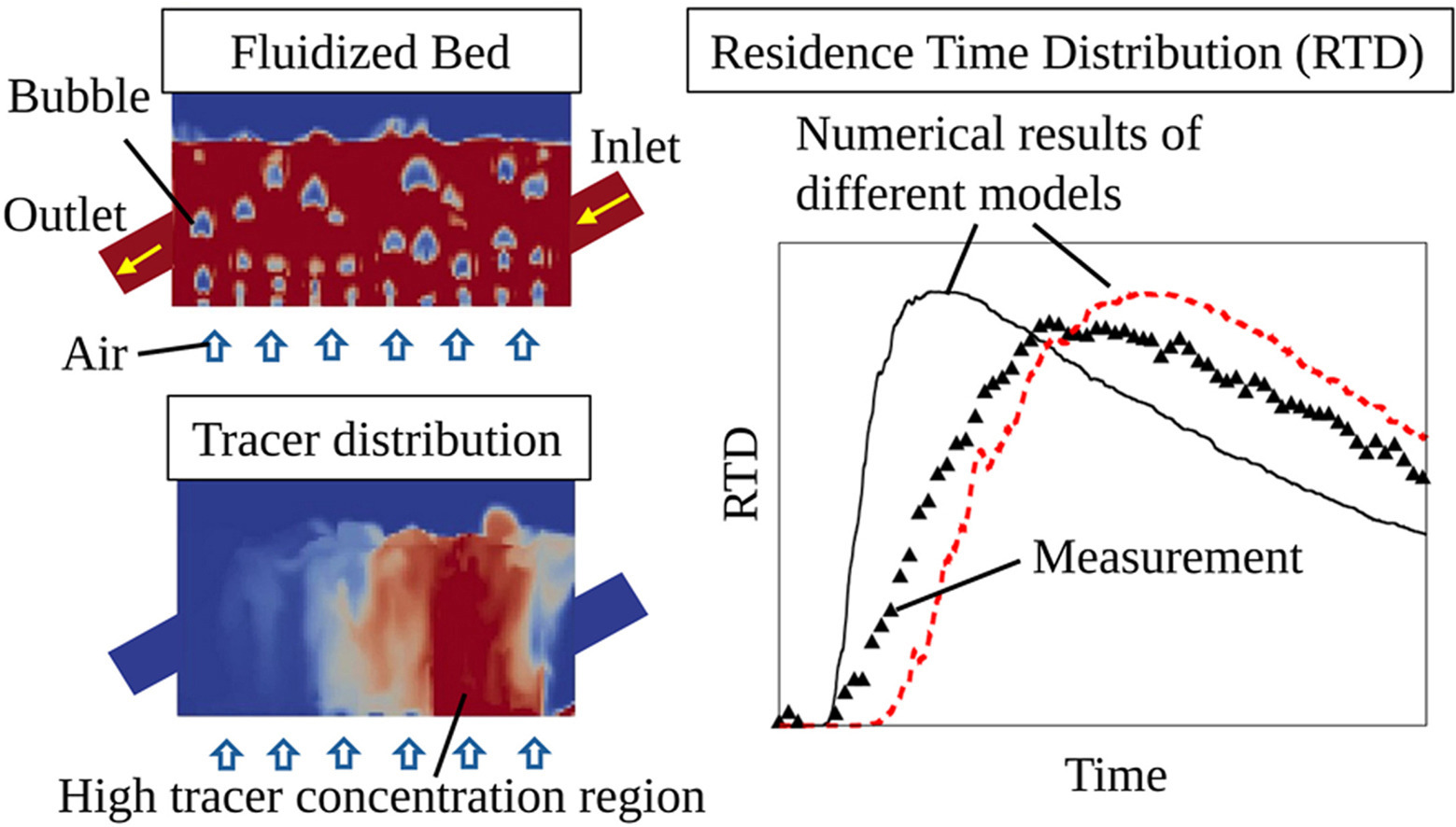
To investigate the effects of drag and frictional stress models in two-fluid model simulations, fluidized beds of Geldart type B particles are simulated, and the results are compared with experimental data for cases at lower fluidization numbers than those reported in the literature. The residence time distribution (RTD) of the particles is focused on because it reflects mixing behaviour that has a significant impact on the performance of fluidized bed reactors. The experimental results are reasonably modeled by a series of a plug flow reactor with axial dispersion and a continuous stirred tank reactor. Homogeneous and heterogeneous drag models are compared because the effects of the differences between them are unclear relative to those observed for Geldart type A particles. For the frictional stress, a model that reflects the effect of dilatation and compaction in BFBs is employed. Clear effects of the numerical models are observed when the fluidization number is reduced to 2.9. Although the simulated vertical distribution of average volume fraction is less sensitive to the drag model type than in the cases of Geldart type A particles, the simulated local distribution of the volume fraction is influenced. This influence leads to a change in the mixing behaviour. It is found that the frictional stress model effectively contributes to the prediction of mixing behaviour when combined with the heterogeneous drag model, which clearly represents bubbles. Without the frictional stress model, the mixing intensity is overestimated even with the heterogeneous drag model, indicating the importance of the combination of both models.
Graphical abstract
Keywords
Fluidized bed; Two-fluid model; Drag force model; Frictional stress model; Residence time distribution
文章导读