
期刊文章
过刊浏览
- Volumes 108-119 (2025)
-
Volumes 96-107 (2025)
-
Volume 107
Pages 1-376 (December 2025)
-
Volume 106
Pages 1-336 (November 2025)
-
Volume 105
Pages 1-356 (October 2025)
-
Volume 104
Pages 1-332 (September 2025)
-
Volume 103
Pages 1-314 (August 2025)
-
Volume 102
Pages 1-276 (July 2025)
-
Volume 101
Pages 1-166 (June 2025)
-
Volume 100
Pages 1-256 (May 2025)
-
Volume 99
Pages 1-242 (April 2025)
-
Volume 98
Pages 1-288 (March 2025)
-
Volume 97
Pages 1-256 (February 2025)
-
Volume 96
Pages 1-340 (January 2025)
-
Volume 107
-
Volumes 84-95 (2024)
-
Volume 95
Pages 1-392 (December 2024)
-
Volume 94
Pages 1-400 (November 2024)
-
Volume 93
Pages 1-376 (October 2024)
-
Volume 92
Pages 1-316 (September 2024)
-
Volume 91
Pages 1-378 (August 2024)
-
Volume 90
Pages 1-580 (July 2024)
-
Volume 89
Pages 1-278 (June 2024)
-
Volume 88
Pages 1-350 (May 2024)
-
Volume 87
Pages 1-338 (April 2024)
-
Volume 86
Pages 1-312 (March 2024)
-
Volume 85
Pages 1-334 (February 2024)
-
Volume 84
Pages 1-308 (January 2024)
-
Volume 95
-
Volumes 72-83 (2023)
-
Volume 83
Pages 1-258 (December 2023)
-
Volume 82
Pages 1-204 (November 2023)
-
Volume 81
Pages 1-188 (October 2023)
-
Volume 80
Pages 1-202 (September 2023)
-
Volume 79
Pages 1-172 (August 2023)
-
Volume 78
Pages 1-146 (July 2023)
-
Volume 77
Pages 1-152 (June 2023)
-
Volume 76
Pages 1-176 (May 2023)
-
Volume 75
Pages 1-228 (April 2023)
-
Volume 74
Pages 1-200 (March 2023)
-
Volume 73
Pages 1-138 (February 2023)
-
Volume 72
Pages 1-144 (January 2023)
-
Volume 83
-
Volumes 60-71 (2022)
-
Volume 71
Pages 1-108 (December 2022)
-
Volume 70
Pages 1-106 (November 2022)
-
Volume 69
Pages 1-122 (October 2022)
-
Volume 68
Pages 1-124 (September 2022)
-
Volume 67
Pages 1-102 (August 2022)
-
Volume 66
Pages 1-112 (July 2022)
-
Volume 65
Pages 1-138 (June 2022)
-
Volume 64
Pages 1-186 (May 2022)
-
Volume 63
Pages 1-124 (April 2022)
-
Volume 62
Pages 1-104 (March 2022)
-
Volume 61
Pages 1-120 (February 2022)
-
Volume 60
Pages 1-124 (January 2022)
-
Volume 71
- Volumes 54-59 (2021)
- Volumes 48-53 (2020)
- Volumes 42-47 (2019)
- Volumes 36-41 (2018)
- Volumes 30-35 (2017)
- Volumes 24-29 (2016)
- Volumes 18-23 (2015)
- Volumes 12-17 (2014)
- Volume 11 (2013)
- Volume 10 (2012)
- Volume 9 (2011)
- Volume 8 (2010)
- Volume 7 (2009)
- Volume 6 (2008)
- Volume 5 (2007)
- Volume 4 (2006)
- Volume 3 (2005)
- Volume 2 (2004)
- Volume 1 (2003)
Volume 116
Study on the synergistic effect of vibration and airflow on fine coal distribution in a vibrating separation fluidized bed
Ruikang Fan a b c, Yu Wang a b c, Yuanyuan Li a b c, Yadong Zhang a b c, Enhui Zhou a b c *
a Jiangsu Key Laboratory for Clean Utilization of Carbon Resources, Xuzhou, 221116, China
b Key Laboratory of Coal Processing & Efficient Utilization, Ministry of Education, Xuzhou, 221116, China
c School of Chemical Engineering & Technology, China University of Mining & Technology, Xuzhou, 221116, China
10.1016/j.partic.2026.06.001
Volume 116,
September 2026,
Pages 1-16
Received 14 March 2026, Revised 16 May 2026, Accepted 2 June 2026, Available online 10 June 2026, Version of Record 17 June 2026.
E-mail:
zeh@cumt.edu.cn
Highlights
• Vibration–airflow synergy yields a more stable and uniform fluidized bed, enabling high-efficiency fine coal separation.
• Vibration and bubble energy components are quantitatively distinguished for better understanding of bed dynamic behavior.
• Uniform energy distribution across the bed significantly improves the precision of fine coal density stratification.
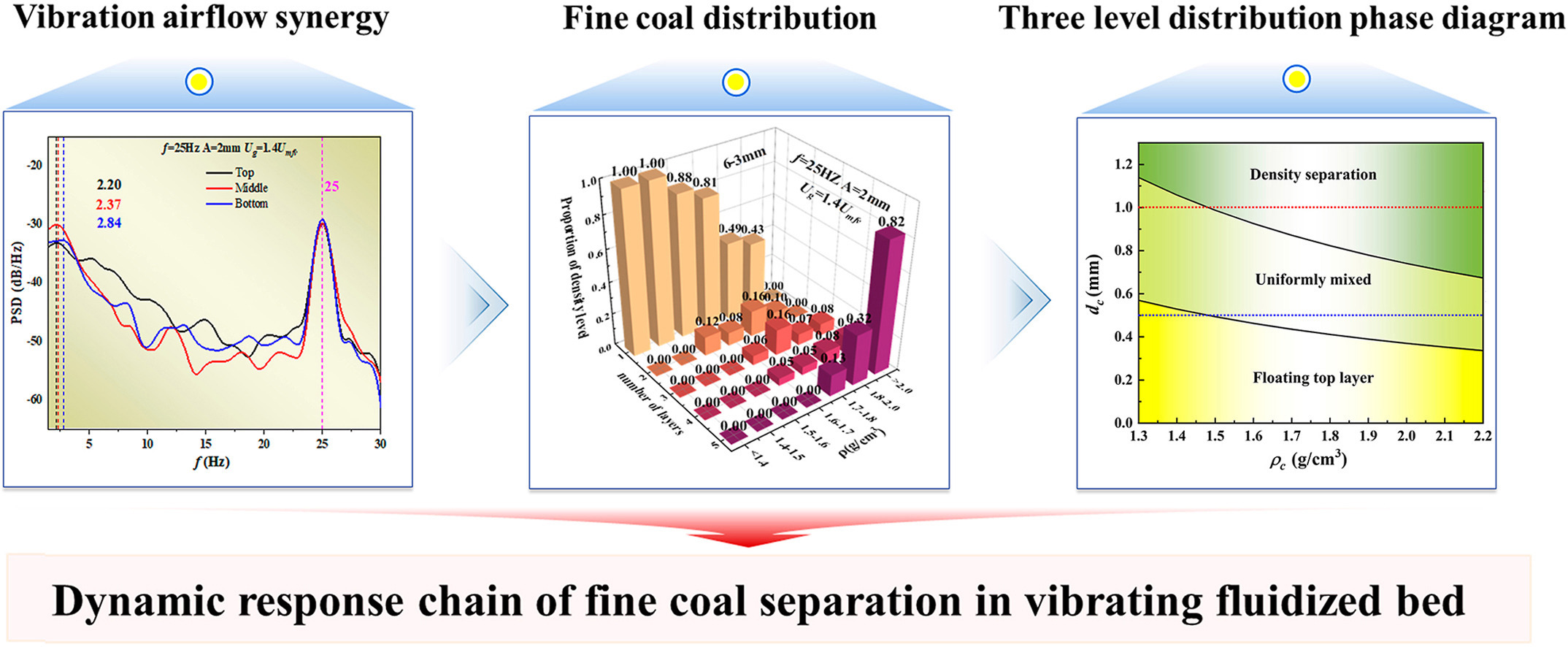
• A three-level classification framework is established to identify coal particle distribution regimes in the fluidized bed.
Abstract
Vibration-gas synergy determines dense-medium fluidization for fine coal separation in vibrating fluidized beds, while underlying energy evolution and particle distribution mechanisms are unclear. This work uses PSD to capture vibration/bubble characteristic frequencies, vertical vibration energy attenuation and gas-velocity modulation on bed activity, and applies EMD to separate total fluctuating energy into vibrational and bubble energy. Results indicate that under low vibration and gas velocities, bubble energy remains uniformly distributed while vibration energy decays monotonically with bed height, causing fine coal to stratify at the bed top and resulting in poor separation efficiency. Optimal separation performance is achieved at f = 25 Hz, A = 2 mm, Ug = 1.4 Umfv, where vibration and bubble energy are balanced across the bed. Conversely, excessive vibration and gas velocities trigger pronounced fluctuations in both energy forms, hindering separation. By correlating spatial disparities in energy distribution with separation accuracy (E-value), this work transcends traditional approaches limited to density fluctuation standard deviation. It further delineates the effects of particle size and density on separation sensitivity, establishes a three-level distribution principle for separated particles, and constructs corresponding phase diagrams, thereby offering systematic theoretical insights and operational guidance for fine coal separation via vibrating fluidization.
Graphical abstract
Keywords
Vibration fluidization; Vibration energy; Bubble energy; Fine coal distribution
文章导读