
期刊文章
过刊浏览
- Volumes 108-119 (2025)
-
Volumes 96-107 (2025)
-
Volume 107
Pages 1-376 (December 2025)
-
Volume 106
Pages 1-336 (November 2025)
-
Volume 105
Pages 1-356 (October 2025)
-
Volume 104
Pages 1-332 (September 2025)
-
Volume 103
Pages 1-314 (August 2025)
-
Volume 102
Pages 1-276 (July 2025)
-
Volume 101
Pages 1-166 (June 2025)
-
Volume 100
Pages 1-256 (May 2025)
-
Volume 99
Pages 1-242 (April 2025)
-
Volume 98
Pages 1-288 (March 2025)
-
Volume 97
Pages 1-256 (February 2025)
-
Volume 96
Pages 1-340 (January 2025)
-
Volume 107
-
Volumes 84-95 (2024)
-
Volume 95
Pages 1-392 (December 2024)
-
Volume 94
Pages 1-400 (November 2024)
-
Volume 93
Pages 1-376 (October 2024)
-
Volume 92
Pages 1-316 (September 2024)
-
Volume 91
Pages 1-378 (August 2024)
-
Volume 90
Pages 1-580 (July 2024)
-
Volume 89
Pages 1-278 (June 2024)
-
Volume 88
Pages 1-350 (May 2024)
-
Volume 87
Pages 1-338 (April 2024)
-
Volume 86
Pages 1-312 (March 2024)
-
Volume 85
Pages 1-334 (February 2024)
-
Volume 84
Pages 1-308 (January 2024)
-
Volume 95
-
Volumes 72-83 (2023)
-
Volume 83
Pages 1-258 (December 2023)
-
Volume 82
Pages 1-204 (November 2023)
-
Volume 81
Pages 1-188 (October 2023)
-
Volume 80
Pages 1-202 (September 2023)
-
Volume 79
Pages 1-172 (August 2023)
-
Volume 78
Pages 1-146 (July 2023)
-
Volume 77
Pages 1-152 (June 2023)
-
Volume 76
Pages 1-176 (May 2023)
-
Volume 75
Pages 1-228 (April 2023)
-
Volume 74
Pages 1-200 (March 2023)
-
Volume 73
Pages 1-138 (February 2023)
-
Volume 72
Pages 1-144 (January 2023)
-
Volume 83
-
Volumes 60-71 (2022)
-
Volume 71
Pages 1-108 (December 2022)
-
Volume 70
Pages 1-106 (November 2022)
-
Volume 69
Pages 1-122 (October 2022)
-
Volume 68
Pages 1-124 (September 2022)
-
Volume 67
Pages 1-102 (August 2022)
-
Volume 66
Pages 1-112 (July 2022)
-
Volume 65
Pages 1-138 (June 2022)
-
Volume 64
Pages 1-186 (May 2022)
-
Volume 63
Pages 1-124 (April 2022)
-
Volume 62
Pages 1-104 (March 2022)
-
Volume 61
Pages 1-120 (February 2022)
-
Volume 60
Pages 1-124 (January 2022)
-
Volume 71
- Volumes 54-59 (2021)
- Volumes 48-53 (2020)
- Volumes 42-47 (2019)
- Volumes 36-41 (2018)
- Volumes 30-35 (2017)
- Volumes 24-29 (2016)
- Volumes 18-23 (2015)
- Volumes 12-17 (2014)
- Volume 11 (2013)
- Volume 10 (2012)
- Volume 9 (2011)
- Volume 8 (2010)
- Volume 7 (2009)
- Volume 6 (2008)
- Volume 5 (2007)
- Volume 4 (2006)
- Volume 3 (2005)
- Volume 2 (2004)
- Volume 1 (2003)
Volume 116
A source-term-based unresolved LBM–DEM method for fluid–particle flow simulations
Chao Xu a 1, Xiang Li a 1, JiaBao Zhang a, Du Zhou b, Zihan Liu a, Jian Yang a, Lianyong Zhou c, Yongzhi Zhao a *
a College of Energy Engineering, Zhejiang University, Hangzhou, 310027, China
b China Nuclear Power Operations Co., Ltd, Shenzhen, 518000, China
c College of Smart Energy, Shanghai Jiao Tong University, Shanghai, 200240, China
10.1016/j.partic.2026.06.010
Volume 116,
September 2026,
Pages 17-33
Received 1 April 2026, Revised 18 May 2026, Accepted 8 June 2026, Available online 15 June 2026, Version of Record 20 June 2026.
E-mail:
yzzhao@zju.edu.cn
Highlights
• Proposes a novel unresolved LBM-DEM method that strictly recovers the volume-averaged Navier-Stokes equations.
• The proposed method eliminates spurious velocities inherently and achieves fully explicit computation.
• Robustly simulates highly dynamic fluid-particle flows with temporally and spatially varying solid volume fractions.
• The method is validated by the results of benchmark cases and the fluidized bed experiments.
Abstract
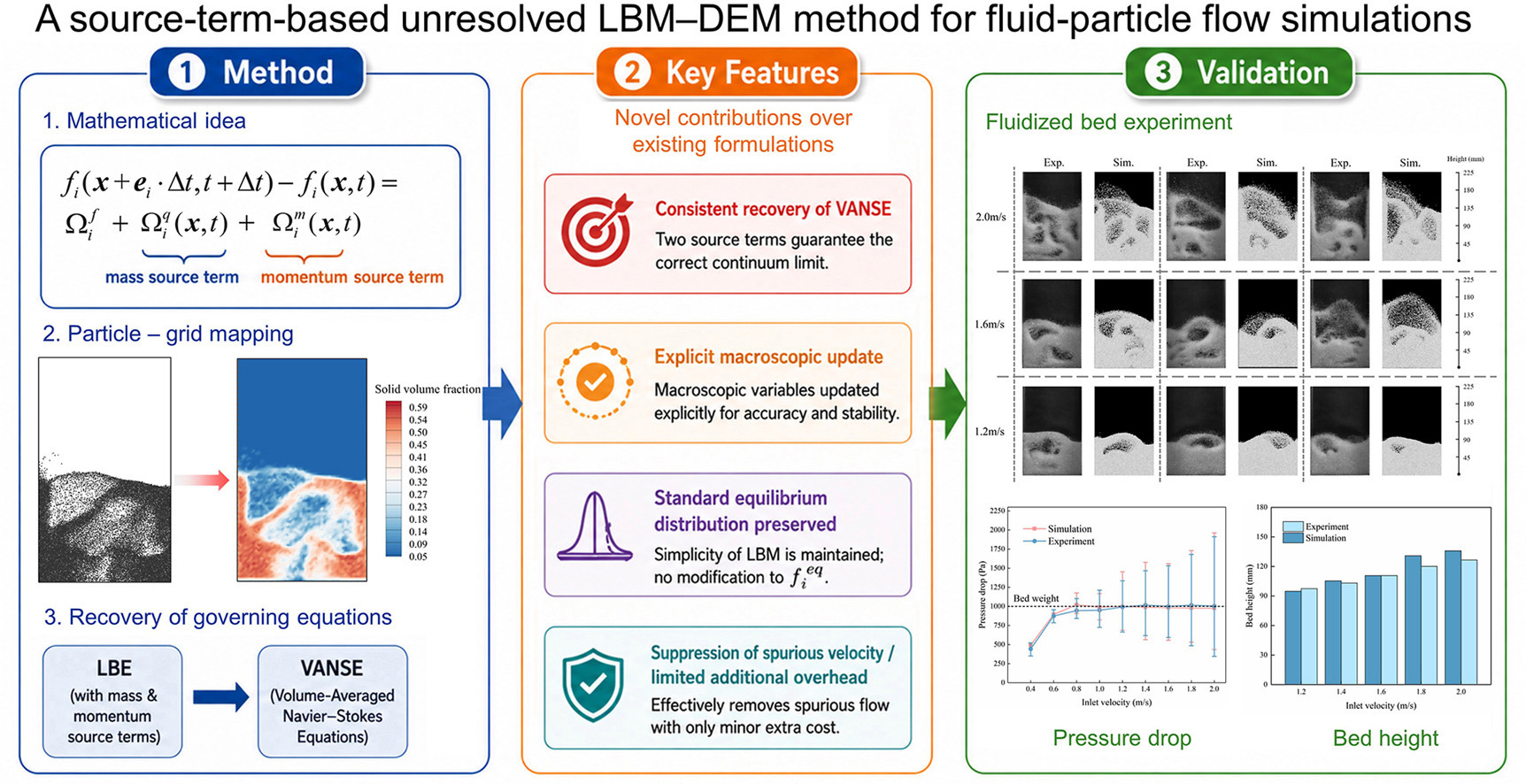
This study presents a new source-term-based unresolved LBM–DEM coupling method for fluid–particle flow simulations. The method extends the lattice Boltzmann equation by introducing mass and momentum source terms to recover the volume-averaged governing equations required in unresolved formulations, while preserving the standard equilibrium distribution function and explicit macroscopic update procedure. This treatment avoids spurious velocities and does not introduce additional implicit coupling during the fluid update. To improve numerical robustness, the method is implemented with a multiple-relaxation-time collision model and a WALE-based large-eddy simulation model. The proposed framework is assessed using several benchmark problems, including a variable-porosity no-spurious-velocity test, Couette flow in porous media, and fixed-bed flow. Good agreement is obtained with the corresponding benchmark or analytical results. The method is further applied to a quasi-two-dimensional fluidized-bed case, where the predicted transient particle behavior, bed height, pressure drop, and dominant fluctuation frequency are in reasonable agreement with experimental observations. In addition, a benchmark-specific performance study is conducted against an unresolved CFD–DEM baseline for the same fluidized-bed problem. The results show that the present unresolved LBM–DEM implementation requires less wall-clock time to advance the tested case under the reported hardware and time-step settings. These results indicate that the proposed method provides a theoretically consistent, numerically robust, and computationally promising framework for unresolved fluid–particle flow simulations.
Graphical abstract
Keywords
Lattice Boltzmann method; Discrete element method; LBM-DEM coupling method; Unresolved fluid-particle flow; Multiphase flows
文章导读