
期刊文章
过刊浏览
- Volumes 108-119 (2025)
-
Volumes 96-107 (2025)
-
Volume 107
Pages 1-376 (December 2025)
-
Volume 106
Pages 1-336 (November 2025)
-
Volume 105
Pages 1-356 (October 2025)
-
Volume 104
Pages 1-332 (September 2025)
-
Volume 103
Pages 1-314 (August 2025)
-
Volume 102
Pages 1-276 (July 2025)
-
Volume 101
Pages 1-166 (June 2025)
-
Volume 100
Pages 1-256 (May 2025)
-
Volume 99
Pages 1-242 (April 2025)
-
Volume 98
Pages 1-288 (March 2025)
-
Volume 97
Pages 1-256 (February 2025)
-
Volume 96
Pages 1-340 (January 2025)
-
Volume 107
-
Volumes 84-95 (2024)
-
Volume 95
Pages 1-392 (December 2024)
-
Volume 94
Pages 1-400 (November 2024)
-
Volume 93
Pages 1-376 (October 2024)
-
Volume 92
Pages 1-316 (September 2024)
-
Volume 91
Pages 1-378 (August 2024)
-
Volume 90
Pages 1-580 (July 2024)
-
Volume 89
Pages 1-278 (June 2024)
-
Volume 88
Pages 1-350 (May 2024)
-
Volume 87
Pages 1-338 (April 2024)
-
Volume 86
Pages 1-312 (March 2024)
-
Volume 85
Pages 1-334 (February 2024)
-
Volume 84
Pages 1-308 (January 2024)
-
Volume 95
-
Volumes 72-83 (2023)
-
Volume 83
Pages 1-258 (December 2023)
-
Volume 82
Pages 1-204 (November 2023)
-
Volume 81
Pages 1-188 (October 2023)
-
Volume 80
Pages 1-202 (September 2023)
-
Volume 79
Pages 1-172 (August 2023)
-
Volume 78
Pages 1-146 (July 2023)
-
Volume 77
Pages 1-152 (June 2023)
-
Volume 76
Pages 1-176 (May 2023)
-
Volume 75
Pages 1-228 (April 2023)
-
Volume 74
Pages 1-200 (March 2023)
-
Volume 73
Pages 1-138 (February 2023)
-
Volume 72
Pages 1-144 (January 2023)
-
Volume 83
-
Volumes 60-71 (2022)
-
Volume 71
Pages 1-108 (December 2022)
-
Volume 70
Pages 1-106 (November 2022)
-
Volume 69
Pages 1-122 (October 2022)
-
Volume 68
Pages 1-124 (September 2022)
-
Volume 67
Pages 1-102 (August 2022)
-
Volume 66
Pages 1-112 (July 2022)
-
Volume 65
Pages 1-138 (June 2022)
-
Volume 64
Pages 1-186 (May 2022)
-
Volume 63
Pages 1-124 (April 2022)
-
Volume 62
Pages 1-104 (March 2022)
-
Volume 61
Pages 1-120 (February 2022)
-
Volume 60
Pages 1-124 (January 2022)
-
Volume 71
- Volumes 54-59 (2021)
- Volumes 48-53 (2020)
- Volumes 42-47 (2019)
- Volumes 36-41 (2018)
- Volumes 30-35 (2017)
- Volumes 24-29 (2016)
- Volumes 18-23 (2015)
- Volumes 12-17 (2014)
- Volume 11 (2013)
- Volume 10 (2012)
- Volume 9 (2011)
- Volume 8 (2010)
- Volume 7 (2009)
- Volume 6 (2008)
- Volume 5 (2007)
- Volume 4 (2006)
- Volume 3 (2005)
- Volume 2 (2004)
- Volume 1 (2003)
Volume 116
Decoupling morphology and facet effects on Li-ion transport kinetics and interfacial stability in spinel LiMn2O4 cathodes for high-voltage lithium-ion batteries
Z.I. Radzi a *, M.Z. Kufian b, V. Balakrishnan a, J. Selvaraj a c d *
a Higher Institution Centre of Excellence (HICoE), UM Power Energy Dedicated Advanced Centre (UMPEDAC), Universiti Malaya, Level 4, Wisma R&D, Jalan Pantai Baharu, 59990, Kuala Lumpur, Malaysia
b Centre for Ionics University of Malaya (CIUM), Physics Department, Faculty of Science, Universiti Malaya, 50603, Kuala Lumpur, Malaysia
c Department of Mathematical Sciences, Saveetha School of Engineering, SIMATS, Chennai, Tamil Nadu, 602105, India
d Department of Electrical Engineering, Faculty of Engineering, Universitas Negeri Padang, Padang, Indonesia
10.1016/j.partic.2026.06.011
Volume 116,
September 2026,
Pages 34-43
Received 4 May 2026, Revised 4 June 2026, Accepted 9 June 2026, Available online 16 June 2026, Version of Record 22 June 2026.
E-mail:
jeyraj@um.edu.my
Highlights
• Morphology-facet interplay governs the rate-stability trade-off in spinel LiMn2O4 at 4.6 V operation.
• Nanostructured LiMn2O4 enhances Li + transport and high-rate electrochemical response.
• Facet-stabilized microstructured LiMn2O4 exhibits superior cycling and interfacial stability.
• Postmortem analyses reveal cracking and thick surface films in nanoscale LiMn2O4 at high voltage.
• Facet-engineered morphology offers a pathway to balance kinetics and durability in spinel cathodes.
Abstract
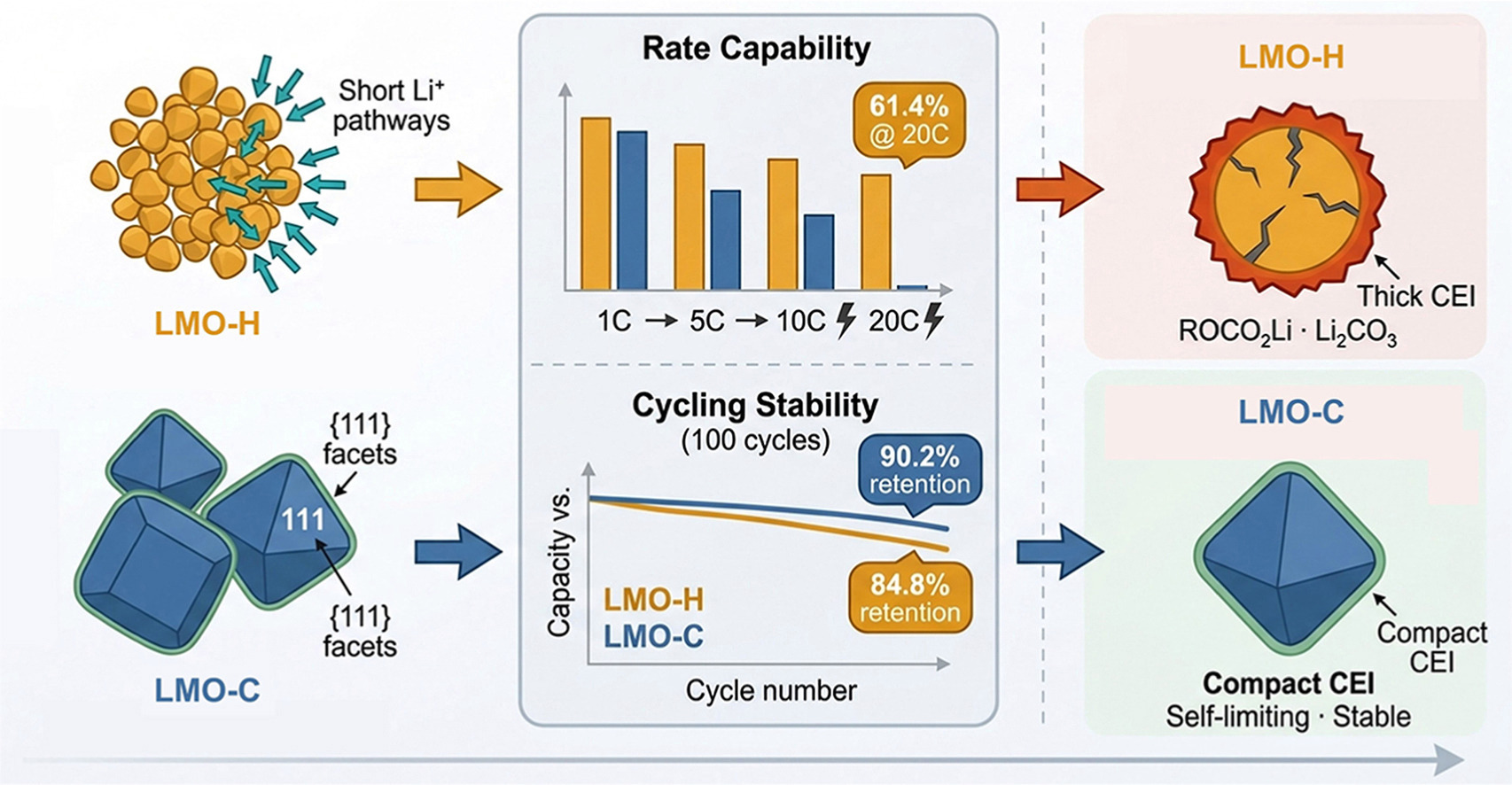
Spinel LiMn2O4 (LMO) is a promising cobalt-free cathode for high-voltage lithium-ion batteries, yet the interplay between particle morphology, crystallographic facet orientation, and electrochemical performance remains poorly understood. Here, we systematically decouple the morphology and facet-dependent determinants of the rate-stability trade-off by comparing hydrothermally synthesized nanostructured LMO (LMO-H) and commercial microstructured LMO (LMO-C) under an aggressive cut-off voltage of 4.6 V vs. Li/Li+. LMO-H, with an average particle size of ∼31 nm, delivers exceptional high-rate capability, retaining 61.4% capacity at 20C, among the highest reported for undoped spinel LMO, owing to dramatically shortened Li-ion diffusion pathways and superior Li diffusivity (up to 1.23 × 10⁻¹¹ cm2 s−1). However, this kinetic advantage is progressively offset by particle fracture and accelerated cathode electrolyte interphase (CEI) growth, resulting in 84.8% capacity retention at 1C after 100 cycles. By contrast, LMO-C, whose surface is dominated by thermodynamically stable {111} facets, nucleates a compact, self-limiting interphase that suppresses electrolyte decomposition, achieving an outstanding 90.2% capacity retention at 1C after 100 cycles. Postmortem SEM, EIS, and FTIR analyses confirm that uncontrolled interfacial reactions drive thick ROCO2Li and Li2CO3 accumulation in LMO-H, whereas LMO-C preserves structural integrity under identical conditions. These findings establish a fundamental size-facet interplay governing the kinetic-stability balance in spinel LMO, offering actionable design guidelines for next-generation cathodes that concurrently optimize Li-ion transport and interfacial robustness.
Graphical abstract
Keywords
LiMn2O4; Hydrothermal synthesis; Morphology control; Facet engineering; High-voltage stability
文章导读