
期刊文章
过刊浏览
- Volumes 108-119 (2025)
-
Volumes 96-107 (2025)
-
Volume 107
Pages 1-376 (December 2025)
-
Volume 106
Pages 1-336 (November 2025)
-
Volume 105
Pages 1-356 (October 2025)
-
Volume 104
Pages 1-332 (September 2025)
-
Volume 103
Pages 1-314 (August 2025)
-
Volume 102
Pages 1-276 (July 2025)
-
Volume 101
Pages 1-166 (June 2025)
-
Volume 100
Pages 1-256 (May 2025)
-
Volume 99
Pages 1-242 (April 2025)
-
Volume 98
Pages 1-288 (March 2025)
-
Volume 97
Pages 1-256 (February 2025)
-
Volume 96
Pages 1-340 (January 2025)
-
Volume 107
-
Volumes 84-95 (2024)
-
Volume 95
Pages 1-392 (December 2024)
-
Volume 94
Pages 1-400 (November 2024)
-
Volume 93
Pages 1-376 (October 2024)
-
Volume 92
Pages 1-316 (September 2024)
-
Volume 91
Pages 1-378 (August 2024)
-
Volume 90
Pages 1-580 (July 2024)
-
Volume 89
Pages 1-278 (June 2024)
-
Volume 88
Pages 1-350 (May 2024)
-
Volume 87
Pages 1-338 (April 2024)
-
Volume 86
Pages 1-312 (March 2024)
-
Volume 85
Pages 1-334 (February 2024)
-
Volume 84
Pages 1-308 (January 2024)
-
Volume 95
-
Volumes 72-83 (2023)
-
Volume 83
Pages 1-258 (December 2023)
-
Volume 82
Pages 1-204 (November 2023)
-
Volume 81
Pages 1-188 (October 2023)
-
Volume 80
Pages 1-202 (September 2023)
-
Volume 79
Pages 1-172 (August 2023)
-
Volume 78
Pages 1-146 (July 2023)
-
Volume 77
Pages 1-152 (June 2023)
-
Volume 76
Pages 1-176 (May 2023)
-
Volume 75
Pages 1-228 (April 2023)
-
Volume 74
Pages 1-200 (March 2023)
-
Volume 73
Pages 1-138 (February 2023)
-
Volume 72
Pages 1-144 (January 2023)
-
Volume 83
-
Volumes 60-71 (2022)
-
Volume 71
Pages 1-108 (December 2022)
-
Volume 70
Pages 1-106 (November 2022)
-
Volume 69
Pages 1-122 (October 2022)
-
Volume 68
Pages 1-124 (September 2022)
-
Volume 67
Pages 1-102 (August 2022)
-
Volume 66
Pages 1-112 (July 2022)
-
Volume 65
Pages 1-138 (June 2022)
-
Volume 64
Pages 1-186 (May 2022)
-
Volume 63
Pages 1-124 (April 2022)
-
Volume 62
Pages 1-104 (March 2022)
-
Volume 61
Pages 1-120 (February 2022)
-
Volume 60
Pages 1-124 (January 2022)
-
Volume 71
- Volumes 54-59 (2021)
- Volumes 48-53 (2020)
- Volumes 42-47 (2019)
- Volumes 36-41 (2018)
- Volumes 30-35 (2017)
- Volumes 24-29 (2016)
- Volumes 18-23 (2015)
- Volumes 12-17 (2014)
- Volume 11 (2013)
- Volume 10 (2012)
- Volume 9 (2011)
- Volume 8 (2010)
- Volume 7 (2009)
- Volume 6 (2008)
- Volume 5 (2007)
- Volume 4 (2006)
- Volume 3 (2005)
- Volume 2 (2004)
- Volume 1 (2003)
Volume 116
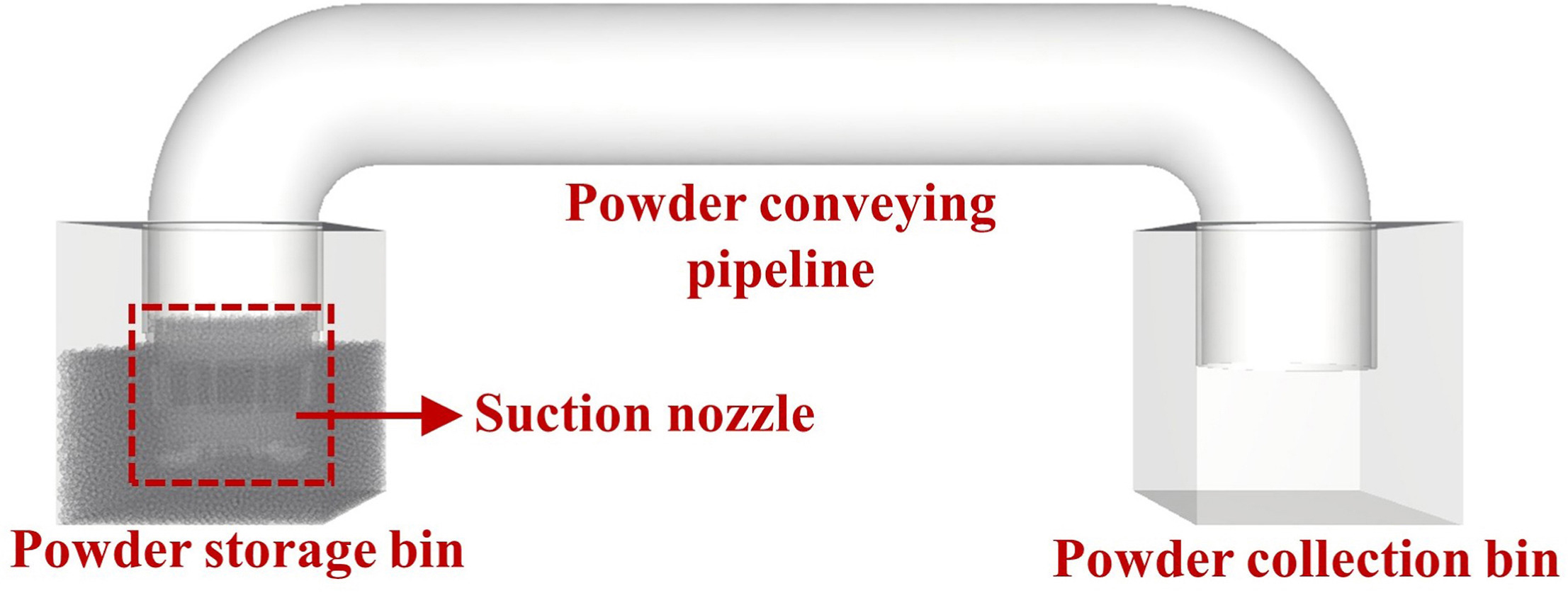
CFD-DEM simulation and multi-objective optimization of a novel suction nozzle for enhanced powder delivery in selective laser melting
Xiaoping You a *, Linxue Wen a b, Junrong Wang c, Tingting Shen a, Yuxian Liang a, Qiyuan Dong a, Manqian Sun d e
a School of Mechanical and Electrical Engineering and Automation, Xiamen University Tan Kah Kee College, Zhangzhou, 363105, China
b Pen-Tung Sah Institute of Micro-Nano Science and Technology, Xiamen University, Xiamen, 361005, China
c Xiamen Han Yin Co., Ltd., Xiamen, 361000, China
d College of Marine Equipment and Mechanical Engineering, Jimei University, Xiamen, 361000, China
e Faculty of Mechanical Engineering, Lodz University of Technology, Lodz, 90-924, Poland
10.1016/j.partic.2026.06.012
Volume 116,
September 2026,
Pages 55-68
Received 28 April 2026, Revised 28 May 2026, Accepted 9 June 2026, Available online 16 June 2026, Version of Record 22 June 2026.
E-mail:
xp.you@qq.com
Highlights
• A novel suction nozzle was developed to improve powder delivery stability in SLM.
• A validated CFD-DEM model was established to simulate gas-solid transport during suction.
• Effects of inclination angle, opening height, and opening number on performance were quantified.
• Flow-field analysis revealed the optimized nozzle enlarges the high-speed low-pressure core region.
• Multi-objective optimization achieved 47.4% higher cleaning efficiency and 34.5% faster conveying.
Abstract
The stability and efficiency of powder delivery are critical for high-quality powder deposition in selective laser melting (SLM). This study proposes a novel suction nozzle design to optimize the internal flow field at the source, breaking from the conventional focus on blades and process parameters. A validated CFD-DEM model was employed to investigate the effects of inclination angle, vertical opening height, and number of openings on cleaning efficiency and conveying speed. Flow mechanism analysis reveals that the performance improvement stems from an expanded high-speed, low-pressure core area and a more uniform flow field gradient. Orthogonal experiments and response surface analysis quantitatively identified the main effects of each parameter. Using a satisfaction function for multi-objective optimization, the optimal parameter combination (θ = 14.2°, H = 0.32H0, N = 7) was obtained, achieving a comprehensive satisfaction of 0.89. Compared to the baseline, the optimized design increases cleaning efficiency by 47.4% (to 73.98%) and conveying speed by 34.5% (to 0.74 g/s), successfully balancing both performance metrics. This work provides an effective design methodology for SLM powder delivery systems.
Graphical abstract
Keywords
Selective laser melting; Powder delivery; Suction nozzle; CFD-DEM; Flow mechanism
文章导读