
期刊文章
过刊浏览
- Volumes 108-119 (2025)
-
Volumes 96-107 (2025)
-
Volume 107
Pages 1-376 (December 2025)
-
Volume 106
Pages 1-336 (November 2025)
-
Volume 105
Pages 1-356 (October 2025)
-
Volume 104
Pages 1-332 (September 2025)
-
Volume 103
Pages 1-314 (August 2025)
-
Volume 102
Pages 1-276 (July 2025)
-
Volume 101
Pages 1-166 (June 2025)
-
Volume 100
Pages 1-256 (May 2025)
-
Volume 99
Pages 1-242 (April 2025)
-
Volume 98
Pages 1-288 (March 2025)
-
Volume 97
Pages 1-256 (February 2025)
-
Volume 96
Pages 1-340 (January 2025)
-
Volume 107
-
Volumes 84-95 (2024)
-
Volume 95
Pages 1-392 (December 2024)
-
Volume 94
Pages 1-400 (November 2024)
-
Volume 93
Pages 1-376 (October 2024)
-
Volume 92
Pages 1-316 (September 2024)
-
Volume 91
Pages 1-378 (August 2024)
-
Volume 90
Pages 1-580 (July 2024)
-
Volume 89
Pages 1-278 (June 2024)
-
Volume 88
Pages 1-350 (May 2024)
-
Volume 87
Pages 1-338 (April 2024)
-
Volume 86
Pages 1-312 (March 2024)
-
Volume 85
Pages 1-334 (February 2024)
-
Volume 84
Pages 1-308 (January 2024)
-
Volume 95
-
Volumes 72-83 (2023)
-
Volume 83
Pages 1-258 (December 2023)
-
Volume 82
Pages 1-204 (November 2023)
-
Volume 81
Pages 1-188 (October 2023)
-
Volume 80
Pages 1-202 (September 2023)
-
Volume 79
Pages 1-172 (August 2023)
-
Volume 78
Pages 1-146 (July 2023)
-
Volume 77
Pages 1-152 (June 2023)
-
Volume 76
Pages 1-176 (May 2023)
-
Volume 75
Pages 1-228 (April 2023)
-
Volume 74
Pages 1-200 (March 2023)
-
Volume 73
Pages 1-138 (February 2023)
-
Volume 72
Pages 1-144 (January 2023)
-
Volume 83
-
Volumes 60-71 (2022)
-
Volume 71
Pages 1-108 (December 2022)
-
Volume 70
Pages 1-106 (November 2022)
-
Volume 69
Pages 1-122 (October 2022)
-
Volume 68
Pages 1-124 (September 2022)
-
Volume 67
Pages 1-102 (August 2022)
-
Volume 66
Pages 1-112 (July 2022)
-
Volume 65
Pages 1-138 (June 2022)
-
Volume 64
Pages 1-186 (May 2022)
-
Volume 63
Pages 1-124 (April 2022)
-
Volume 62
Pages 1-104 (March 2022)
-
Volume 61
Pages 1-120 (February 2022)
-
Volume 60
Pages 1-124 (January 2022)
-
Volume 71
- Volumes 54-59 (2021)
- Volumes 48-53 (2020)
- Volumes 42-47 (2019)
- Volumes 36-41 (2018)
- Volumes 30-35 (2017)
- Volumes 24-29 (2016)
- Volumes 18-23 (2015)
- Volumes 12-17 (2014)
- Volume 11 (2013)
- Volume 10 (2012)
- Volume 9 (2011)
- Volume 8 (2010)
- Volume 7 (2009)
- Volume 6 (2008)
- Volume 5 (2007)
- Volume 4 (2006)
- Volume 3 (2005)
- Volume 2 (2004)
- Volume 1 (2003)
Volume 116
Effects of inlet velocities on two-phase mixing and particle transport in a post-mixed abrasive waterjet nozzle with dual-sided abrasive inlets
Fuzeng Wang *, Zhanpeng Xiao, Zixian Jiang, Penghui Zeng, Feng Jiang
Institute of Manufacturing Engineering, Huaqiao University, Xiamen, 361021, China
10.1016/j.partic.2026.06.014
Volume 116,
September 2026,
Pages 69-86
Received 14 April 2026, Revised 12 June 2026, Accepted 14 June 2026, Available online 17 June 2026, Version of Record 22 June 2026.
E-mail:
wangfuzeng1987@163.com
Highlights
• Developed a coupled SPH-FEM model to simulate AWJ two-phase flow behavior.
• High water inlet velocity reduces particle residence time but increases wall stress.
• Abrasive inlet velocity enhances flow deflection, reducing particle acceleration efficiency.
• Focusing tube entry is the primary zone for momentum exchange and energy dissipation.
Abstract
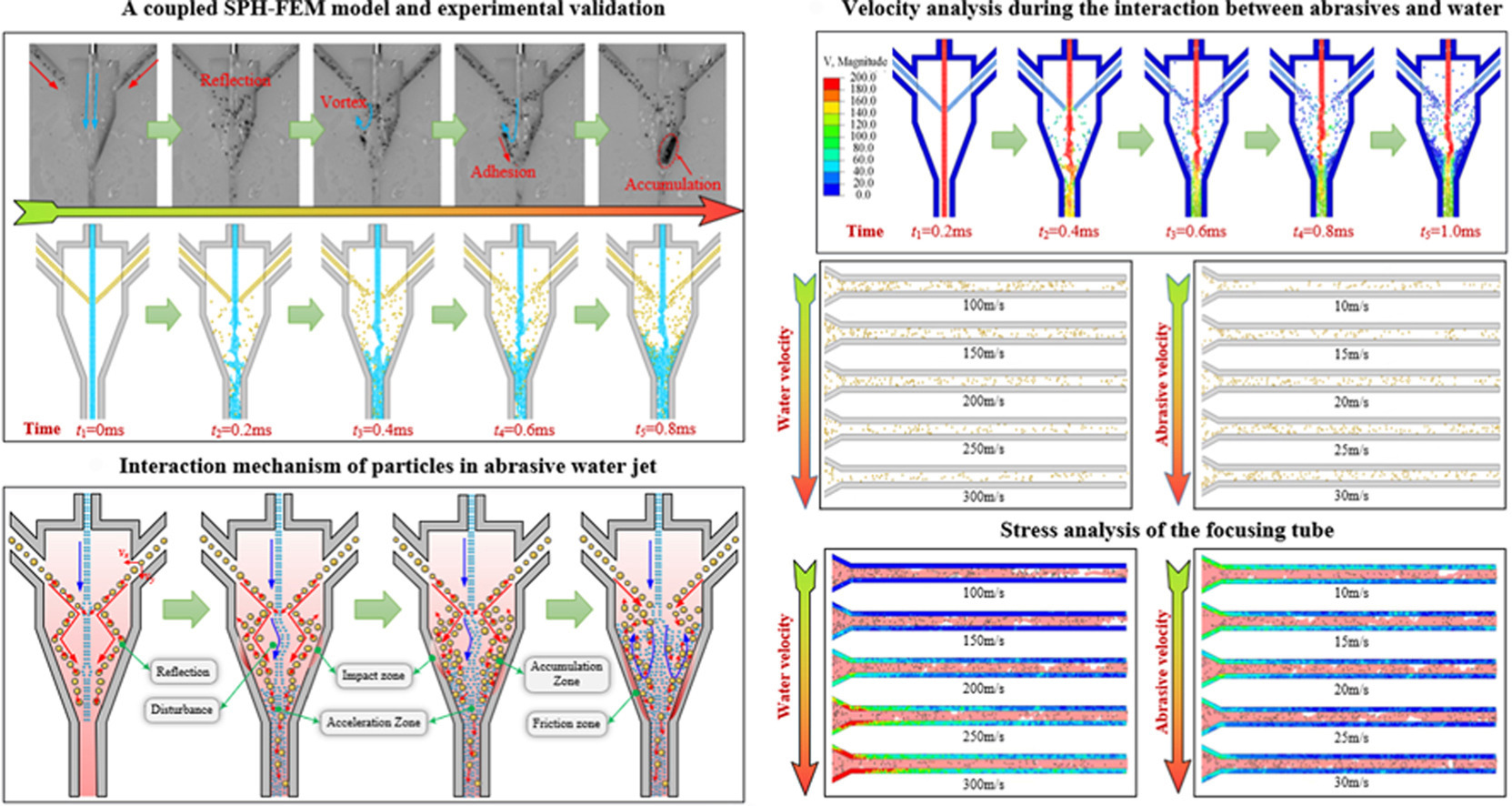
In abrasive waterjet (AWJ) machining, the internal mixing behavior of water and abrasive particles plays a key role in particle acceleration and flow development. In this study, a coupled SPH-FEM numerical model is developed to investigate the transient liquid-solid interaction in a post-mixed AWJ nozzle with dual-sided abrasive inlets. The model is qualitatively validated by high-speed imaging of particle motion. The effects of water inlet velocity and abrasive inlet velocity on particle transport, velocity evolution, and wall stress distribution are systematically analyzed. Results show that increasing water inlet velocity enhances the continuity of the high-speed core flow, promotes particle transport through the mixing chamber, and increases the average velocities of both phases in the focusing tube. In contrast, increasing abrasive inlet velocity strengthens particle-induced disturbance, accelerates water kinetic energy dissipation, and weakens the continuous acceleration of both phases. The entrance of the focusing tube is identified as the key region for momentum exchange, energy dissipation, and wall loading concentration. These findings provide theoretical support for understanding the internal two-phase mixing mechanism in post-mixed AWJ nozzles with dual-sided abrasive inlets.
Graphical abstract
Keywords
Abrasive waterjet; Dual-sided abrasive inlet; SPH-FEM coupling; Particle transport; Multiphase flow simulation
文章导读