
期刊文章
过刊浏览
- Volumes 108-119 (2025)
-
Volumes 96-107 (2025)
-
Volume 107
Pages 1-376 (December 2025)
-
Volume 106
Pages 1-336 (November 2025)
-
Volume 105
Pages 1-356 (October 2025)
-
Volume 104
Pages 1-332 (September 2025)
-
Volume 103
Pages 1-314 (August 2025)
-
Volume 102
Pages 1-276 (July 2025)
-
Volume 101
Pages 1-166 (June 2025)
-
Volume 100
Pages 1-256 (May 2025)
-
Volume 99
Pages 1-242 (April 2025)
-
Volume 98
Pages 1-288 (March 2025)
-
Volume 97
Pages 1-256 (February 2025)
-
Volume 96
Pages 1-340 (January 2025)
-
Volume 107
-
Volumes 84-95 (2024)
-
Volume 95
Pages 1-392 (December 2024)
-
Volume 94
Pages 1-400 (November 2024)
-
Volume 93
Pages 1-376 (October 2024)
-
Volume 92
Pages 1-316 (September 2024)
-
Volume 91
Pages 1-378 (August 2024)
-
Volume 90
Pages 1-580 (July 2024)
-
Volume 89
Pages 1-278 (June 2024)
-
Volume 88
Pages 1-350 (May 2024)
-
Volume 87
Pages 1-338 (April 2024)
-
Volume 86
Pages 1-312 (March 2024)
-
Volume 85
Pages 1-334 (February 2024)
-
Volume 84
Pages 1-308 (January 2024)
-
Volume 95
-
Volumes 72-83 (2023)
-
Volume 83
Pages 1-258 (December 2023)
-
Volume 82
Pages 1-204 (November 2023)
-
Volume 81
Pages 1-188 (October 2023)
-
Volume 80
Pages 1-202 (September 2023)
-
Volume 79
Pages 1-172 (August 2023)
-
Volume 78
Pages 1-146 (July 2023)
-
Volume 77
Pages 1-152 (June 2023)
-
Volume 76
Pages 1-176 (May 2023)
-
Volume 75
Pages 1-228 (April 2023)
-
Volume 74
Pages 1-200 (March 2023)
-
Volume 73
Pages 1-138 (February 2023)
-
Volume 72
Pages 1-144 (January 2023)
-
Volume 83
-
Volumes 60-71 (2022)
-
Volume 71
Pages 1-108 (December 2022)
-
Volume 70
Pages 1-106 (November 2022)
-
Volume 69
Pages 1-122 (October 2022)
-
Volume 68
Pages 1-124 (September 2022)
-
Volume 67
Pages 1-102 (August 2022)
-
Volume 66
Pages 1-112 (July 2022)
-
Volume 65
Pages 1-138 (June 2022)
-
Volume 64
Pages 1-186 (May 2022)
-
Volume 63
Pages 1-124 (April 2022)
-
Volume 62
Pages 1-104 (March 2022)
-
Volume 61
Pages 1-120 (February 2022)
-
Volume 60
Pages 1-124 (January 2022)
-
Volume 71
- Volumes 54-59 (2021)
- Volumes 48-53 (2020)
- Volumes 42-47 (2019)
- Volumes 36-41 (2018)
- Volumes 30-35 (2017)
- Volumes 24-29 (2016)
- Volumes 18-23 (2015)
- Volumes 12-17 (2014)
- Volume 11 (2013)
- Volume 10 (2012)
- Volume 9 (2011)
- Volume 8 (2010)
- Volume 7 (2009)
- Volume 6 (2008)
- Volume 5 (2007)
- Volume 4 (2006)
- Volume 3 (2005)
- Volume 2 (2004)
- Volume 1 (2003)
Volume 116
Parameter optimization of static mixers to enhance mixing performance
Libo Li a, Rui Tan a, Bei Wu a b *, Zixiao Shi a, Zihao Ou a, Yangbiao Huang a, Xu Li a b, Bang Ji a b, Dawei Liu a b, Fangping Xie a b, Ping Jiang a b
a College of Mechanical and Electrical Engineering, Hunan Agricultural University, Changsha, 410128, China
b Hunan Key Laboratory of Intelligent Agricultural Machinery and Equipment, Changsha, 410128, China
10.1016/j.partic.2026.06.008
Volume 116,
September 2026,
Pages 87-99
Received 24 March 2026, Revised 16 May 2026, Accepted 7 June 2026, Available online 12 June 2026, Version of Record 22 June 2026.
E-mail:
wubei@hunau.edu.cn
Highlights
• Separating/blending angles and focal distance govern particle flow trajectories.
• RSM optimized angles (46.85°, 30.73°) and focal distance (−17.5 mm) for best mixing.
• Optimized design lowered experimental RSD to 7.87%, an 11.57% drop vs. preoptimization.
Abstract
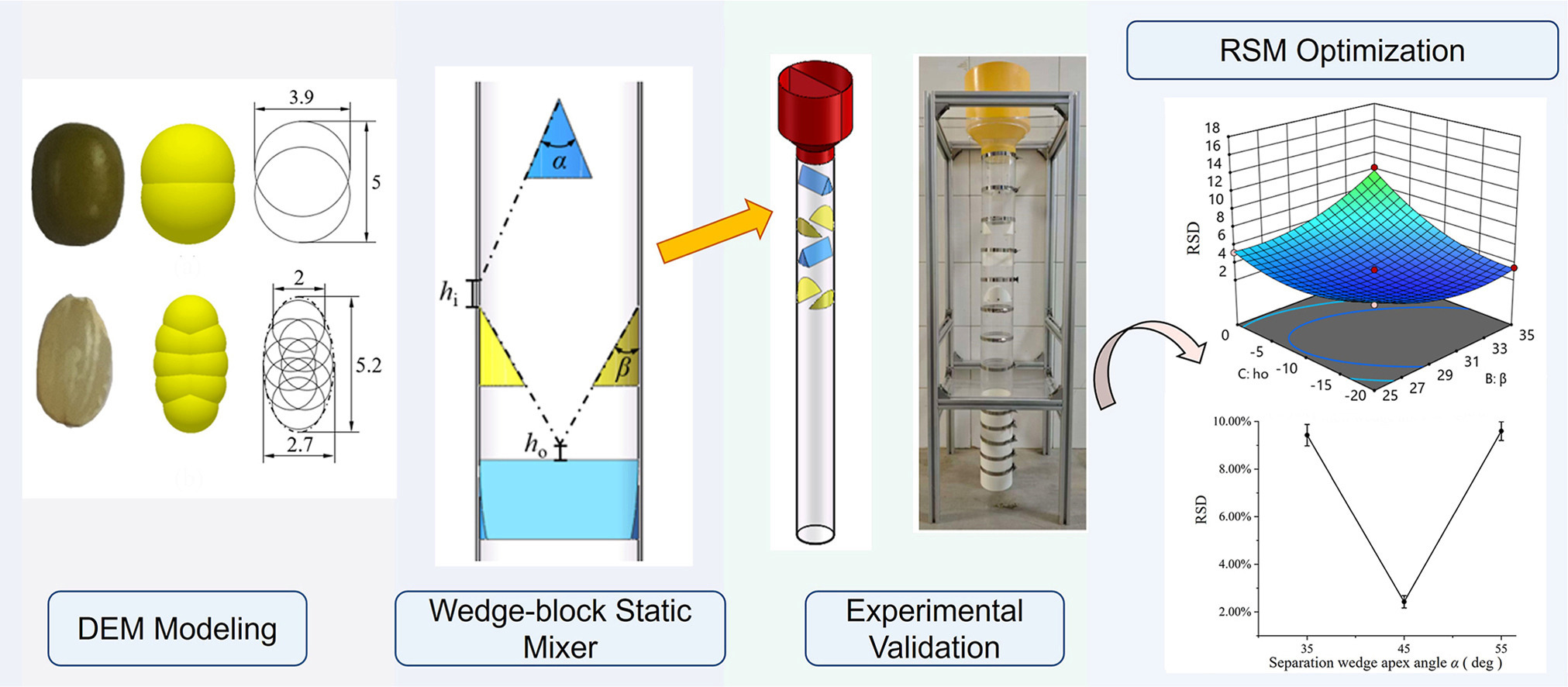
Efficient and homogeneous mixing of granular ingredients is critical for product quality and cost-effectiveness in the food and feed industries. Although wedge-block static mixers offer a promising solution, the specific influence of their geometric parameters on mixing performance remains underexplored. This study integrates Discrete Element Method (DEM) simulations with Response Surface Methodology (RSM) to optimize a wedge-block static mixer for blending mung beans and brown rice. Single-factor DEM analyses identified key structural variables, which were subsequently optimized via RSM and validated through bench-scale experiments. Results indicate that the apex angles of the separating and blending wedges, along with the inter-group focal distance, significantly govern particle trajectories and diffusion rates. The optimal configuration-comprising a separating wedge angle of 46.85°, a blending wedge angle of 30.73°, and a focal distance of −17.5 mm-yielded a Relative Standard Deviation (RSD) of 2.29% in simulations and 7.87% in experiments. Notably, the optimized design reduced the experimental RSD by 11.57% compared to the pre-optimized design, demonstrating a substantial enhancement in mixing uniformity. The close agreement between DEM predictions and experimental data validates the proposed approach. These findings provide a robust theoretical basis and practical guidelines for designing high-efficiency static mixers tailored for granular food processing.
Graphical abstract
Keywords
Static mixer; Granular food mixing; Discrete element method (DEM); Response surface methodology (RSM); Granular mixing; Mixing uniformity
文章导读