
期刊文章
过刊浏览
- Volumes 108-119 (2025)
-
Volumes 96-107 (2025)
-
Volume 107
Pages 1-376 (December 2025)
-
Volume 106
Pages 1-336 (November 2025)
-
Volume 105
Pages 1-356 (October 2025)
-
Volume 104
Pages 1-332 (September 2025)
-
Volume 103
Pages 1-314 (August 2025)
-
Volume 102
Pages 1-276 (July 2025)
-
Volume 101
Pages 1-166 (June 2025)
-
Volume 100
Pages 1-256 (May 2025)
-
Volume 99
Pages 1-242 (April 2025)
-
Volume 98
Pages 1-288 (March 2025)
-
Volume 97
Pages 1-256 (February 2025)
-
Volume 96
Pages 1-340 (January 2025)
-
Volume 107
-
Volumes 84-95 (2024)
-
Volume 95
Pages 1-392 (December 2024)
-
Volume 94
Pages 1-400 (November 2024)
-
Volume 93
Pages 1-376 (October 2024)
-
Volume 92
Pages 1-316 (September 2024)
-
Volume 91
Pages 1-378 (August 2024)
-
Volume 90
Pages 1-580 (July 2024)
-
Volume 89
Pages 1-278 (June 2024)
-
Volume 88
Pages 1-350 (May 2024)
-
Volume 87
Pages 1-338 (April 2024)
-
Volume 86
Pages 1-312 (March 2024)
-
Volume 85
Pages 1-334 (February 2024)
-
Volume 84
Pages 1-308 (January 2024)
-
Volume 95
-
Volumes 72-83 (2023)
-
Volume 83
Pages 1-258 (December 2023)
-
Volume 82
Pages 1-204 (November 2023)
-
Volume 81
Pages 1-188 (October 2023)
-
Volume 80
Pages 1-202 (September 2023)
-
Volume 79
Pages 1-172 (August 2023)
-
Volume 78
Pages 1-146 (July 2023)
-
Volume 77
Pages 1-152 (June 2023)
-
Volume 76
Pages 1-176 (May 2023)
-
Volume 75
Pages 1-228 (April 2023)
-
Volume 74
Pages 1-200 (March 2023)
-
Volume 73
Pages 1-138 (February 2023)
-
Volume 72
Pages 1-144 (January 2023)
-
Volume 83
-
Volumes 60-71 (2022)
-
Volume 71
Pages 1-108 (December 2022)
-
Volume 70
Pages 1-106 (November 2022)
-
Volume 69
Pages 1-122 (October 2022)
-
Volume 68
Pages 1-124 (September 2022)
-
Volume 67
Pages 1-102 (August 2022)
-
Volume 66
Pages 1-112 (July 2022)
-
Volume 65
Pages 1-138 (June 2022)
-
Volume 64
Pages 1-186 (May 2022)
-
Volume 63
Pages 1-124 (April 2022)
-
Volume 62
Pages 1-104 (March 2022)
-
Volume 61
Pages 1-120 (February 2022)
-
Volume 60
Pages 1-124 (January 2022)
-
Volume 71
- Volumes 54-59 (2021)
- Volumes 48-53 (2020)
- Volumes 42-47 (2019)
- Volumes 36-41 (2018)
- Volumes 30-35 (2017)
- Volumes 24-29 (2016)
- Volumes 18-23 (2015)
- Volumes 12-17 (2014)
- Volume 11 (2013)
- Volume 10 (2012)
- Volume 9 (2011)
- Volume 8 (2010)
- Volume 7 (2009)
- Volume 6 (2008)
- Volume 5 (2007)
- Volume 4 (2006)
- Volume 3 (2005)
- Volume 2 (2004)
- Volume 1 (2003)
Volume 116
Numerical and experimental study of shear dilation and force chain evolution of solid lubricant particles in die-wall lubrication
Wei Zhang a b *, Weichang Wu a b, Chenkang Lin a b, Kewen Cheng a b, Rongxin Chen a b, Guofu Lian a b
a School of Mechanical and Automotive Engineering, Fujian University of Technology, Fuzhou, 350118, China
b Fujian Key Laboratory of Intelligent Machining Technology and Equipment, Fujian University of Technology, Fuzhou, 350118, China
10.1016/j.partic.2026.06.015
Volume 116,
September 2026,
Pages 100-118
Received 19 April 2026, Revised 5 June 2026, Accepted 15 June 2026, Available online 19 June 2026, Version of Record 26 June 2026.
E-mail:
zw1256@fjut.edu.cn
Highlights
• A new method for classifying multilevel force chains by their strength is proposed.
• Shear dilation behavior of lubricating particles under various conditions.
• The die-wall lubricant particles in metal powder compaction have been identified as a quasi-static flow.
• Correlation between lubricant shear dilation and force chains.
• Distribution of multilevel force chains of die-wall lubricant particles in metal powder compaction is observed.
Abstract
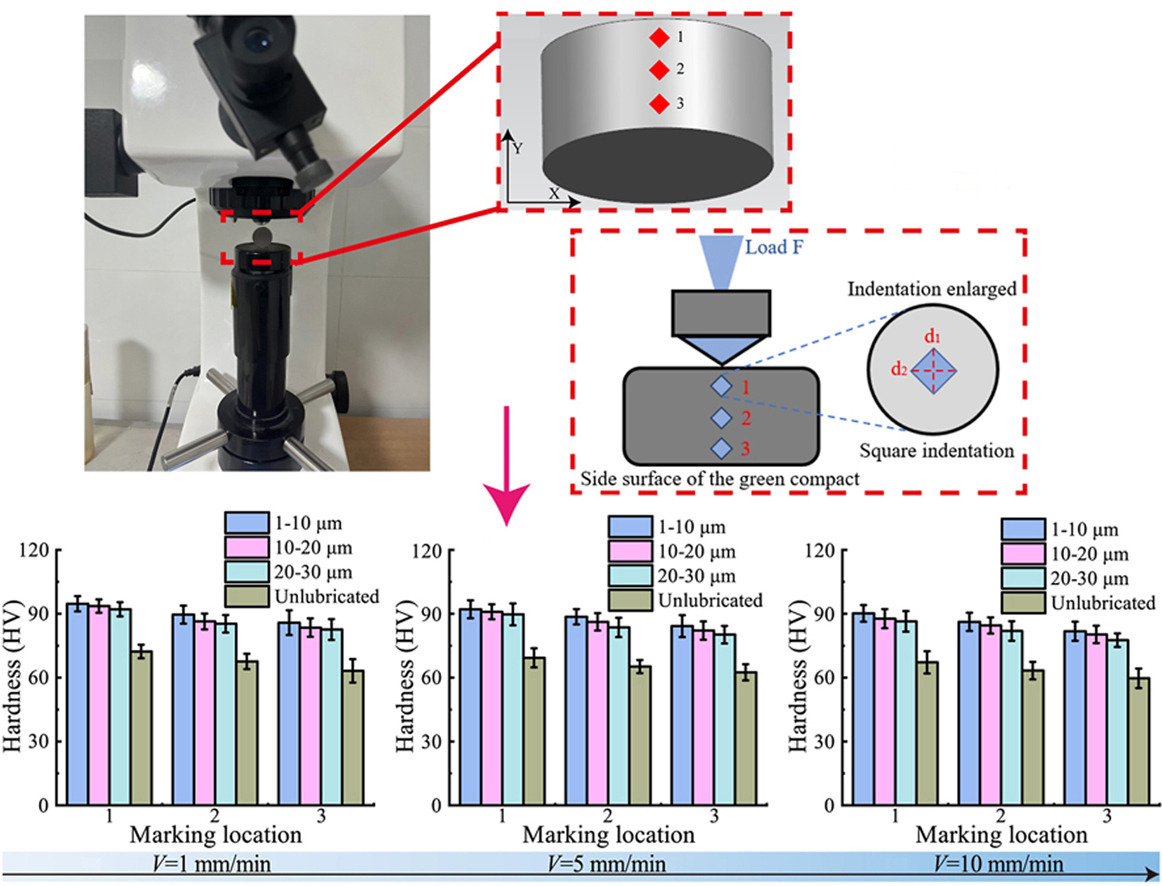
Based on an integrated discrete element (DEM) and experimental approach, this study elucidates the effect of die-wall lubrication on green compact surface quality in metal powder compaction. A novel mesoscopic method for multi-level force chain extraction was developed to bridge macroscopic lubrication behavior with force chain evolution. Key findings reveal that shear dilation exhibits non-monotonic dependence on shear pressure and increases with shear velocity, influenced more significantly by larger lubricant particles than by interparticle friction. Fine lubricant particles (1–10 μm) promote stable lubrication, whereas coarser particles induce surface damage during the positive dilatancy phase, exacerbated at higher velocities. With an inertial number ≤10−2 confirming quasi-static flow, fine particles form denser force chains with broader distribution, higher transmission index, and concentrated orientation in [50°, 80°], enhancing load-bearing capacity and lubrication performance. Increased shear dilation correlates with decreased force chain numbers, accompanied by rises in inertial coefficient and force chain fluctuations. Experimentally, lower shear velocity and finer particles produce compacts with superior hardness and density. This study investigates shear dilation and mesoscopic multi-level force chains during the die wall lubrication stage of metal powder compaction, thereby establishing a critical theoretical basis for optimized processing and improved green part quality.
Graphical abstract
Keywords
Powder compaction; Die-wall lubrication; Particulate materials; Shear dilation; Multi-level force chains
文章导读