
期刊文章
过刊浏览
- Volumes 108-119 (2025)
-
Volumes 96-107 (2025)
-
Volume 107
Pages 1-376 (December 2025)
-
Volume 106
Pages 1-336 (November 2025)
-
Volume 105
Pages 1-356 (October 2025)
-
Volume 104
Pages 1-332 (September 2025)
-
Volume 103
Pages 1-314 (August 2025)
-
Volume 102
Pages 1-276 (July 2025)
-
Volume 101
Pages 1-166 (June 2025)
-
Volume 100
Pages 1-256 (May 2025)
-
Volume 99
Pages 1-242 (April 2025)
-
Volume 98
Pages 1-288 (March 2025)
-
Volume 97
Pages 1-256 (February 2025)
-
Volume 96
Pages 1-340 (January 2025)
-
Volume 107
-
Volumes 84-95 (2024)
-
Volume 95
Pages 1-392 (December 2024)
-
Volume 94
Pages 1-400 (November 2024)
-
Volume 93
Pages 1-376 (October 2024)
-
Volume 92
Pages 1-316 (September 2024)
-
Volume 91
Pages 1-378 (August 2024)
-
Volume 90
Pages 1-580 (July 2024)
-
Volume 89
Pages 1-278 (June 2024)
-
Volume 88
Pages 1-350 (May 2024)
-
Volume 87
Pages 1-338 (April 2024)
-
Volume 86
Pages 1-312 (March 2024)
-
Volume 85
Pages 1-334 (February 2024)
-
Volume 84
Pages 1-308 (January 2024)
-
Volume 95
-
Volumes 72-83 (2023)
-
Volume 83
Pages 1-258 (December 2023)
-
Volume 82
Pages 1-204 (November 2023)
-
Volume 81
Pages 1-188 (October 2023)
-
Volume 80
Pages 1-202 (September 2023)
-
Volume 79
Pages 1-172 (August 2023)
-
Volume 78
Pages 1-146 (July 2023)
-
Volume 77
Pages 1-152 (June 2023)
-
Volume 76
Pages 1-176 (May 2023)
-
Volume 75
Pages 1-228 (April 2023)
-
Volume 74
Pages 1-200 (March 2023)
-
Volume 73
Pages 1-138 (February 2023)
-
Volume 72
Pages 1-144 (January 2023)
-
Volume 83
-
Volumes 60-71 (2022)
-
Volume 71
Pages 1-108 (December 2022)
-
Volume 70
Pages 1-106 (November 2022)
-
Volume 69
Pages 1-122 (October 2022)
-
Volume 68
Pages 1-124 (September 2022)
-
Volume 67
Pages 1-102 (August 2022)
-
Volume 66
Pages 1-112 (July 2022)
-
Volume 65
Pages 1-138 (June 2022)
-
Volume 64
Pages 1-186 (May 2022)
-
Volume 63
Pages 1-124 (April 2022)
-
Volume 62
Pages 1-104 (March 2022)
-
Volume 61
Pages 1-120 (February 2022)
-
Volume 60
Pages 1-124 (January 2022)
-
Volume 71
- Volumes 54-59 (2021)
- Volumes 48-53 (2020)
- Volumes 42-47 (2019)
- Volumes 36-41 (2018)
- Volumes 30-35 (2017)
- Volumes 24-29 (2016)
- Volumes 18-23 (2015)
- Volumes 12-17 (2014)
- Volume 11 (2013)
- Volume 10 (2012)
- Volume 9 (2011)
- Volume 8 (2010)
- Volume 7 (2009)
- Volume 6 (2008)
- Volume 5 (2007)
- Volume 4 (2006)
- Volume 3 (2005)
- Volume 2 (2004)
- Volume 1 (2003)
Volume 116
Dimensionless scaling of the penalty parameter for DEM–FEM volume coupling (Open Access)
Akhil Mathews a *, Hongyang Cheng b, Miguel Angel Celigueta c, Jin Y. Ooi a
a School of Engineering, Institute for Infrastructure and Environment, The University of Edinburgh, The King's Buildings, Edinburgh, EH9 3JL, United Kingdom
b Department of Civil Engineering & Management, Faculty of Engineering Technology, University of Twente, P.O. Box 217, Enschede, 7500 AE, the Netherlands
c Altair EDEM, Spain
10.1016/j.partic.2026.06.017
Volume 116,
September 2026,
Pages 119-125
Received 13 September 2025, Revised 9 June 2026, Accepted 16 June 2026, Available online 24 June 2026, Version of Record 29 June 2026.
E-mail:
amathews@ed.ac.uk
Highlights
• A compact scaling law sets the penalty parameter for DEM-FEM displacement continuity.
• Scaling verified across meshes, particle diameter, overlap sizes, and particle stiffness.
• At a dimensionless constant of ~10, mean stress matches ground truth DEM.
• Provides simple, portable rule for robust DEM–FEM hybrid coupling.
Abstract
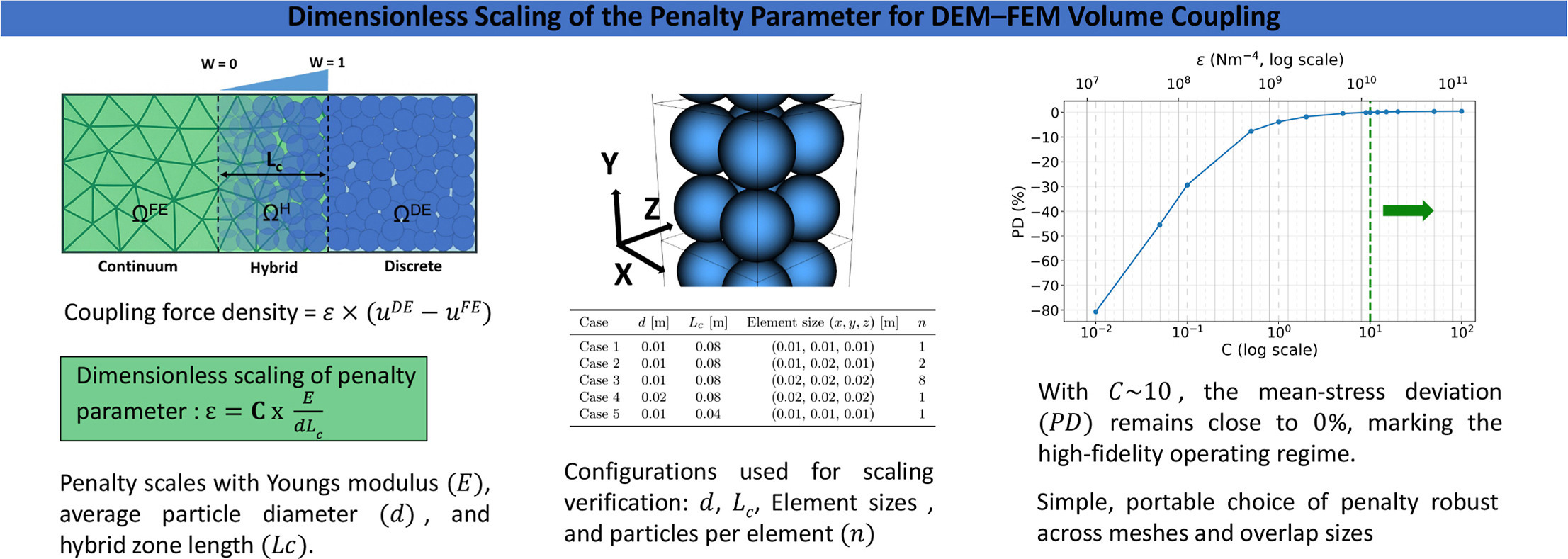
Hybrid DEM–FEM methods with overlapping domains offer accurate yet affordable modelling of dense granular systems. A key practical question is how to choose the coupling penalty parameter, which enforces displacement compatibility without polluting the overlap solution. We propose a compact, discretisation-agnostic scaling law that expresses penalty parameter as a dimensionless constant times the ratio of the effective modulus to the product of a characteristic particle size and the hybrid-zone thickness. When confinement effects are relevant, a multiplicative correction based on the effective Poisson's ratio and lateral-stress ratio can be included, though this has negligible impact for the results reported here. Verification on a one-dimensional monodisperse column and a confined polydisperse compaction demonstrates that the proposed scaling unifies penalty choices across varying mesh sizes and overlap thicknesses, and that a dimensionless constant of approximately 10 drives the mean-stress deviation to approximately 0% for the monodisperse cases and within 2.4% for the polydisperse case, reaching a saturation plateau beyond which further increases in penalty parameter bring no accuracy benefit. The rule provides a simple, portable recipe for selecting penalty parameter in DEM–FEM volume coupling.
Graphical abstract
Keywords
DEM–FEM coupling; Penalty method; Hybrid overlap; Scaling law; Granular mechanics
文章导读