
期刊文章
过刊浏览
- Volumes 108-119 (2025)
-
Volumes 96-107 (2025)
-
Volume 107
Pages 1-376 (December 2025)
-
Volume 106
Pages 1-336 (November 2025)
-
Volume 105
Pages 1-356 (October 2025)
-
Volume 104
Pages 1-332 (September 2025)
-
Volume 103
Pages 1-314 (August 2025)
-
Volume 102
Pages 1-276 (July 2025)
-
Volume 101
Pages 1-166 (June 2025)
-
Volume 100
Pages 1-256 (May 2025)
-
Volume 99
Pages 1-242 (April 2025)
-
Volume 98
Pages 1-288 (March 2025)
-
Volume 97
Pages 1-256 (February 2025)
-
Volume 96
Pages 1-340 (January 2025)
-
Volume 107
-
Volumes 84-95 (2024)
-
Volume 95
Pages 1-392 (December 2024)
-
Volume 94
Pages 1-400 (November 2024)
-
Volume 93
Pages 1-376 (October 2024)
-
Volume 92
Pages 1-316 (September 2024)
-
Volume 91
Pages 1-378 (August 2024)
-
Volume 90
Pages 1-580 (July 2024)
-
Volume 89
Pages 1-278 (June 2024)
-
Volume 88
Pages 1-350 (May 2024)
-
Volume 87
Pages 1-338 (April 2024)
-
Volume 86
Pages 1-312 (March 2024)
-
Volume 85
Pages 1-334 (February 2024)
-
Volume 84
Pages 1-308 (January 2024)
-
Volume 95
-
Volumes 72-83 (2023)
-
Volume 83
Pages 1-258 (December 2023)
-
Volume 82
Pages 1-204 (November 2023)
-
Volume 81
Pages 1-188 (October 2023)
-
Volume 80
Pages 1-202 (September 2023)
-
Volume 79
Pages 1-172 (August 2023)
-
Volume 78
Pages 1-146 (July 2023)
-
Volume 77
Pages 1-152 (June 2023)
-
Volume 76
Pages 1-176 (May 2023)
-
Volume 75
Pages 1-228 (April 2023)
-
Volume 74
Pages 1-200 (March 2023)
-
Volume 73
Pages 1-138 (February 2023)
-
Volume 72
Pages 1-144 (January 2023)
-
Volume 83
-
Volumes 60-71 (2022)
-
Volume 71
Pages 1-108 (December 2022)
-
Volume 70
Pages 1-106 (November 2022)
-
Volume 69
Pages 1-122 (October 2022)
-
Volume 68
Pages 1-124 (September 2022)
-
Volume 67
Pages 1-102 (August 2022)
-
Volume 66
Pages 1-112 (July 2022)
-
Volume 65
Pages 1-138 (June 2022)
-
Volume 64
Pages 1-186 (May 2022)
-
Volume 63
Pages 1-124 (April 2022)
-
Volume 62
Pages 1-104 (March 2022)
-
Volume 61
Pages 1-120 (February 2022)
-
Volume 60
Pages 1-124 (January 2022)
-
Volume 71
- Volumes 54-59 (2021)
- Volumes 48-53 (2020)
- Volumes 42-47 (2019)
- Volumes 36-41 (2018)
- Volumes 30-35 (2017)
- Volumes 24-29 (2016)
- Volumes 18-23 (2015)
- Volumes 12-17 (2014)
- Volume 11 (2013)
- Volume 10 (2012)
- Volume 9 (2011)
- Volume 8 (2010)
- Volume 7 (2009)
- Volume 6 (2008)
- Volume 5 (2007)
- Volume 4 (2006)
- Volume 3 (2005)
- Volume 2 (2004)
- Volume 1 (2003)
Volume 116
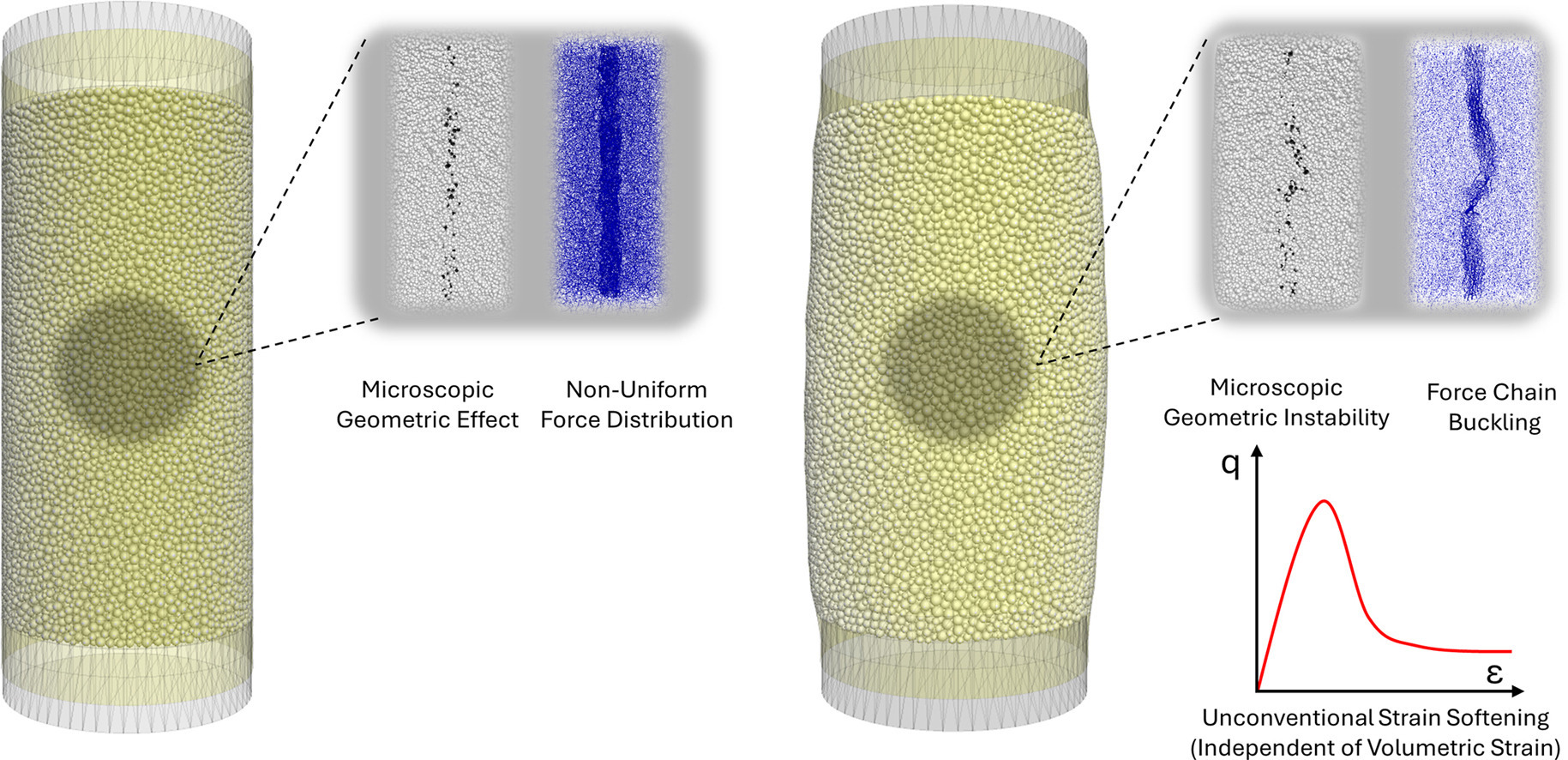
Micro-geometric instability of granular material: A DEM investigation on the buckling of force chain column
Liming Zheng a *, Fangzhou Liu a b, Dave H. Chan a
a Department of Civil and Environmental Engineering, University of Alberta, Edmonton, Alberta, Canada
b Department of Civil Engineering, McGill University, Montreal, Quebec, Canada
10.1016/j.partic.2026.06.019
Volume 116,
September 2026,
Pages 126-138
Received 11 March 2026, Revised 17 June 2026, Accepted 19 June 2026, Available online 24 June 2026, Version of Record 1 July 2026.
E-mail:
liming4@ualberta.ca
Highlights
• Non-uniform force distribution and force transmission can lead to a microscopic geometric instability effect.
• Microstructural geometric effect and instability can contribute to macroscopic failure.
• Geometric instability is an atypical form of strain softening that is independent of volumetric change.
Abstract
In the analysis of soil mechanical response, it is often assumed that the stress state and intergranular force transmission are uniform based on the continuum theory. However, at the microscopic scale, stress and force transmissions are inherently non-uniform. This non-uniformity can be attributed to material imperfections, soil fabric, and/or particle bonding. In this study, a 3D discrete element method (DEM) model is used to analyze the internal geometric instability of a soil. A geometric instability of a column analogous to Euler's Buckling Theory is introduced in the soil specimen. The results reveal that the observed instability mode arises from microstructural geometric effects rather than insufficient material strength, which has not been explicitly considered in conventional interpretations of soil microstructure. This suggests that a microscopic geometric instability of a soil alone may trigger a macroscopic global failure.
Graphical abstract
Keywords
Soil microstructural geometric effects; Geometric instability; Granular mechanics; Discrete element method; Euler's buckling theory
文章导读