
期刊文章
过刊浏览
- Volumes 108-119 (2025)
-
Volumes 96-107 (2025)
-
Volume 107
Pages 1-376 (December 2025)
-
Volume 106
Pages 1-336 (November 2025)
-
Volume 105
Pages 1-356 (October 2025)
-
Volume 104
Pages 1-332 (September 2025)
-
Volume 103
Pages 1-314 (August 2025)
-
Volume 102
Pages 1-276 (July 2025)
-
Volume 101
Pages 1-166 (June 2025)
-
Volume 100
Pages 1-256 (May 2025)
-
Volume 99
Pages 1-242 (April 2025)
-
Volume 98
Pages 1-288 (March 2025)
-
Volume 97
Pages 1-256 (February 2025)
-
Volume 96
Pages 1-340 (January 2025)
-
Volume 107
-
Volumes 84-95 (2024)
-
Volume 95
Pages 1-392 (December 2024)
-
Volume 94
Pages 1-400 (November 2024)
-
Volume 93
Pages 1-376 (October 2024)
-
Volume 92
Pages 1-316 (September 2024)
-
Volume 91
Pages 1-378 (August 2024)
-
Volume 90
Pages 1-580 (July 2024)
-
Volume 89
Pages 1-278 (June 2024)
-
Volume 88
Pages 1-350 (May 2024)
-
Volume 87
Pages 1-338 (April 2024)
-
Volume 86
Pages 1-312 (March 2024)
-
Volume 85
Pages 1-334 (February 2024)
-
Volume 84
Pages 1-308 (January 2024)
-
Volume 95
-
Volumes 72-83 (2023)
-
Volume 83
Pages 1-258 (December 2023)
-
Volume 82
Pages 1-204 (November 2023)
-
Volume 81
Pages 1-188 (October 2023)
-
Volume 80
Pages 1-202 (September 2023)
-
Volume 79
Pages 1-172 (August 2023)
-
Volume 78
Pages 1-146 (July 2023)
-
Volume 77
Pages 1-152 (June 2023)
-
Volume 76
Pages 1-176 (May 2023)
-
Volume 75
Pages 1-228 (April 2023)
-
Volume 74
Pages 1-200 (March 2023)
-
Volume 73
Pages 1-138 (February 2023)
-
Volume 72
Pages 1-144 (January 2023)
-
Volume 83
-
Volumes 60-71 (2022)
-
Volume 71
Pages 1-108 (December 2022)
-
Volume 70
Pages 1-106 (November 2022)
-
Volume 69
Pages 1-122 (October 2022)
-
Volume 68
Pages 1-124 (September 2022)
-
Volume 67
Pages 1-102 (August 2022)
-
Volume 66
Pages 1-112 (July 2022)
-
Volume 65
Pages 1-138 (June 2022)
-
Volume 64
Pages 1-186 (May 2022)
-
Volume 63
Pages 1-124 (April 2022)
-
Volume 62
Pages 1-104 (March 2022)
-
Volume 61
Pages 1-120 (February 2022)
-
Volume 60
Pages 1-124 (January 2022)
-
Volume 71
- Volumes 54-59 (2021)
- Volumes 48-53 (2020)
- Volumes 42-47 (2019)
- Volumes 36-41 (2018)
- Volumes 30-35 (2017)
- Volumes 24-29 (2016)
- Volumes 18-23 (2015)
- Volumes 12-17 (2014)
- Volume 11 (2013)
- Volume 10 (2012)
- Volume 9 (2011)
- Volume 8 (2010)
- Volume 7 (2009)
- Volume 6 (2008)
- Volume 5 (2007)
- Volume 4 (2006)
- Volume 3 (2005)
- Volume 2 (2004)
- Volume 1 (2003)
Volume 116
Efficient prediction method for erosion-corrosion damage in elbows of coal indirect liquefaction industrial pipelines
Liyun Zhu a, Yongchao Li a, Sheng Chen b, Meng He b, Jiarui Shi a, Zhongwei Liu a
a China University of Petroleum (East China), Qingdao, 266580, China
b Technology Innovation Center of Risk Prevention and Control of Refining and Chemical Equipment, State Administration for Market Regulation, China Special Equipment Inspection and Research Institute, Beijing, 100029, China
10.1016/j.partic.2026.06.021
Volume 116,
September 2026,
Pages 152-168
Received 18 January 2026, Revised 6 June 2026, Accepted 10 June 2026, Available online 27 June 2026, Version of Record 3 July 2026.
E-mail:
chensheng_csei@163.com
Highlights
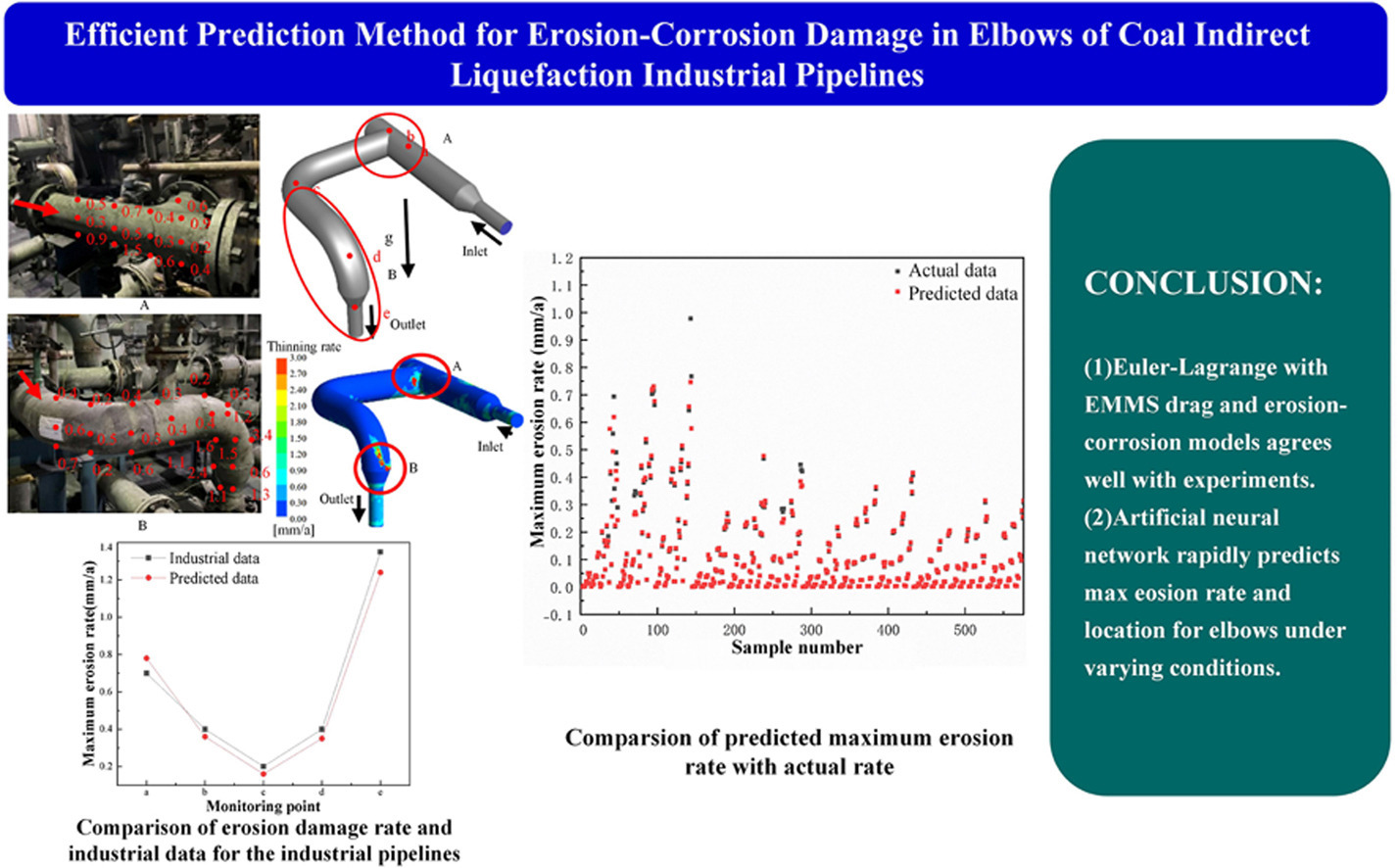
• Euler-Lagrange with EMMS drag and erosion-corrosion models agrees well with industrial data.
• Artificial Neural Network predicts maximum erosion rate and position for elbows under varying parameters.
• Inlet vorticity critically affects erosion rate and position, dictating flow range and damage shape.
Abstract
The elbow of indirect coal liquefaction pipelines is a high-risk area for coupled erosion-corrosion damage from liquid-solid two-phase flow, significantly impacting long-term safe operation. This study investigated coupled mechanisms under various spatial arrangements, structures, and operating parameters using an Euler-Lagrange CFD method incorporating an EMMS drag and corrosion factor correction model. Additionally, four neural models were developed for rapid prediction of maximum erosion rate and location based on extensive simulation data. Results indicate that erosion-affected zone distributions remained consistent across three spatial arrangements with increasing inlet velocity, particle concentration, and corrosion factor, while maximum erosion rate increased. As bend angle increased, the most severe erosion shifted farther from the outlet, with 45° elbows showing lower maximum erosion rates than 90° and 180° configurations. Fluid vorticity elevated maximum erosion rates and transformed erosion patterns from strip-like to cluster-like. The RIME-BP model achieved superior prediction accuracy for maximum erosion rate (R2 ≈ 0.91, RPD >3) and location (R2 > 0.99, 95% residuals within ±2) compared to BP, PSO-BP, and SSA-BP models. This neural network-based method enables rapid damage assessment while considerably improving erosion prediction, monitoring, inspection, and risk prevention efficiency.
Graphical abstract
Keywords
Liquid-solid two-phase flow; Coupled erosion-corrosion model; EMMS; RIME-BP
文章导读