
期刊文章
过刊浏览
- Volumes 108-119 (2025)
-
Volumes 96-107 (2025)
-
Volume 107
Pages 1-376 (December 2025)
-
Volume 106
Pages 1-336 (November 2025)
-
Volume 105
Pages 1-356 (October 2025)
-
Volume 104
Pages 1-332 (September 2025)
-
Volume 103
Pages 1-314 (August 2025)
-
Volume 102
Pages 1-276 (July 2025)
-
Volume 101
Pages 1-166 (June 2025)
-
Volume 100
Pages 1-256 (May 2025)
-
Volume 99
Pages 1-242 (April 2025)
-
Volume 98
Pages 1-288 (March 2025)
-
Volume 97
Pages 1-256 (February 2025)
-
Volume 96
Pages 1-340 (January 2025)
-
Volume 107
-
Volumes 84-95 (2024)
-
Volume 95
Pages 1-392 (December 2024)
-
Volume 94
Pages 1-400 (November 2024)
-
Volume 93
Pages 1-376 (October 2024)
-
Volume 92
Pages 1-316 (September 2024)
-
Volume 91
Pages 1-378 (August 2024)
-
Volume 90
Pages 1-580 (July 2024)
-
Volume 89
Pages 1-278 (June 2024)
-
Volume 88
Pages 1-350 (May 2024)
-
Volume 87
Pages 1-338 (April 2024)
-
Volume 86
Pages 1-312 (March 2024)
-
Volume 85
Pages 1-334 (February 2024)
-
Volume 84
Pages 1-308 (January 2024)
-
Volume 95
-
Volumes 72-83 (2023)
-
Volume 83
Pages 1-258 (December 2023)
-
Volume 82
Pages 1-204 (November 2023)
-
Volume 81
Pages 1-188 (October 2023)
-
Volume 80
Pages 1-202 (September 2023)
-
Volume 79
Pages 1-172 (August 2023)
-
Volume 78
Pages 1-146 (July 2023)
-
Volume 77
Pages 1-152 (June 2023)
-
Volume 76
Pages 1-176 (May 2023)
-
Volume 75
Pages 1-228 (April 2023)
-
Volume 74
Pages 1-200 (March 2023)
-
Volume 73
Pages 1-138 (February 2023)
-
Volume 72
Pages 1-144 (January 2023)
-
Volume 83
-
Volumes 60-71 (2022)
-
Volume 71
Pages 1-108 (December 2022)
-
Volume 70
Pages 1-106 (November 2022)
-
Volume 69
Pages 1-122 (October 2022)
-
Volume 68
Pages 1-124 (September 2022)
-
Volume 67
Pages 1-102 (August 2022)
-
Volume 66
Pages 1-112 (July 2022)
-
Volume 65
Pages 1-138 (June 2022)
-
Volume 64
Pages 1-186 (May 2022)
-
Volume 63
Pages 1-124 (April 2022)
-
Volume 62
Pages 1-104 (March 2022)
-
Volume 61
Pages 1-120 (February 2022)
-
Volume 60
Pages 1-124 (January 2022)
-
Volume 71
- Volumes 54-59 (2021)
- Volumes 48-53 (2020)
- Volumes 42-47 (2019)
- Volumes 36-41 (2018)
- Volumes 30-35 (2017)
- Volumes 24-29 (2016)
- Volumes 18-23 (2015)
- Volumes 12-17 (2014)
- Volume 11 (2013)
- Volume 10 (2012)
- Volume 9 (2011)
- Volume 8 (2010)
- Volume 7 (2009)
- Volume 6 (2008)
- Volume 5 (2007)
- Volume 4 (2006)
- Volume 3 (2005)
- Volume 2 (2004)
- Volume 1 (2003)
Volume 116
Rheology of one-part carbide slag-sodium silicate activated slag pastes: Mechanisms and modeling informed by interfacial electrical properties and solution chemistry
Zuodong Cheng a b, Yingli Gao a b *, Jin Zhang a b, Yuelin Li a b, Weixiang Liu a b, Yehua Liu a b
a Hunan Provincial Engineering Technology Research Center for Novel and Carbon Neutral Road Material, Changsha University of Science & Technology, Changsha, 410114, China
b School of Transportation, Changsha University of Science & Technology, Changsha, 410114, China
10.1016/j.partic.2026.06.020
Volume 116,
September 2026,
Pages 169-187
September 2026
E-mail:
yingligao509@126.com
Highlights
• Zeta potential and pH were insufficient to explain CSAS rheology.
• Ca-Na-Si balance and ionic dilution controlled CSAS rheology.
• Dispersion, structuration and dilution defined three control pathways.
• A reduced parameter quantified electro-structuration balance in CSAS paste.
• Mechanism-constrained models for rheological parameters were established.
Abstract
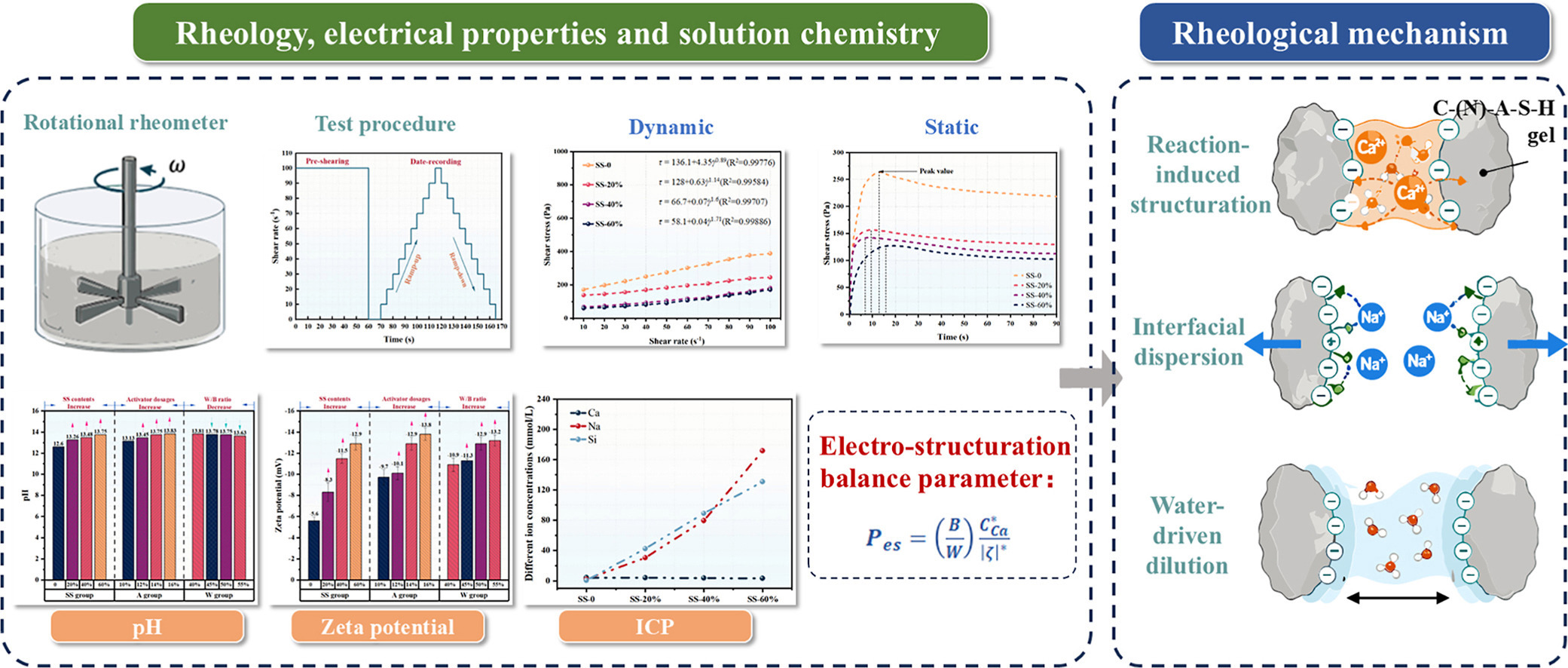
This study investigates the effects of sodium silicate content, activator dosage and water-to-binder ratio on the flowability and rheology of one-part carbide slag-sodium silicate activated slag (CSAS) pastes, and elucidates the mechanisms using interfacial electrical properties and solution chemistry. Increasing sodium silicate content and water-to-binder ratio decreased static yield stress, dynamic yield stress, plastic viscosity and thixotropy, whereas higher activator dosage increased flow resistance and thixotropic response. A correlation model between flowability, dynamic yield stress and plastic viscosity showed satisfactory fitting. All pastes had negative zeta potentials, while pH maintained the alkaline activation environment. Higher sodium silicate content shifted the pore solution from Ca-rich to Na-silicate-rich, weakened Ca-mediated bridging and enhanced dispersion. Higher activator dosage increased Ca, Na and dissolved Si concentrations, promoting reaction-induced structuring, whereas higher water-to-binder ratio weakened structural connectivity through ionic dilution, thicker water films and larger interparticle spacing. CSAS paste rheology is governed by the balance among interfacial dispersion, reaction-induced structuration and water-driven dilution. A reduced parameter for Ca-driven structuring and negative-charge-driven dispersion enabled mechanism-constrained models, with R2 values of 0.903, 0.857 and 0.801. These findings support rheology-oriented mix design of low-carbon one-part CSAS materials.
Graphical abstract
Keywords
Carbide slag; Sodium silicate; Interfacial electrical properties; Solution chemistry; Rheological mechanism and models
文章导读