
期刊文章
过刊浏览
- Volumes 108-119 (2025)
-
Volumes 96-107 (2025)
-
Volume 107
Pages 1-376 (December 2025)
-
Volume 106
Pages 1-336 (November 2025)
-
Volume 105
Pages 1-356 (October 2025)
-
Volume 104
Pages 1-332 (September 2025)
-
Volume 103
Pages 1-314 (August 2025)
-
Volume 102
Pages 1-276 (July 2025)
-
Volume 101
Pages 1-166 (June 2025)
-
Volume 100
Pages 1-256 (May 2025)
-
Volume 99
Pages 1-242 (April 2025)
-
Volume 98
Pages 1-288 (March 2025)
-
Volume 97
Pages 1-256 (February 2025)
-
Volume 96
Pages 1-340 (January 2025)
-
Volume 107
-
Volumes 84-95 (2024)
-
Volume 95
Pages 1-392 (December 2024)
-
Volume 94
Pages 1-400 (November 2024)
-
Volume 93
Pages 1-376 (October 2024)
-
Volume 92
Pages 1-316 (September 2024)
-
Volume 91
Pages 1-378 (August 2024)
-
Volume 90
Pages 1-580 (July 2024)
-
Volume 89
Pages 1-278 (June 2024)
-
Volume 88
Pages 1-350 (May 2024)
-
Volume 87
Pages 1-338 (April 2024)
-
Volume 86
Pages 1-312 (March 2024)
-
Volume 85
Pages 1-334 (February 2024)
-
Volume 84
Pages 1-308 (January 2024)
-
Volume 95
-
Volumes 72-83 (2023)
-
Volume 83
Pages 1-258 (December 2023)
-
Volume 82
Pages 1-204 (November 2023)
-
Volume 81
Pages 1-188 (October 2023)
-
Volume 80
Pages 1-202 (September 2023)
-
Volume 79
Pages 1-172 (August 2023)
-
Volume 78
Pages 1-146 (July 2023)
-
Volume 77
Pages 1-152 (June 2023)
-
Volume 76
Pages 1-176 (May 2023)
-
Volume 75
Pages 1-228 (April 2023)
-
Volume 74
Pages 1-200 (March 2023)
-
Volume 73
Pages 1-138 (February 2023)
-
Volume 72
Pages 1-144 (January 2023)
-
Volume 83
-
Volumes 60-71 (2022)
-
Volume 71
Pages 1-108 (December 2022)
-
Volume 70
Pages 1-106 (November 2022)
-
Volume 69
Pages 1-122 (October 2022)
-
Volume 68
Pages 1-124 (September 2022)
-
Volume 67
Pages 1-102 (August 2022)
-
Volume 66
Pages 1-112 (July 2022)
-
Volume 65
Pages 1-138 (June 2022)
-
Volume 64
Pages 1-186 (May 2022)
-
Volume 63
Pages 1-124 (April 2022)
-
Volume 62
Pages 1-104 (March 2022)
-
Volume 61
Pages 1-120 (February 2022)
-
Volume 60
Pages 1-124 (January 2022)
-
Volume 71
- Volumes 54-59 (2021)
- Volumes 48-53 (2020)
- Volumes 42-47 (2019)
- Volumes 36-41 (2018)
- Volumes 30-35 (2017)
- Volumes 24-29 (2016)
- Volumes 18-23 (2015)
- Volumes 12-17 (2014)
- Volume 11 (2013)
- Volume 10 (2012)
- Volume 9 (2011)
- Volume 8 (2010)
- Volume 7 (2009)
- Volume 6 (2008)
- Volume 5 (2007)
- Volume 4 (2006)
- Volume 3 (2005)
- Volume 2 (2004)
- Volume 1 (2003)
Volume 116
Elucidating the mesoscopic kinetics of seed pelleting via a moisture-driven dynamic cohesion DEM model
Zilong Jia a, Ziyuan Fang a, Weiqi Lu a, Youming Yang a, Yubin Bi a b, Yuxiang Huang a b *
a College of Mechanical and Electronic Engineering, Northwest A&F University, Yangling, 712100, China
b Hainan Institute of Northwest A&F University, Sanya, 572000, China
10.1016/j.partic.2026.06.024
Volume 116,
September 2026,
Pages 188-201
Received 7 April 2026, Revised 3 June 2026, Accepted 19 June 2026, Available online 27 June 2026, Version of Record 3 July 2026.
E-mail:
hyx@nwsuaf.edu.cn
Highlights
• A novel moisture-driven dynamic cohesion DEM model for seed pelleting is proposed.
• Cohesion is self-adaptively updated via API based on time-varying moisture.
• Mesoscopic kinetics of nucleation, growth, and consolidation are characterized.
• Radial distribution deviation provides structural evidence for densification.
Abstract
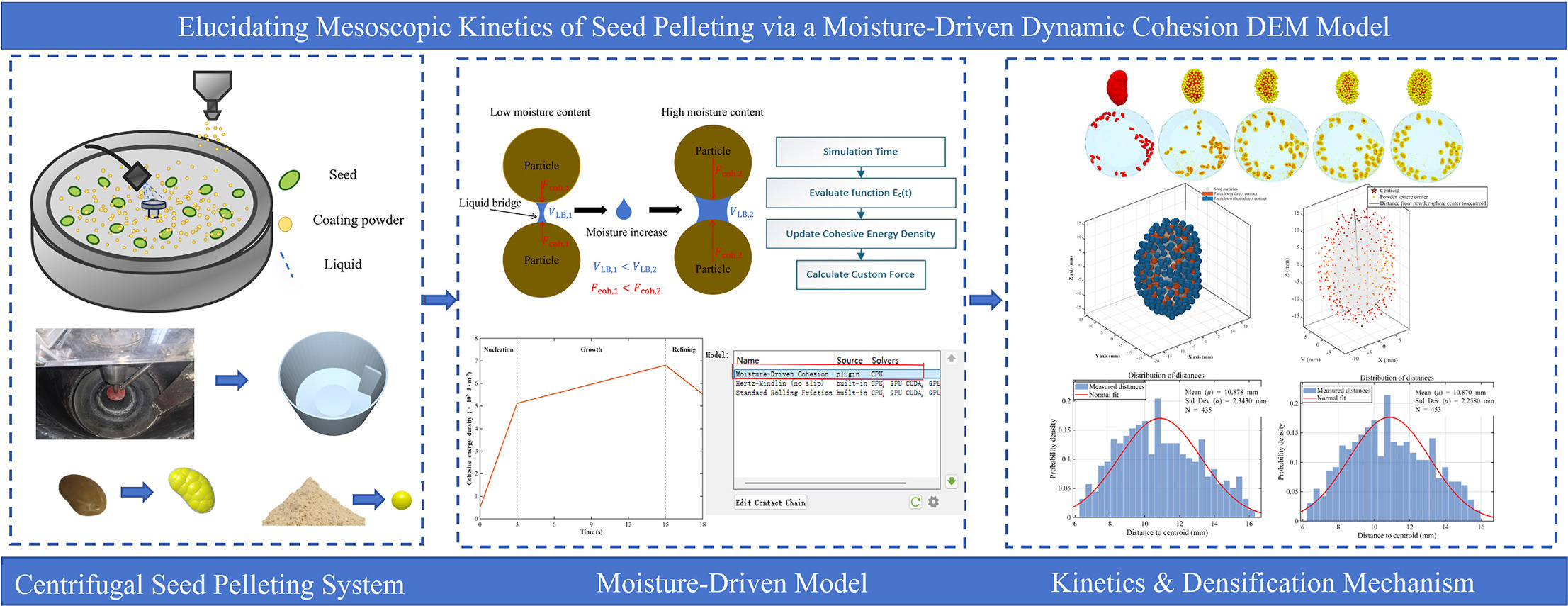
Seed pelleting is essential for precision agriculture, but DEM simulation remains challenging because wet-powder cohesion evolves with moisture rather than remaining constant. This study developed a moisture-driven dynamic cohesion DEM framework based on an experimental-to-numerical inversion strategy. During physical pelleting, the time-varying moisture content of the coating powder, was measured by oven drying and mapped onto the compressed DEM timescale. At representative moisture levels, angle-of-repose tests were performed and corresponding DEM simulations were inversely calibrated to back-calculate the equivalent cohesive energy density, yielding a time-dependent cohesion function. This function was implemented in EDEM through a customized C++ API to update contact cohesion automatically. A Bond-number-conserved differential coarse-graining strategy was also introduced to reduce computational cost while preserving cohesive similarity. The model was validated under different operating conditions. The simulated inter-pellet coefficient of variation in coating mass was strongly and negatively correlated with the experimental qualification rate (R2 = 0.89). Under optimized conditions of 918 rpm pan speed, 1.94 g powder feed, and 0.53 g liquid supply, the qualification rate reached 94.8%, with a relative prediction error of 2.4%. Mesoscopically, the model reproduced primary adhesion, secondary layering, and refining-induced densification.
Graphical abstract
Keywords
Discrete element method (DEM); Seed pelleting; Coarse-graining scaling; Moisture-driven cohesion model; Mesoscopic consolidation mechanism
文章导读