
期刊文章
过刊浏览
- Volumes 108-119 (2025)
-
Volumes 96-107 (2025)
-
Volume 107
Pages 1-376 (December 2025)
-
Volume 106
Pages 1-336 (November 2025)
-
Volume 105
Pages 1-356 (October 2025)
-
Volume 104
Pages 1-332 (September 2025)
-
Volume 103
Pages 1-314 (August 2025)
-
Volume 102
Pages 1-276 (July 2025)
-
Volume 101
Pages 1-166 (June 2025)
-
Volume 100
Pages 1-256 (May 2025)
-
Volume 99
Pages 1-242 (April 2025)
-
Volume 98
Pages 1-288 (March 2025)
-
Volume 97
Pages 1-256 (February 2025)
-
Volume 96
Pages 1-340 (January 2025)
-
Volume 107
-
Volumes 84-95 (2024)
-
Volume 95
Pages 1-392 (December 2024)
-
Volume 94
Pages 1-400 (November 2024)
-
Volume 93
Pages 1-376 (October 2024)
-
Volume 92
Pages 1-316 (September 2024)
-
Volume 91
Pages 1-378 (August 2024)
-
Volume 90
Pages 1-580 (July 2024)
-
Volume 89
Pages 1-278 (June 2024)
-
Volume 88
Pages 1-350 (May 2024)
-
Volume 87
Pages 1-338 (April 2024)
-
Volume 86
Pages 1-312 (March 2024)
-
Volume 85
Pages 1-334 (February 2024)
-
Volume 84
Pages 1-308 (January 2024)
-
Volume 95
-
Volumes 72-83 (2023)
-
Volume 83
Pages 1-258 (December 2023)
-
Volume 82
Pages 1-204 (November 2023)
-
Volume 81
Pages 1-188 (October 2023)
-
Volume 80
Pages 1-202 (September 2023)
-
Volume 79
Pages 1-172 (August 2023)
-
Volume 78
Pages 1-146 (July 2023)
-
Volume 77
Pages 1-152 (June 2023)
-
Volume 76
Pages 1-176 (May 2023)
-
Volume 75
Pages 1-228 (April 2023)
-
Volume 74
Pages 1-200 (March 2023)
-
Volume 73
Pages 1-138 (February 2023)
-
Volume 72
Pages 1-144 (January 2023)
-
Volume 83
-
Volumes 60-71 (2022)
-
Volume 71
Pages 1-108 (December 2022)
-
Volume 70
Pages 1-106 (November 2022)
-
Volume 69
Pages 1-122 (October 2022)
-
Volume 68
Pages 1-124 (September 2022)
-
Volume 67
Pages 1-102 (August 2022)
-
Volume 66
Pages 1-112 (July 2022)
-
Volume 65
Pages 1-138 (June 2022)
-
Volume 64
Pages 1-186 (May 2022)
-
Volume 63
Pages 1-124 (April 2022)
-
Volume 62
Pages 1-104 (March 2022)
-
Volume 61
Pages 1-120 (February 2022)
-
Volume 60
Pages 1-124 (January 2022)
-
Volume 71
- Volumes 54-59 (2021)
- Volumes 48-53 (2020)
- Volumes 42-47 (2019)
- Volumes 36-41 (2018)
- Volumes 30-35 (2017)
- Volumes 24-29 (2016)
- Volumes 18-23 (2015)
- Volumes 12-17 (2014)
- Volume 11 (2013)
- Volume 10 (2012)
- Volume 9 (2011)
- Volume 8 (2010)
- Volume 7 (2009)
- Volume 6 (2008)
- Volume 5 (2007)
- Volume 4 (2006)
- Volume 3 (2005)
- Volume 2 (2004)
- Volume 1 (2003)
Volume 116
Strongly nonlinear pulse attenuation in microgranular chains with fractional contact dissipation
Dong Feng, Kai Zheng *
RWTH Aachen University, Mies-van-der-Rohe-Straße 1, 52074, Aachen, Germany
10.1016/j.partic.2026.06.009
Volume 116,
September 2026,
Pages 202-213
Received 3 April 2026, Revised 4 June 2026, Accepted 8 June 2026, Available online 13 June 2026, Version of Record 4 July 2026.
E-mail:
kai.zheng@rwth-aachen.de
Highlights
• Fractional contact dissipation captures coating-induced memory in microgranular contacts.
• Memory damping reshapes pulse decay from near-exponential behavior to anomalous power-law trends.
• A truncated Grünwald–Letnikov scheme enables efficient history-dependent simulations.
• The memory order and strength tune attenuation and pulse broadening in nonlinear lattices.
Abstract
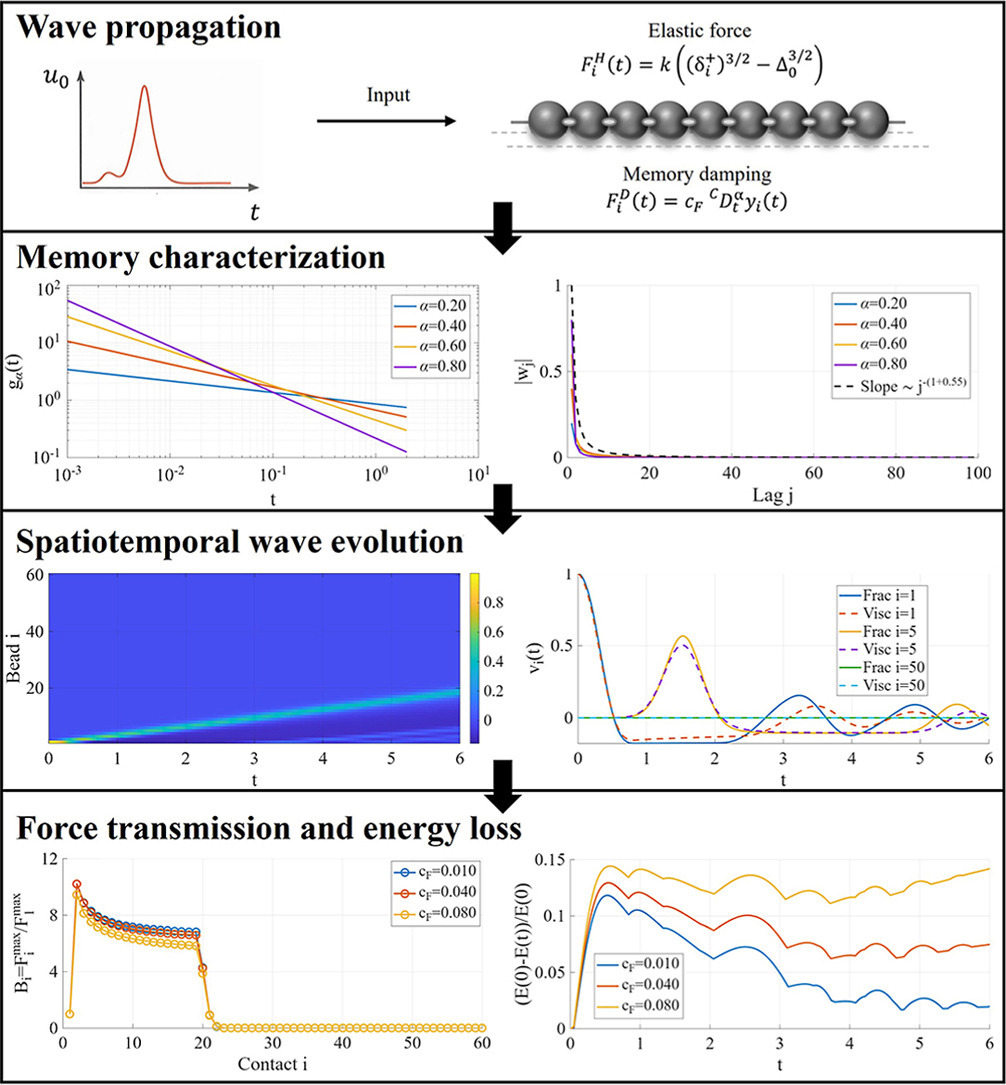
Microgranular chains provide a useful platform for controlling impact pulses and wave transmission in microscale granular metamaterials, where interfacial coatings, adsorbed layers, and adhesive junctions can strongly affect contact dissipation. However, most existing granular-chain models still rely on local, memoryless damping laws and therefore cannot adequately describe broad relaxation spectra and long-tailed memory effects at microcontacts. This study aims to clarify how non-Markovian contact dissipation modifies strongly nonlinear pulse attenuation and waveform evolution. A one-dimensional precompressed chain of identical microspheres is formulated by combining Hertzian contact nonlinearity with a Caputo-type fractional contact dissipation law. The resulting history-dependent lattice is solved using an explicit time-stepping scheme coupled with a truncated Grünwald–Letnikov convolution, and its response is compared with that of a classical viscous reference model subjected to impact excitation. The results show that fractional dissipation produces nonuniform attenuation, persistent post-peak tails, and pronounced pulse broadening that cannot be reproduced by local viscous damping. Increasing the dissipation strength reduces transmitted peak velocities and contact forces while increasing cumulative energy loss. Overall, the main contributions of this study are the development of a fractional contact-dissipation model for microgranular chains, the implementation of an efficient truncated Grünwald–Letnikov scheme, and the demonstration that contact memory provides an effective mechanism for controlling pulse attenuation, broadening, and energy loss.
Graphical abstract
Keywords
Microgranular chains; Fractional dissipation; Memory effects; Grünwald–Letnikov convolution
文章导读