
期刊文章
过刊浏览
- Volumes 108-119 (2025)
-
Volumes 96-107 (2025)
-
Volume 107
Pages 1-376 (December 2025)
-
Volume 106
Pages 1-336 (November 2025)
-
Volume 105
Pages 1-356 (October 2025)
-
Volume 104
Pages 1-332 (September 2025)
-
Volume 103
Pages 1-314 (August 2025)
-
Volume 102
Pages 1-276 (July 2025)
-
Volume 101
Pages 1-166 (June 2025)
-
Volume 100
Pages 1-256 (May 2025)
-
Volume 99
Pages 1-242 (April 2025)
-
Volume 98
Pages 1-288 (March 2025)
-
Volume 97
Pages 1-256 (February 2025)
-
Volume 96
Pages 1-340 (January 2025)
-
Volume 107
-
Volumes 84-95 (2024)
-
Volume 95
Pages 1-392 (December 2024)
-
Volume 94
Pages 1-400 (November 2024)
-
Volume 93
Pages 1-376 (October 2024)
-
Volume 92
Pages 1-316 (September 2024)
-
Volume 91
Pages 1-378 (August 2024)
-
Volume 90
Pages 1-580 (July 2024)
-
Volume 89
Pages 1-278 (June 2024)
-
Volume 88
Pages 1-350 (May 2024)
-
Volume 87
Pages 1-338 (April 2024)
-
Volume 86
Pages 1-312 (March 2024)
-
Volume 85
Pages 1-334 (February 2024)
-
Volume 84
Pages 1-308 (January 2024)
-
Volume 95
-
Volumes 72-83 (2023)
-
Volume 83
Pages 1-258 (December 2023)
-
Volume 82
Pages 1-204 (November 2023)
-
Volume 81
Pages 1-188 (October 2023)
-
Volume 80
Pages 1-202 (September 2023)
-
Volume 79
Pages 1-172 (August 2023)
-
Volume 78
Pages 1-146 (July 2023)
-
Volume 77
Pages 1-152 (June 2023)
-
Volume 76
Pages 1-176 (May 2023)
-
Volume 75
Pages 1-228 (April 2023)
-
Volume 74
Pages 1-200 (March 2023)
-
Volume 73
Pages 1-138 (February 2023)
-
Volume 72
Pages 1-144 (January 2023)
-
Volume 83
-
Volumes 60-71 (2022)
-
Volume 71
Pages 1-108 (December 2022)
-
Volume 70
Pages 1-106 (November 2022)
-
Volume 69
Pages 1-122 (October 2022)
-
Volume 68
Pages 1-124 (September 2022)
-
Volume 67
Pages 1-102 (August 2022)
-
Volume 66
Pages 1-112 (July 2022)
-
Volume 65
Pages 1-138 (June 2022)
-
Volume 64
Pages 1-186 (May 2022)
-
Volume 63
Pages 1-124 (April 2022)
-
Volume 62
Pages 1-104 (March 2022)
-
Volume 61
Pages 1-120 (February 2022)
-
Volume 60
Pages 1-124 (January 2022)
-
Volume 71
- Volumes 54-59 (2021)
- Volumes 48-53 (2020)
- Volumes 42-47 (2019)
- Volumes 36-41 (2018)
- Volumes 30-35 (2017)
- Volumes 24-29 (2016)
- Volumes 18-23 (2015)
- Volumes 12-17 (2014)
- Volume 11 (2013)
- Volume 10 (2012)
- Volume 9 (2011)
- Volume 8 (2010)
- Volume 7 (2009)
- Volume 6 (2008)
- Volume 5 (2007)
- Volume 4 (2006)
- Volume 3 (2005)
- Volume 2 (2004)
- Volume 1 (2003)
Volume 116
From particle dynamics to process optimization: Effect of roller on powder spreading in laser beam powder bed fusion of molybdenum
Ge Yu a, Kefan Cao b, Meng Li a, Deyu Yue a, Jun Wen a, Xizhong An a *
a Key Laboratory for Ecological Metallurgy of Multimetallic Mineral of Ministry of Education, School of Metallurgy, Northeastern University, Shenyang, 110819, China
b The 13th Research Institute of China Electronics Technology Group Corporation, Shijiazhuang, 050051, China
10.1016/j.partic.2026.06.025
Volume 116,
September 2026,
Pages 214-226
Received 8 May 2026, Revised 23 June 2026, Accepted 24 June 2026, Available online 30 June 2026, Version of Record 6 July 2026.
E-mail:
anxz@mail.neu.edu.cn
Highlights
• Coupled spreading parameters controls Mo powder bed quality in PBF-LB.
• Moderate roller rotation improves particle rearrangement via convective loops.
• High spreading parameters induces powder ejection, unstable flow, and larger pores.
• Five optimal trade-off solutions are presented based on Pareto front algorithm.
• Velocity dominates densification, and parameters interaction governs uniformity.
Abstract
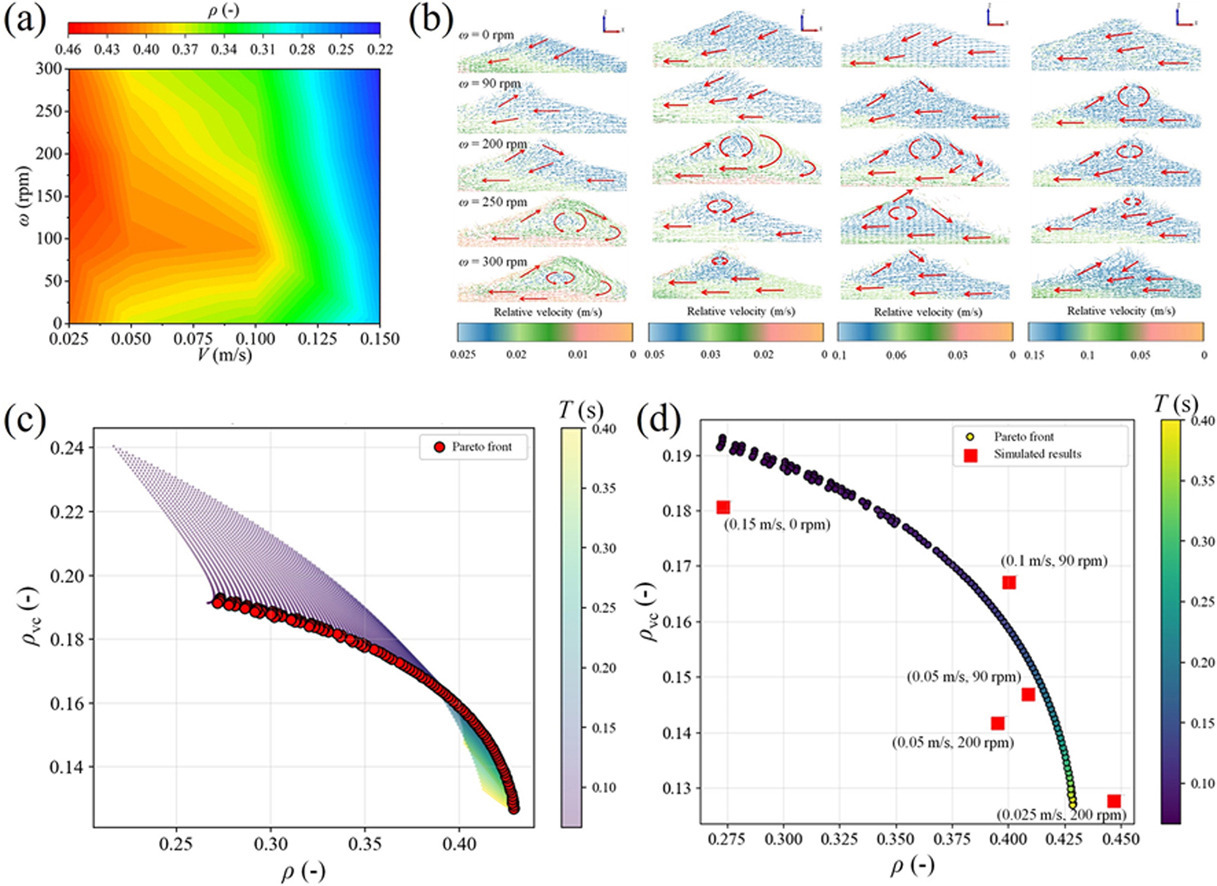
The powder spreading process critically influences the quality and reliability of laser beam powder bed fusion of molybdenum. Compared with the blade spreader, the roller spreader shows its specific characteristics in improving powder bed performance. In this study, the coupled effects of spreading velocity and rotation speed of the roller on powder bed formation are systematically investigated using the discrete element method. Powder bed properties are evaluated in terms of packing density, uniformity, surface roughness, and pore structure. The results reveal that powder bed characteristics are governed by the interaction between spreading velocity and rotation speed. At low spreading velocities, moderate roller rotation enhances particle rearrangement through convective motion, leading to improved packing density and uniformity. Mechanism analysis shows that roller rotation alters particle transport from translational motion to vortical flow, while the evolution of contact force networks reflects a balance between force disruption and transmission. A multi-objective optimization framework based on Pareto analysis identifies optimal parameter regimes that balance deposition efficiency and powder bed quality. Statistical analysis further quantitatively confirms that spreading velocity dominates densification, whereas the interaction of spreading velocity and rotation speed plays a critical role in governing uniformity.
Graphical abstract
Keywords
DEM simulation; Roller-based powder spreading; Mechanism analysis; Pareto front algorithm; Statistical analysis
文章导读