
期刊文章
过刊浏览
- Volumes 108-119 (2025)
-
Volumes 96-107 (2025)
-
Volume 107
Pages 1-376 (December 2025)
-
Volume 106
Pages 1-336 (November 2025)
-
Volume 105
Pages 1-356 (October 2025)
-
Volume 104
Pages 1-332 (September 2025)
-
Volume 103
Pages 1-314 (August 2025)
-
Volume 102
Pages 1-276 (July 2025)
-
Volume 101
Pages 1-166 (June 2025)
-
Volume 100
Pages 1-256 (May 2025)
-
Volume 99
Pages 1-242 (April 2025)
-
Volume 98
Pages 1-288 (March 2025)
-
Volume 97
Pages 1-256 (February 2025)
-
Volume 96
Pages 1-340 (January 2025)
-
Volume 107
-
Volumes 84-95 (2024)
-
Volume 95
Pages 1-392 (December 2024)
-
Volume 94
Pages 1-400 (November 2024)
-
Volume 93
Pages 1-376 (October 2024)
-
Volume 92
Pages 1-316 (September 2024)
-
Volume 91
Pages 1-378 (August 2024)
-
Volume 90
Pages 1-580 (July 2024)
-
Volume 89
Pages 1-278 (June 2024)
-
Volume 88
Pages 1-350 (May 2024)
-
Volume 87
Pages 1-338 (April 2024)
-
Volume 86
Pages 1-312 (March 2024)
-
Volume 85
Pages 1-334 (February 2024)
-
Volume 84
Pages 1-308 (January 2024)
-
Volume 95
-
Volumes 72-83 (2023)
-
Volume 83
Pages 1-258 (December 2023)
-
Volume 82
Pages 1-204 (November 2023)
-
Volume 81
Pages 1-188 (October 2023)
-
Volume 80
Pages 1-202 (September 2023)
-
Volume 79
Pages 1-172 (August 2023)
-
Volume 78
Pages 1-146 (July 2023)
-
Volume 77
Pages 1-152 (June 2023)
-
Volume 76
Pages 1-176 (May 2023)
-
Volume 75
Pages 1-228 (April 2023)
-
Volume 74
Pages 1-200 (March 2023)
-
Volume 73
Pages 1-138 (February 2023)
-
Volume 72
Pages 1-144 (January 2023)
-
Volume 83
-
Volumes 60-71 (2022)
-
Volume 71
Pages 1-108 (December 2022)
-
Volume 70
Pages 1-106 (November 2022)
-
Volume 69
Pages 1-122 (October 2022)
-
Volume 68
Pages 1-124 (September 2022)
-
Volume 67
Pages 1-102 (August 2022)
-
Volume 66
Pages 1-112 (July 2022)
-
Volume 65
Pages 1-138 (June 2022)
-
Volume 64
Pages 1-186 (May 2022)
-
Volume 63
Pages 1-124 (April 2022)
-
Volume 62
Pages 1-104 (March 2022)
-
Volume 61
Pages 1-120 (February 2022)
-
Volume 60
Pages 1-124 (January 2022)
-
Volume 71
- Volumes 54-59 (2021)
- Volumes 48-53 (2020)
- Volumes 42-47 (2019)
- Volumes 36-41 (2018)
- Volumes 30-35 (2017)
- Volumes 24-29 (2016)
- Volumes 18-23 (2015)
- Volumes 12-17 (2014)
- Volume 11 (2013)
- Volume 10 (2012)
- Volume 9 (2011)
- Volume 8 (2010)
- Volume 7 (2009)
- Volume 6 (2008)
- Volume 5 (2007)
- Volume 4 (2006)
- Volume 3 (2005)
- Volume 2 (2004)
- Volume 1 (2003)
Volume 116
Interfacial regulation and cycling performance of PVDF@NZSPO composite solid electrolyte for sodium metal batteries
Jing Zhang a b 1, Haiqiang Bai a 1 *, Jingwen Huang a c, Ling Kang a c, Lei Ai d, Rui Ding a b, Xiaohua Wang a b, Yunhua Xu a c
a College of New Energy, Yulin University, Yulin, 719000, China
b School of Chemistry and Chemical Engineering, Yulin University, Yulin, 719000, China
c School of Material Science and Engineering, Xi'an University of Technology, Xi'an, 710048, China
d Administrative Committee of Yulin Economic and Technological Development Zone (Yushen Industrial Zone), Yulin, 719000, China
10.1016/j.partic.2026.06.028
Volume 116,
September 2026,
Pages 240-248
Received 21 May 2026, Revised 19 June 2026, Accepted 24 June 2026, Available online 1 July 2026, Version of Record 10 July 2026.
E-mail:
baihaiqiang0107@163.com
Highlights
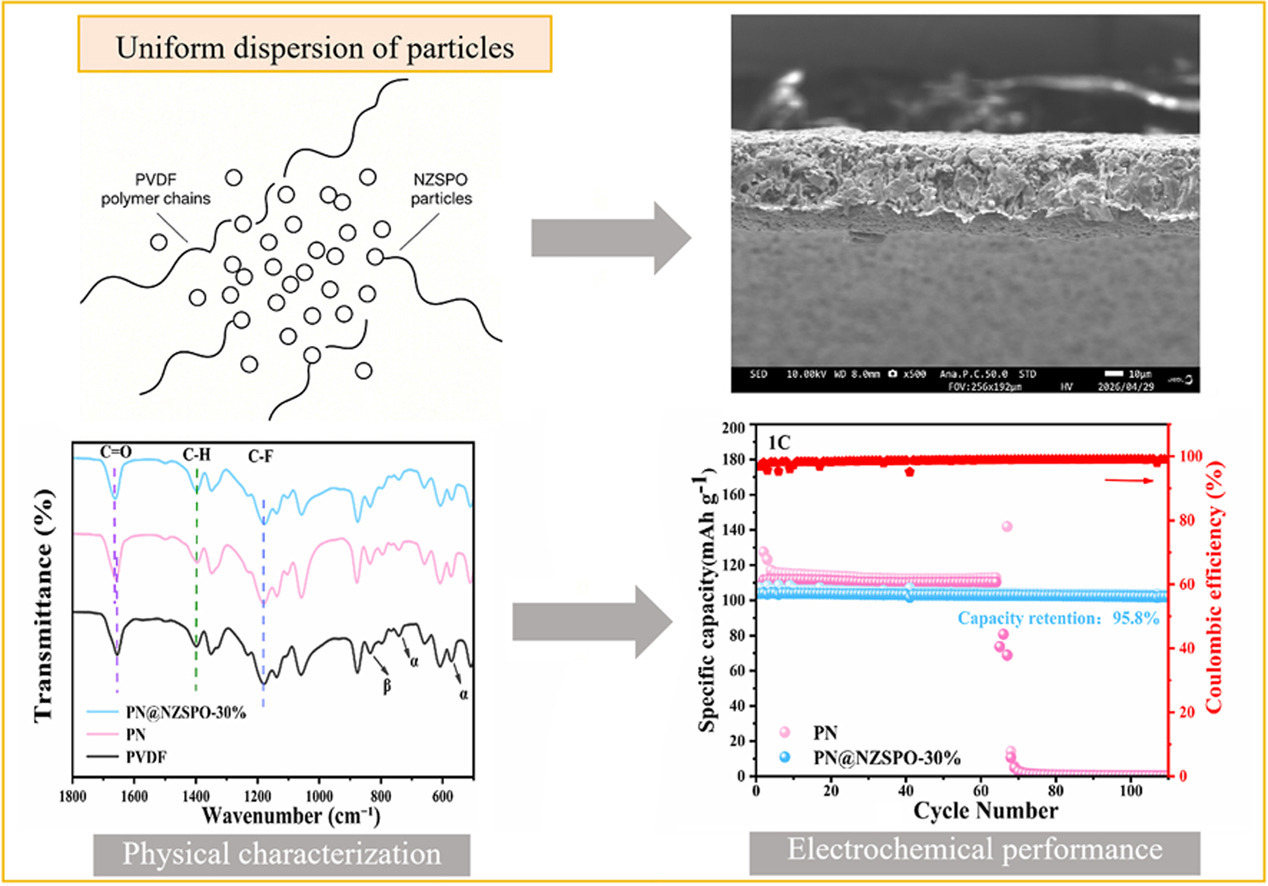
• NASICON-type NZSPO particles are uniformly incorporated into a PVDF matrix.
• NZSPO particles effectively induce α-to-β phase transition of PVDF.
• A high ionic conductivity of 3.83 × 10⁻⁴ S cm−1 and a Na+ transference number of 0.56 are achieved.
• Composite solid electrolyte enables stable cycling of Na//Na symmetric cells for 200 h.
Abstract
Composite solid-state electrolytes (CSSEs) are one of the effective strategies to address the safety hazards of liquid electrolytes and the low ionic conductivity of polymer electrolytes. However, the mismatch in ion transport capability between the inorganic filler and the polymer matrix often leads to uneven Na flux distribution, and the side reactions at the electrolyte/electrode interface easily induce sodium dendrite growth. To address these issues, this work designs a solid-state electrolyte by incorporating NASICON-type Na3Zr2Si2PO12 (NZSPO) particles into a poly (vinylidene fluoride) (PVDF) matrix. This design effectively promotes homogeneous Na migration, enabling the optimized PN@NZSPO-30% CSSE to achieve an ionic conductivity of 3.83 × 10⁻⁴ S cm−1 and a Na transference number of 0.56 at room temperature. Meanwhile, the PVDF matrix forms a stable interfacial structure upon contact with the sodium metal anode, effectively suppressing dendrite growth. The Na//PN@NZSPO-30%//Na symmetric cell achieves stable cycling for 50 to 200 h under different current densities, and the Na//PN@NZSPO-30%//NVP full cell exhibits a capacity retention of 95.8% after 100 cycles at 1 C, along with excellent rate reversibility in the range of 0.1-1 C. This study provides a new approach for constructing solid-state sodium metal batteries with high performance and suppressed sodium dendrite growth.
Graphical abstract
Keywords
Composite solid-state electrolyte; Polyvinylidene fluoride; NASICON; Sodium metal battery; Ionic conductivity; Interfacial stability
文章导读