
期刊文章
过刊浏览
- Volumes 108-119 (2025)
-
Volumes 96-107 (2025)
-
Volume 107
Pages 1-376 (December 2025)
-
Volume 106
Pages 1-336 (November 2025)
-
Volume 105
Pages 1-356 (October 2025)
-
Volume 104
Pages 1-332 (September 2025)
-
Volume 103
Pages 1-314 (August 2025)
-
Volume 102
Pages 1-276 (July 2025)
-
Volume 101
Pages 1-166 (June 2025)
-
Volume 100
Pages 1-256 (May 2025)
-
Volume 99
Pages 1-242 (April 2025)
-
Volume 98
Pages 1-288 (March 2025)
-
Volume 97
Pages 1-256 (February 2025)
-
Volume 96
Pages 1-340 (January 2025)
-
Volume 107
-
Volumes 84-95 (2024)
-
Volume 95
Pages 1-392 (December 2024)
-
Volume 94
Pages 1-400 (November 2024)
-
Volume 93
Pages 1-376 (October 2024)
-
Volume 92
Pages 1-316 (September 2024)
-
Volume 91
Pages 1-378 (August 2024)
-
Volume 90
Pages 1-580 (July 2024)
-
Volume 89
Pages 1-278 (June 2024)
-
Volume 88
Pages 1-350 (May 2024)
-
Volume 87
Pages 1-338 (April 2024)
-
Volume 86
Pages 1-312 (March 2024)
-
Volume 85
Pages 1-334 (February 2024)
-
Volume 84
Pages 1-308 (January 2024)
-
Volume 95
-
Volumes 72-83 (2023)
-
Volume 83
Pages 1-258 (December 2023)
-
Volume 82
Pages 1-204 (November 2023)
-
Volume 81
Pages 1-188 (October 2023)
-
Volume 80
Pages 1-202 (September 2023)
-
Volume 79
Pages 1-172 (August 2023)
-
Volume 78
Pages 1-146 (July 2023)
-
Volume 77
Pages 1-152 (June 2023)
-
Volume 76
Pages 1-176 (May 2023)
-
Volume 75
Pages 1-228 (April 2023)
-
Volume 74
Pages 1-200 (March 2023)
-
Volume 73
Pages 1-138 (February 2023)
-
Volume 72
Pages 1-144 (January 2023)
-
Volume 83
-
Volumes 60-71 (2022)
-
Volume 71
Pages 1-108 (December 2022)
-
Volume 70
Pages 1-106 (November 2022)
-
Volume 69
Pages 1-122 (October 2022)
-
Volume 68
Pages 1-124 (September 2022)
-
Volume 67
Pages 1-102 (August 2022)
-
Volume 66
Pages 1-112 (July 2022)
-
Volume 65
Pages 1-138 (June 2022)
-
Volume 64
Pages 1-186 (May 2022)
-
Volume 63
Pages 1-124 (April 2022)
-
Volume 62
Pages 1-104 (March 2022)
-
Volume 61
Pages 1-120 (February 2022)
-
Volume 60
Pages 1-124 (January 2022)
-
Volume 71
- Volumes 54-59 (2021)
- Volumes 48-53 (2020)
- Volumes 42-47 (2019)
- Volumes 36-41 (2018)
- Volumes 30-35 (2017)
- Volumes 24-29 (2016)
- Volumes 18-23 (2015)
- Volumes 12-17 (2014)
- Volume 11 (2013)
- Volume 10 (2012)
- Volume 9 (2011)
- Volume 8 (2010)
- Volume 7 (2009)
- Volume 6 (2008)
- Volume 5 (2007)
- Volume 4 (2006)
- Volume 3 (2005)
- Volume 2 (2004)
- Volume 1 (2003)
Volume 116
Hybrid nanoparticle-enhanced green bio-oils: Experimental evaluation and mathematical modelling for cleaner lubrication
Sikta Panda a b, Gaurab Kumar Ghosh b, Subrata Kumar Ghosh a *
a Department of Mechanical Engineering, Indian Institute of Technology (ISM), Dhanbad, 826004, India
b Department of Mechanical Engineering, Indira Gandhi Institute of Technology, Sarang, Dhenkanal, 759146, India
10.1016/j.partic.2026.06.032
Volume 116,
September 2026,
Pages 264-278
Received 20 April 2026, Revised 11 June 2026, Accepted 26 June 2026, Available online 3 July 2026, Version of Record 11 July 2026.
E-mail:
subrata@iitism.ac.in
Highlights
• Nano-biolubricant samples yielded good stability (Zeta potential >40 mV).
• Stokes-based settling estimates indicated ideal-condition stability.
• Heat transfer with Brownian motion predicted the trend of thermal behaviour.
• Significant reduction of 46.77% in COF with 0.05% nano-oil sample.
• Dominating nano-lubrication mechanisms were ball bearing and polishing effect.
Abstract
The increasing need for environmentally sustainable industrial practices has encouraged research on bio-derived lubricants as greener substitutes for petroleum oils. Here, hybrid nano-biolubricants were synthesized to counter the inherent shortcomings of traditional bio-lubricantswhile improving their rheological and tribological characteristics. The nano-biolubricants comprising of TiO2-Cu(II)O (80:20 ratio) were dispersed at 0.05, 0.10, and 0.15 vol% in Jatropha oil following dual step approach and showed appreciable colloidal stability. The samples registered a maximum 46.77% reduction in the coefficient of friction, proving its enhanced friction-reducing ability. Rheological analyses showed shear-thinning behaviour typical of pseudoplastic non-Newtonian liquids, showing adaptability with changing mechanical stresses. Surface topography inspection of wear scars suggested that the ball-bearing action of the hybrid nanoparticles dominated as the lubrication mechanism, reducing asperity interaction and wear. The roughness indices of worn specimens showed reduction in values of around 35% which indicates better aesthetic in their surface profile. Furthermore, Stoke's law was employed to estimate sedimentation velocity and sedimentation time, which estimated a sedimentation time of around 314 days in ideal condition (with no agglomeration). A heat transfer modelling including the Brownian motion of nanoparticles was performed. The formulation of 0.05 vol% produced the lowest friction under reciprocating wear. In general, the results highlight the prospects of jatropha oil-based hybrid nano-biolubricants as efficient, eco-friendly alternatives for future industrial lubrication technology.
Graphical abstract
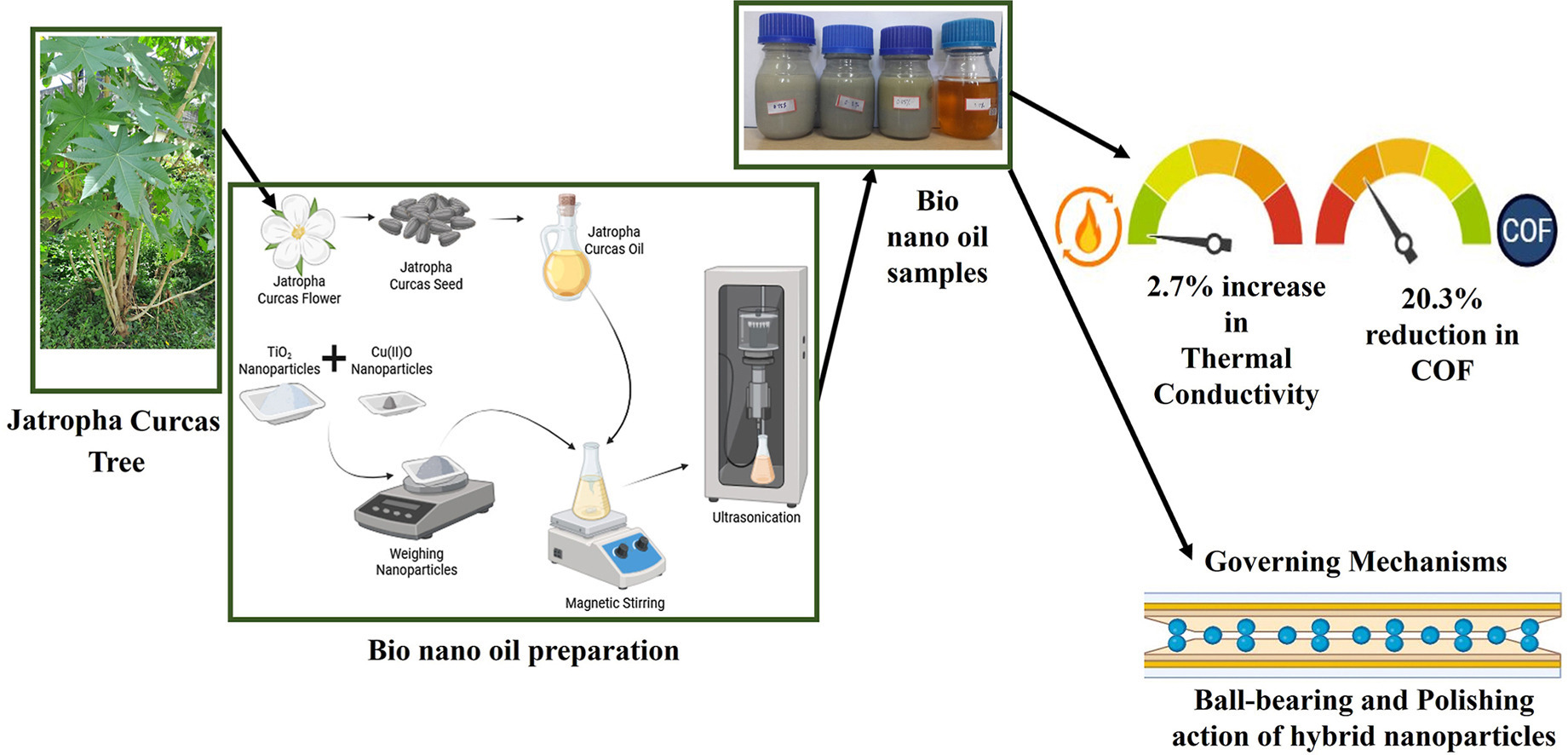
Keywords
Hybrid nanoparticles; Jatropha oil; Thermo-physical properties; Rheology; Four ball tribometer; Reciprocating wear
文章导读