
期刊文章
过刊浏览
- Volumes 108-119 (2025)
-
Volumes 96-107 (2025)
-
Volume 107
Pages 1-376 (December 2025)
-
Volume 106
Pages 1-336 (November 2025)
-
Volume 105
Pages 1-356 (October 2025)
-
Volume 104
Pages 1-332 (September 2025)
-
Volume 103
Pages 1-314 (August 2025)
-
Volume 102
Pages 1-276 (July 2025)
-
Volume 101
Pages 1-166 (June 2025)
-
Volume 100
Pages 1-256 (May 2025)
-
Volume 99
Pages 1-242 (April 2025)
-
Volume 98
Pages 1-288 (March 2025)
-
Volume 97
Pages 1-256 (February 2025)
-
Volume 96
Pages 1-340 (January 2025)
-
Volume 107
-
Volumes 84-95 (2024)
-
Volume 95
Pages 1-392 (December 2024)
-
Volume 94
Pages 1-400 (November 2024)
-
Volume 93
Pages 1-376 (October 2024)
-
Volume 92
Pages 1-316 (September 2024)
-
Volume 91
Pages 1-378 (August 2024)
-
Volume 90
Pages 1-580 (July 2024)
-
Volume 89
Pages 1-278 (June 2024)
-
Volume 88
Pages 1-350 (May 2024)
-
Volume 87
Pages 1-338 (April 2024)
-
Volume 86
Pages 1-312 (March 2024)
-
Volume 85
Pages 1-334 (February 2024)
-
Volume 84
Pages 1-308 (January 2024)
-
Volume 95
-
Volumes 72-83 (2023)
-
Volume 83
Pages 1-258 (December 2023)
-
Volume 82
Pages 1-204 (November 2023)
-
Volume 81
Pages 1-188 (October 2023)
-
Volume 80
Pages 1-202 (September 2023)
-
Volume 79
Pages 1-172 (August 2023)
-
Volume 78
Pages 1-146 (July 2023)
-
Volume 77
Pages 1-152 (June 2023)
-
Volume 76
Pages 1-176 (May 2023)
-
Volume 75
Pages 1-228 (April 2023)
-
Volume 74
Pages 1-200 (March 2023)
-
Volume 73
Pages 1-138 (February 2023)
-
Volume 72
Pages 1-144 (January 2023)
-
Volume 83
-
Volumes 60-71 (2022)
-
Volume 71
Pages 1-108 (December 2022)
-
Volume 70
Pages 1-106 (November 2022)
-
Volume 69
Pages 1-122 (October 2022)
-
Volume 68
Pages 1-124 (September 2022)
-
Volume 67
Pages 1-102 (August 2022)
-
Volume 66
Pages 1-112 (July 2022)
-
Volume 65
Pages 1-138 (June 2022)
-
Volume 64
Pages 1-186 (May 2022)
-
Volume 63
Pages 1-124 (April 2022)
-
Volume 62
Pages 1-104 (March 2022)
-
Volume 61
Pages 1-120 (February 2022)
-
Volume 60
Pages 1-124 (January 2022)
-
Volume 71
- Volumes 54-59 (2021)
- Volumes 48-53 (2020)
- Volumes 42-47 (2019)
- Volumes 36-41 (2018)
- Volumes 30-35 (2017)
- Volumes 24-29 (2016)
- Volumes 18-23 (2015)
- Volumes 12-17 (2014)
- Volume 11 (2013)
- Volume 10 (2012)
- Volume 9 (2011)
- Volume 8 (2010)
- Volume 7 (2009)
- Volume 6 (2008)
- Volume 5 (2007)
- Volume 4 (2006)
- Volume 3 (2005)
- Volume 2 (2004)
- Volume 1 (2003)
Volume 116
Ternary semantic segmentation of hybrid particles in fluidized beds via dual CBAM-DeepLabV3+: Enhanced characterization of nanoparticle agglomeration
Juhui Chen a b *, Yongxin Zhu a b, Dan Li a b, Buyang Peng a b, Yongen Zhao a b, Wenqing Du a b, Xifeng Cao a b, Siarhei Lapatsin c d, Michael Zhuravkov d
a School of Mechanical and Power Engineering, Harbin University of Science and Technology, Harbin, 150080, China
b Key Laboratory of Advanced Manufacturing and Intelligent Technology, Ministry of Education, Harbin University of Science and Technology, Harbin 150080, China
c School of Mechatronics Engineering, Harbin Institute of Technology, Harbin 150001, China
d Chongqing Research Institute, Harbin Institute of Technology, Chongqing 401135, China
10.1016/j.partic.2026.06.022
Volume 116,
September 2026,
Pages 279-296
Received 11 May 2026, Revised 15 June 2026, Accepted 21 June 2026, Available online 27 June 2026, Version of Record 11 July 2026.
E-mail:
chenjuhui@hrbust.edu.cn
Highlights
• Proposing a three-class semantic segmentation model for mixed particle systems.
• Developed a DeepLabV3+ model with dual CBAM for enhanced particle recognition.
• Achieved high-precision pixel-level differentiation of mixed particles.
• Geldart B particles suppress excessive agglomerate growth and irregularity.
Abstract
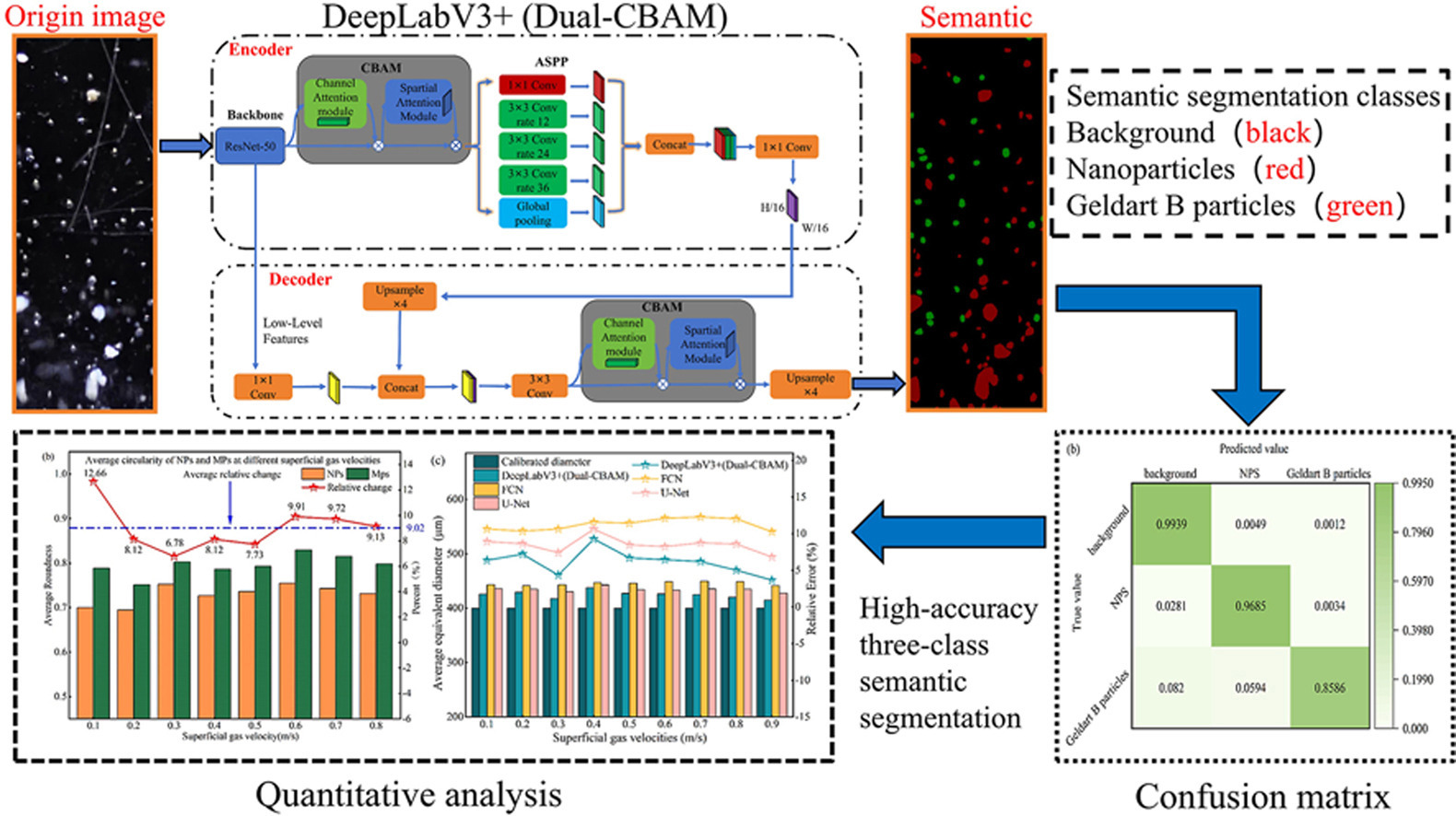
Accurate characterization of nanoparticle agglomeration in mixed-particle micro fluidized beds remains challenging because conventional binary semantic segmentation cannot effectively distinguish nanoparticles from Geldart B particles. To address this issue, a ternary semantic segmentation framework based on an improved DeepLabV3+ architecture is developed, in which pixels are classified into background, nanoparticles, and Geldart B particles. Dual convolutional block attention modules (CBAM) are incorporated to enhance multi-scale feature extraction and boundary recognition under complex fluidization conditions. Compared with baseline models, the proposed framework improves the mean intersection over union (mIoU) by 4.00%, enabling reliable pixel-level separation of mixed particles. Based on the high-precision segmentation results, the evolution of nanoparticle agglomeration characteristics and radial distribution behavior under different superficial gas velocities is quantitatively analyzed. The results show that introducing Geldart B particles suppresses excessive agglomerate growth, reduces the average equivalent diameter, and promotes the formation of more compact and morphologically regular agglomerates. Enhanced local hydrodynamic disturbance and heterogeneous particle interactions further promote agglomerate restructuring and modify the competition between aggregation and breakup processes during fluidization. Overall, the proposed framework provides an effective tool for quantitative investigation of agglomeration behavior and mesoscale flow structure evolution in complex gas–solid fluidized systems.
Graphical abstract
Keywords
Semantic segmentation; DeepLabV3+; Dual CBAM; Geldart B particles; Nanoparticle agglomeration
文章导读