
期刊文章
过刊浏览
- Volumes 108-119 (2025)
-
Volumes 96-107 (2025)
-
Volume 107
Pages 1-376 (December 2025)
-
Volume 106
Pages 1-336 (November 2025)
-
Volume 105
Pages 1-356 (October 2025)
-
Volume 104
Pages 1-332 (September 2025)
-
Volume 103
Pages 1-314 (August 2025)
-
Volume 102
Pages 1-276 (July 2025)
-
Volume 101
Pages 1-166 (June 2025)
-
Volume 100
Pages 1-256 (May 2025)
-
Volume 99
Pages 1-242 (April 2025)
-
Volume 98
Pages 1-288 (March 2025)
-
Volume 97
Pages 1-256 (February 2025)
-
Volume 96
Pages 1-340 (January 2025)
-
Volume 107
-
Volumes 84-95 (2024)
-
Volume 95
Pages 1-392 (December 2024)
-
Volume 94
Pages 1-400 (November 2024)
-
Volume 93
Pages 1-376 (October 2024)
-
Volume 92
Pages 1-316 (September 2024)
-
Volume 91
Pages 1-378 (August 2024)
-
Volume 90
Pages 1-580 (July 2024)
-
Volume 89
Pages 1-278 (June 2024)
-
Volume 88
Pages 1-350 (May 2024)
-
Volume 87
Pages 1-338 (April 2024)
-
Volume 86
Pages 1-312 (March 2024)
-
Volume 85
Pages 1-334 (February 2024)
-
Volume 84
Pages 1-308 (January 2024)
-
Volume 95
-
Volumes 72-83 (2023)
-
Volume 83
Pages 1-258 (December 2023)
-
Volume 82
Pages 1-204 (November 2023)
-
Volume 81
Pages 1-188 (October 2023)
-
Volume 80
Pages 1-202 (September 2023)
-
Volume 79
Pages 1-172 (August 2023)
-
Volume 78
Pages 1-146 (July 2023)
-
Volume 77
Pages 1-152 (June 2023)
-
Volume 76
Pages 1-176 (May 2023)
-
Volume 75
Pages 1-228 (April 2023)
-
Volume 74
Pages 1-200 (March 2023)
-
Volume 73
Pages 1-138 (February 2023)
-
Volume 72
Pages 1-144 (January 2023)
-
Volume 83
-
Volumes 60-71 (2022)
-
Volume 71
Pages 1-108 (December 2022)
-
Volume 70
Pages 1-106 (November 2022)
-
Volume 69
Pages 1-122 (October 2022)
-
Volume 68
Pages 1-124 (September 2022)
-
Volume 67
Pages 1-102 (August 2022)
-
Volume 66
Pages 1-112 (July 2022)
-
Volume 65
Pages 1-138 (June 2022)
-
Volume 64
Pages 1-186 (May 2022)
-
Volume 63
Pages 1-124 (April 2022)
-
Volume 62
Pages 1-104 (March 2022)
-
Volume 61
Pages 1-120 (February 2022)
-
Volume 60
Pages 1-124 (January 2022)
-
Volume 71
- Volumes 54-59 (2021)
- Volumes 48-53 (2020)
- Volumes 42-47 (2019)
- Volumes 36-41 (2018)
- Volumes 30-35 (2017)
- Volumes 24-29 (2016)
- Volumes 18-23 (2015)
- Volumes 12-17 (2014)
- Volume 11 (2013)
- Volume 10 (2012)
- Volume 9 (2011)
- Volume 8 (2010)
- Volume 7 (2009)
- Volume 6 (2008)
- Volume 5 (2007)
- Volume 4 (2006)
- Volume 3 (2005)
- Volume 2 (2004)
- Volume 1 (2003)
Volume 116
Multi-scale computations of reactive multiphase flows: Towards digital twins for energy transition
Mengyu Wang a, Shuai Wang a b, Junjie Lin a b, Kun Luo a b *, Jianren Fan a b
a State Key Laboratory of Clean Energy Utilization, Zhejiang University, Hangzhou 310027, China
b Shanghai Institute for Advanced Study of Zhejiang University, Shanghai 200120, China
10.1016/j.partic.2026.06.029
Volume 116,
September 2026,
Pages 311-328
Received 8 April 2026, Revised 19 May 2026, Accepted 18 June 2026, Available online 2 July 2026, Version of Record 13 July 2026.
E-mail:
zjulk@zju.edu.cn
Highlights
• Advances in multi-scale modeling of reactive multiphase flows are reviewed.
• Physical-based models and AI-driven methods like ROM are highlighted.
• Integrating multi-scale computing with AI paves the way for digital twins.
• Future perspectives on intelligent, self-evolving digital twins are provided.
Abstract
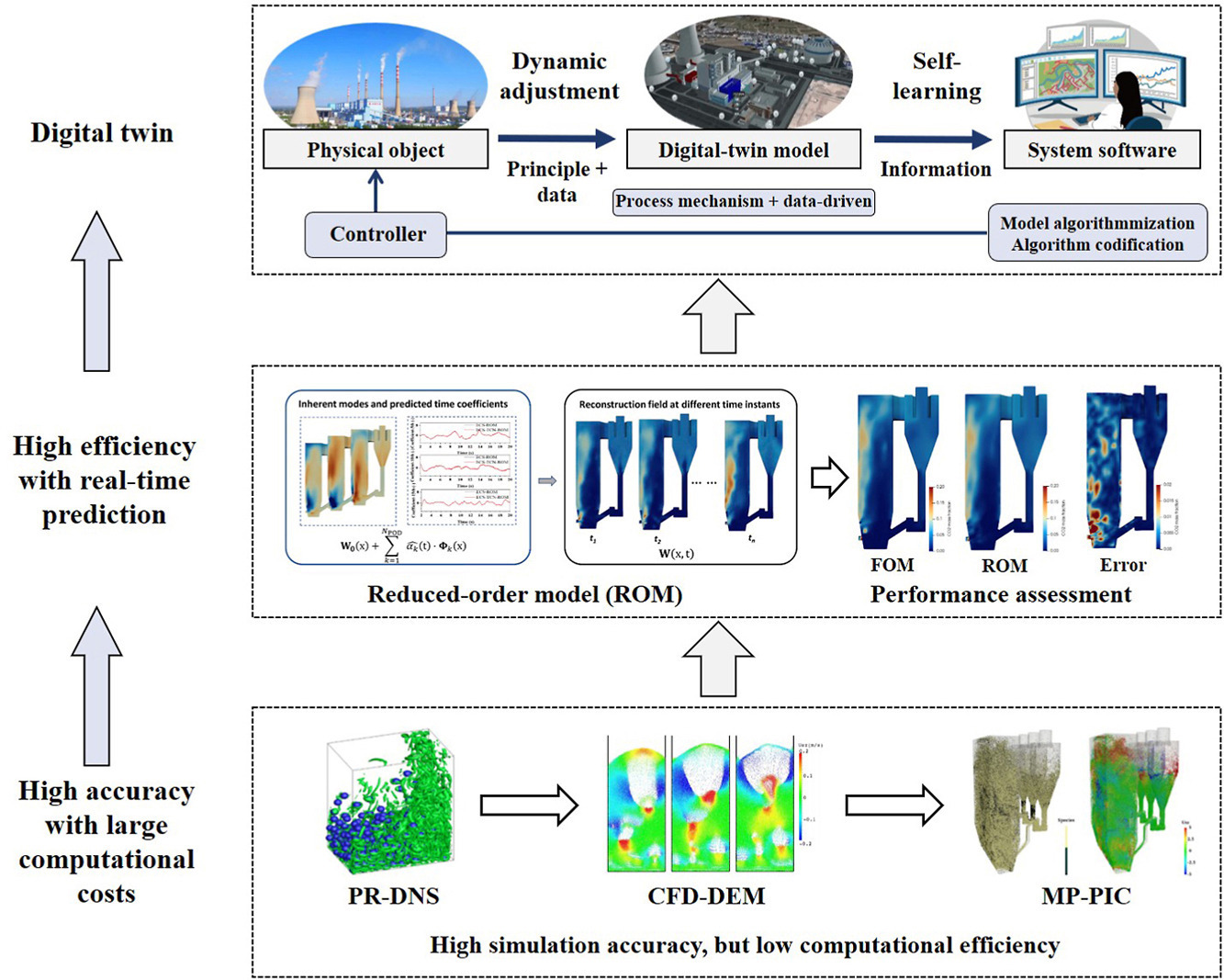
The global energy transition toward carbon neutrality demands transformative innovations in modeling and optimizing complex energy conversion systems. Reactive multiphase flow in industrial processes, particularly circulating fluidized bed (CFB) boilers, is central to clean and efficient energy conversion and constitutes the key physical basis for boiler-state prediction and digital-twin development. However, their multi-scale and multi-physics nature, involving gas-solid flow dynamics, heat and mass transfer, and chemical reactions, presents formidable challenges for real-time prediction and control. This review summarizes recent advances in multi-scale computational modeling for reactive multiphase flows, focusing on how particle-resolved direct numerical simulation (PR-DNS) and computational fluid dynamics-discrete element method (CFD-DEM) provide high-fidelity physical understanding and training data, while reduced-order model (ROM) enables fast boiler-state prediction and digital-twin implementation. The integration of these approaches forms the computational foundation for constructing digital twins of complex energy systems. Finally, challenges and future research directions are discussed, focusing on bridging scales, enhancing real-time prediction capability, and achieving intelligent, self-evolving digital twins to support the global energy transition.
Graphical abstract
Keywords
Multi-scale modeling; Reactive multiphase flow; Digital twin; Reduced-order modeling
文章导读