
期刊文章
过刊浏览
- Volumes 108-119 (2025)
-
Volumes 96-107 (2025)
-
Volume 107
Pages 1-376 (December 2025)
-
Volume 106
Pages 1-336 (November 2025)
-
Volume 105
Pages 1-356 (October 2025)
-
Volume 104
Pages 1-332 (September 2025)
-
Volume 103
Pages 1-314 (August 2025)
-
Volume 102
Pages 1-276 (July 2025)
-
Volume 101
Pages 1-166 (June 2025)
-
Volume 100
Pages 1-256 (May 2025)
-
Volume 99
Pages 1-242 (April 2025)
-
Volume 98
Pages 1-288 (March 2025)
-
Volume 97
Pages 1-256 (February 2025)
-
Volume 96
Pages 1-340 (January 2025)
-
Volume 107
-
Volumes 84-95 (2024)
-
Volume 95
Pages 1-392 (December 2024)
-
Volume 94
Pages 1-400 (November 2024)
-
Volume 93
Pages 1-376 (October 2024)
-
Volume 92
Pages 1-316 (September 2024)
-
Volume 91
Pages 1-378 (August 2024)
-
Volume 90
Pages 1-580 (July 2024)
-
Volume 89
Pages 1-278 (June 2024)
-
Volume 88
Pages 1-350 (May 2024)
-
Volume 87
Pages 1-338 (April 2024)
-
Volume 86
Pages 1-312 (March 2024)
-
Volume 85
Pages 1-334 (February 2024)
-
Volume 84
Pages 1-308 (January 2024)
-
Volume 95
-
Volumes 72-83 (2023)
-
Volume 83
Pages 1-258 (December 2023)
-
Volume 82
Pages 1-204 (November 2023)
-
Volume 81
Pages 1-188 (October 2023)
-
Volume 80
Pages 1-202 (September 2023)
-
Volume 79
Pages 1-172 (August 2023)
-
Volume 78
Pages 1-146 (July 2023)
-
Volume 77
Pages 1-152 (June 2023)
-
Volume 76
Pages 1-176 (May 2023)
-
Volume 75
Pages 1-228 (April 2023)
-
Volume 74
Pages 1-200 (March 2023)
-
Volume 73
Pages 1-138 (February 2023)
-
Volume 72
Pages 1-144 (January 2023)
-
Volume 83
-
Volumes 60-71 (2022)
-
Volume 71
Pages 1-108 (December 2022)
-
Volume 70
Pages 1-106 (November 2022)
-
Volume 69
Pages 1-122 (October 2022)
-
Volume 68
Pages 1-124 (September 2022)
-
Volume 67
Pages 1-102 (August 2022)
-
Volume 66
Pages 1-112 (July 2022)
-
Volume 65
Pages 1-138 (June 2022)
-
Volume 64
Pages 1-186 (May 2022)
-
Volume 63
Pages 1-124 (April 2022)
-
Volume 62
Pages 1-104 (March 2022)
-
Volume 61
Pages 1-120 (February 2022)
-
Volume 60
Pages 1-124 (January 2022)
-
Volume 71
- Volumes 54-59 (2021)
- Volumes 48-53 (2020)
- Volumes 42-47 (2019)
- Volumes 36-41 (2018)
- Volumes 30-35 (2017)
- Volumes 24-29 (2016)
- Volumes 18-23 (2015)
- Volumes 12-17 (2014)
- Volume 11 (2013)
- Volume 10 (2012)
- Volume 9 (2011)
- Volume 8 (2010)
- Volume 7 (2009)
- Volume 6 (2008)
- Volume 5 (2007)
- Volume 4 (2006)
- Volume 3 (2005)
- Volume 2 (2004)
- Volume 1 (2003)
Volume 116
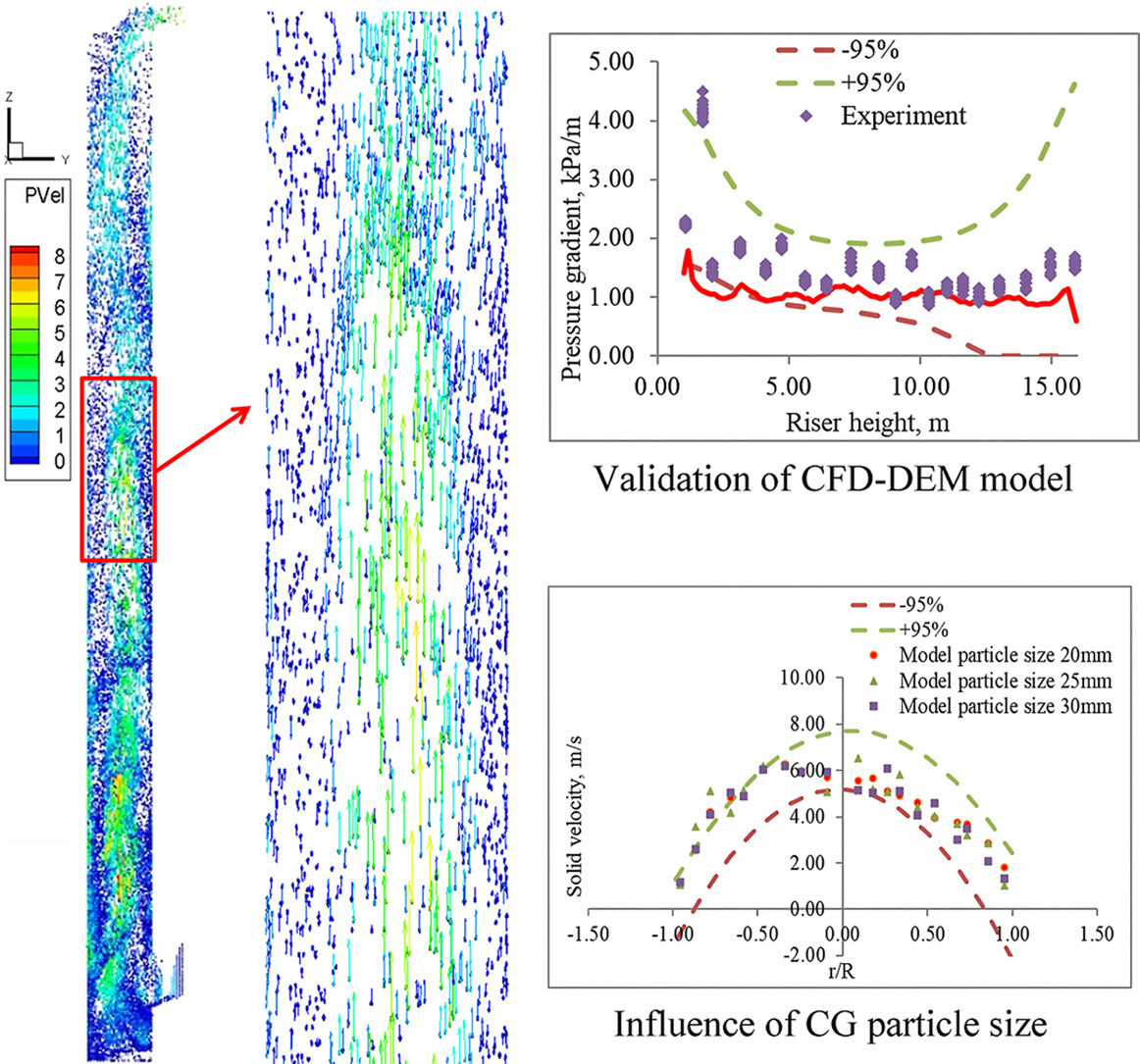
Coarse-grained CFD-DEM modeling of gas-solid flow in a large-scale circulating fluidized bed riser: Validation and parametric study
Kaiwei Chu a c *, Zhengquan Li b c, Li Ji a, Muhammad Zubair a, Wenrui Wang a, Qijun Zheng c, Yuqing Feng d, Huaqing Ma a *
a School of Qilu Transportation, Shandong University, Jinan, 250061, China
b Jiangxi Provincial Key Laboratory of Particle Technology, Jiangxi University of Science and Technology, Ganzhou, 341000, China
c Department of Mechanical and Aerospace Engineering, Monash University, Melbourne, VIC, 3800, Australia
d CSIRO Mineral Resources, Clayton, VIC, 3168, Australia
10.1016/j.partic.2026.06.033
Volume 116,
September 2026,
Pages 329-339
Received 19 May 2026, Revised 20 June 2026, Accepted 26 June 2026, Available online 8 July 2026, Version of Record 14 July 2026.
E-mail:
k.chu@sdu.edu.cn; mhq@sdu.edu.cn
Highlights
• A coarse-grained CFD-DEM model is proposed for industrial-scale CFB riser flows.
• The model can accurately predict pressure gradient, solids velocity, and mass flux.
• The core-annulus flow, solids back-mixing, and particle clustering can be reproduced.
• CG particle size has negligible effect, but high solid loading reduces accuracy.
Abstract
In this paper, a coarse-grained computational fluid dynamics-discrete element method (CG CFD-DEM) approach is developed for the simulation of gas-solid two-phase flow in an large-scale circulating fluidized bed (CFB) riser, where the CG approach servers as a powerful tool to perform large-scale CFD-DEM simulations by avoiding the expensive cost of computing and storing a large number of particles and maintaining the important particle-fluid interaction phenomenon simultaneously. Subsequently, the prediction accuracy of the model is validated against experimental measurements, showing good agreement in axial pressure gradients, solids velocity, and mass flux profile at different radial directions and riser heights across different fluidization regimes. This indicates that the proposed CG CFD-DEM method can satisfactorily reproduce key hydrodynamic properties including solid concentration, back mixing, particle agglomeration, and local velocities of both phases. The influences of solids mass flow rate and particle size on flow structure are also investigated in this paper. Although the discrepancies may become more pronounced at higher solid loadings, the CG CFD-DEM model can remain as a robust and scalable framework for the analysis of the large-scale gas-solid flows in the CFB riser.
Graphical abstract
Keywords
Large-scale simulation; Gas-solid flow; Circulating fluidized bed (CFB) riser; Coarse-grained CFD-DEM
文章导读