
期刊文章
过刊浏览
- Volumes 108-119 (2025)
-
Volumes 96-107 (2025)
-
Volume 107
Pages 1-376 (December 2025)
-
Volume 106
Pages 1-336 (November 2025)
-
Volume 105
Pages 1-356 (October 2025)
-
Volume 104
Pages 1-332 (September 2025)
-
Volume 103
Pages 1-314 (August 2025)
-
Volume 102
Pages 1-276 (July 2025)
-
Volume 101
Pages 1-166 (June 2025)
-
Volume 100
Pages 1-256 (May 2025)
-
Volume 99
Pages 1-242 (April 2025)
-
Volume 98
Pages 1-288 (March 2025)
-
Volume 97
Pages 1-256 (February 2025)
-
Volume 96
Pages 1-340 (January 2025)
-
Volume 107
-
Volumes 84-95 (2024)
-
Volume 95
Pages 1-392 (December 2024)
-
Volume 94
Pages 1-400 (November 2024)
-
Volume 93
Pages 1-376 (October 2024)
-
Volume 92
Pages 1-316 (September 2024)
-
Volume 91
Pages 1-378 (August 2024)
-
Volume 90
Pages 1-580 (July 2024)
-
Volume 89
Pages 1-278 (June 2024)
-
Volume 88
Pages 1-350 (May 2024)
-
Volume 87
Pages 1-338 (April 2024)
-
Volume 86
Pages 1-312 (March 2024)
-
Volume 85
Pages 1-334 (February 2024)
-
Volume 84
Pages 1-308 (January 2024)
-
Volume 95
-
Volumes 72-83 (2023)
-
Volume 83
Pages 1-258 (December 2023)
-
Volume 82
Pages 1-204 (November 2023)
-
Volume 81
Pages 1-188 (October 2023)
-
Volume 80
Pages 1-202 (September 2023)
-
Volume 79
Pages 1-172 (August 2023)
-
Volume 78
Pages 1-146 (July 2023)
-
Volume 77
Pages 1-152 (June 2023)
-
Volume 76
Pages 1-176 (May 2023)
-
Volume 75
Pages 1-228 (April 2023)
-
Volume 74
Pages 1-200 (March 2023)
-
Volume 73
Pages 1-138 (February 2023)
-
Volume 72
Pages 1-144 (January 2023)
-
Volume 83
-
Volumes 60-71 (2022)
-
Volume 71
Pages 1-108 (December 2022)
-
Volume 70
Pages 1-106 (November 2022)
-
Volume 69
Pages 1-122 (October 2022)
-
Volume 68
Pages 1-124 (September 2022)
-
Volume 67
Pages 1-102 (August 2022)
-
Volume 66
Pages 1-112 (July 2022)
-
Volume 65
Pages 1-138 (June 2022)
-
Volume 64
Pages 1-186 (May 2022)
-
Volume 63
Pages 1-124 (April 2022)
-
Volume 62
Pages 1-104 (March 2022)
-
Volume 61
Pages 1-120 (February 2022)
-
Volume 60
Pages 1-124 (January 2022)
-
Volume 71
- Volumes 54-59 (2021)
- Volumes 48-53 (2020)
- Volumes 42-47 (2019)
- Volumes 36-41 (2018)
- Volumes 30-35 (2017)
- Volumes 24-29 (2016)
- Volumes 18-23 (2015)
- Volumes 12-17 (2014)
- Volume 11 (2013)
- Volume 10 (2012)
- Volume 9 (2011)
- Volume 8 (2010)
- Volume 7 (2009)
- Volume 6 (2008)
- Volume 5 (2007)
- Volume 4 (2006)
- Volume 3 (2005)
- Volume 2 (2004)
- Volume 1 (2003)
Volume 116
Dust dispersion characteristics of dual dust sources from shotcrete loading-spraying at U-shaped roadway
Guoming Liu a, Zibiao Feng a, Lianjun Chen a d, Yiming Song b, Siyuan Song c, Pengcheng Li d *
a College of Safety and Environmental Engineering, Shandong University of Science and Technology, Qingdao, 266590, China
b Shandong Energy Group Luxi Mining Co., Ltd, China
c State Key Laboratory of Metal Mine Mining Safety and Disaster Prevention and Control, University of Science and Technology Beijing, Beijing, 100083, China
d School of Civil Engineering, Qingdao University of Technology, Qingdao, 266520, China
10.1016/j.partic.2026.06.027
Volume 116,
September 2026,
Pages 340-354
Received 21 April 2026, Revised 23 June 2026, Accepted 24 June 2026, Available online 1 July 2026, Version of Record 14 July 2026.
E-mail:
lpc4717@163.com
Highlights
• Development process of airflow in a U-shaped roadway is revealed.
• Differences in dust migration between single and dual dust sources in a U-shaped roadway are identified.
• Distribution characteristics of dust concentration at the breathing zone height in a U-shaped roadway are investigated.
Abstract
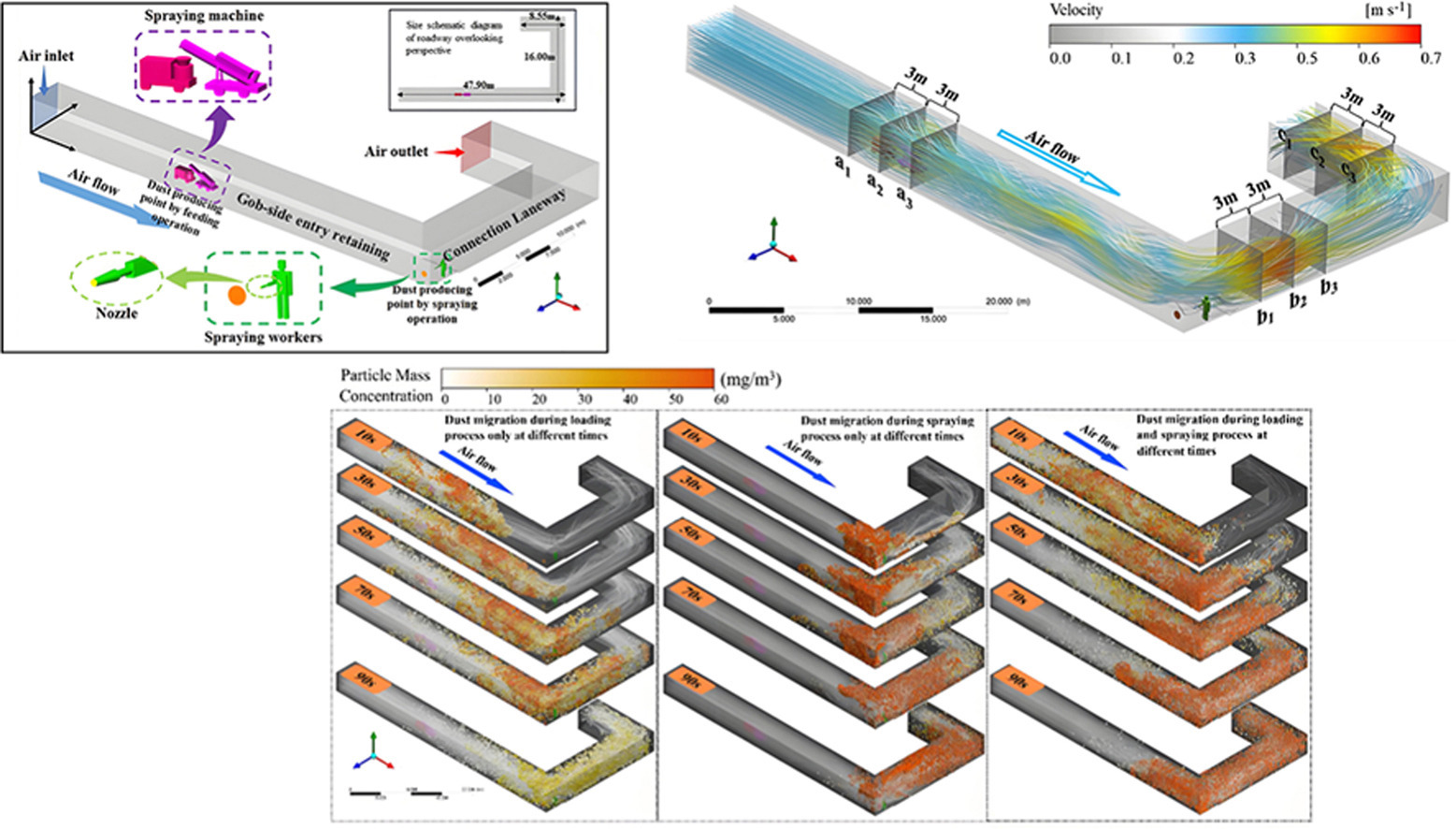
Shotcrete operation in a U-shaped roadway generates serious dust pollution, which threatens the occupational health of on-site workers and the safety of equipment. To clarify the dust migration law during coal mine shotcrete operations, this study takes the 52606 shotcrete face of Daliuta Coal Mine as the engineering background. A physical model of the U-shaped roadway is established using SpaceClaim, and Fluent and EDEM software are used to simulate dust migration characteristics during shotcrete loading and spraying. Dust dispersion shows obvious process-dependent differences: during independent loading, dust concentration decreases gradually; during independent spraying, dust first accumulates and then diffuses; during simultaneous loading and spraying, dust dispersion is complex with local high-concentration zones and significant spatiotemporal variations. At the breathing zone height, dust concentration shows consistent distribution rules: during independent loading, the outer bend side of the working face has higher dust concentration; during independent spraying, the inner bend side has higher dust concentration; during combined operation, the outer bend side still maintains a relatively higher dust concentration than the inner bend side. This study provides a theoretical basis for dust concentration control during loading and spraying of shotcrete in U-shaped roadways.
Graphical abstract
Keywords
Shotcrete; Loading; Spraying; Dust diffusion; Numerical simulation
文章导读