
期刊文章
过刊浏览
- Volumes 108-119 (2025)
-
Volumes 96-107 (2025)
-
Volume 107
Pages 1-376 (December 2025)
-
Volume 106
Pages 1-336 (November 2025)
-
Volume 105
Pages 1-356 (October 2025)
-
Volume 104
Pages 1-332 (September 2025)
-
Volume 103
Pages 1-314 (August 2025)
-
Volume 102
Pages 1-276 (July 2025)
-
Volume 101
Pages 1-166 (June 2025)
-
Volume 100
Pages 1-256 (May 2025)
-
Volume 99
Pages 1-242 (April 2025)
-
Volume 98
Pages 1-288 (March 2025)
-
Volume 97
Pages 1-256 (February 2025)
-
Volume 96
Pages 1-340 (January 2025)
-
Volume 107
-
Volumes 84-95 (2024)
-
Volume 95
Pages 1-392 (December 2024)
-
Volume 94
Pages 1-400 (November 2024)
-
Volume 93
Pages 1-376 (October 2024)
-
Volume 92
Pages 1-316 (September 2024)
-
Volume 91
Pages 1-378 (August 2024)
-
Volume 90
Pages 1-580 (July 2024)
-
Volume 89
Pages 1-278 (June 2024)
-
Volume 88
Pages 1-350 (May 2024)
-
Volume 87
Pages 1-338 (April 2024)
-
Volume 86
Pages 1-312 (March 2024)
-
Volume 85
Pages 1-334 (February 2024)
-
Volume 84
Pages 1-308 (January 2024)
-
Volume 95
-
Volumes 72-83 (2023)
-
Volume 83
Pages 1-258 (December 2023)
-
Volume 82
Pages 1-204 (November 2023)
-
Volume 81
Pages 1-188 (October 2023)
-
Volume 80
Pages 1-202 (September 2023)
-
Volume 79
Pages 1-172 (August 2023)
-
Volume 78
Pages 1-146 (July 2023)
-
Volume 77
Pages 1-152 (June 2023)
-
Volume 76
Pages 1-176 (May 2023)
-
Volume 75
Pages 1-228 (April 2023)
-
Volume 74
Pages 1-200 (March 2023)
-
Volume 73
Pages 1-138 (February 2023)
-
Volume 72
Pages 1-144 (January 2023)
-
Volume 83
-
Volumes 60-71 (2022)
-
Volume 71
Pages 1-108 (December 2022)
-
Volume 70
Pages 1-106 (November 2022)
-
Volume 69
Pages 1-122 (October 2022)
-
Volume 68
Pages 1-124 (September 2022)
-
Volume 67
Pages 1-102 (August 2022)
-
Volume 66
Pages 1-112 (July 2022)
-
Volume 65
Pages 1-138 (June 2022)
-
Volume 64
Pages 1-186 (May 2022)
-
Volume 63
Pages 1-124 (April 2022)
-
Volume 62
Pages 1-104 (March 2022)
-
Volume 61
Pages 1-120 (February 2022)
-
Volume 60
Pages 1-124 (January 2022)
-
Volume 71
- Volumes 54-59 (2021)
- Volumes 48-53 (2020)
- Volumes 42-47 (2019)
- Volumes 36-41 (2018)
- Volumes 30-35 (2017)
- Volumes 24-29 (2016)
- Volumes 18-23 (2015)
- Volumes 12-17 (2014)
- Volume 11 (2013)
- Volume 10 (2012)
- Volume 9 (2011)
- Volume 8 (2010)
- Volume 7 (2009)
- Volume 6 (2008)
- Volume 5 (2007)
- Volume 4 (2006)
- Volume 3 (2005)
- Volume 2 (2004)
- Volume 1 (2003)
Volume 116
A continual learning surrogate network for field prediction of fluidized beds with evolving internals
Tingting Liu a, Yong Jiang b, Ming Pan a, Zheng-Hong Luo a *, Xizhong Chen a *
a State Key Laboratory of Synergistic Chem-Bio Synthesis, Department of Chemical Engineering, School of Chemistry and Chemical Engineering, Shanghai Jiao Tong University, Shanghai, 200240, China
b China Huanqiu Contracting & Engineering (Beijing) CO., LTD, Beijing, 100012, China
10.1016/j.partic.2026.07.001
Volume 116,
September 2026,
Pages 355-368
Received 28 April 2026, Revised 29 June 2026, Accepted 7 July 2026, Available online 7 July 2026, Version of Record 14 July 2026.
E-mail:
Highlights
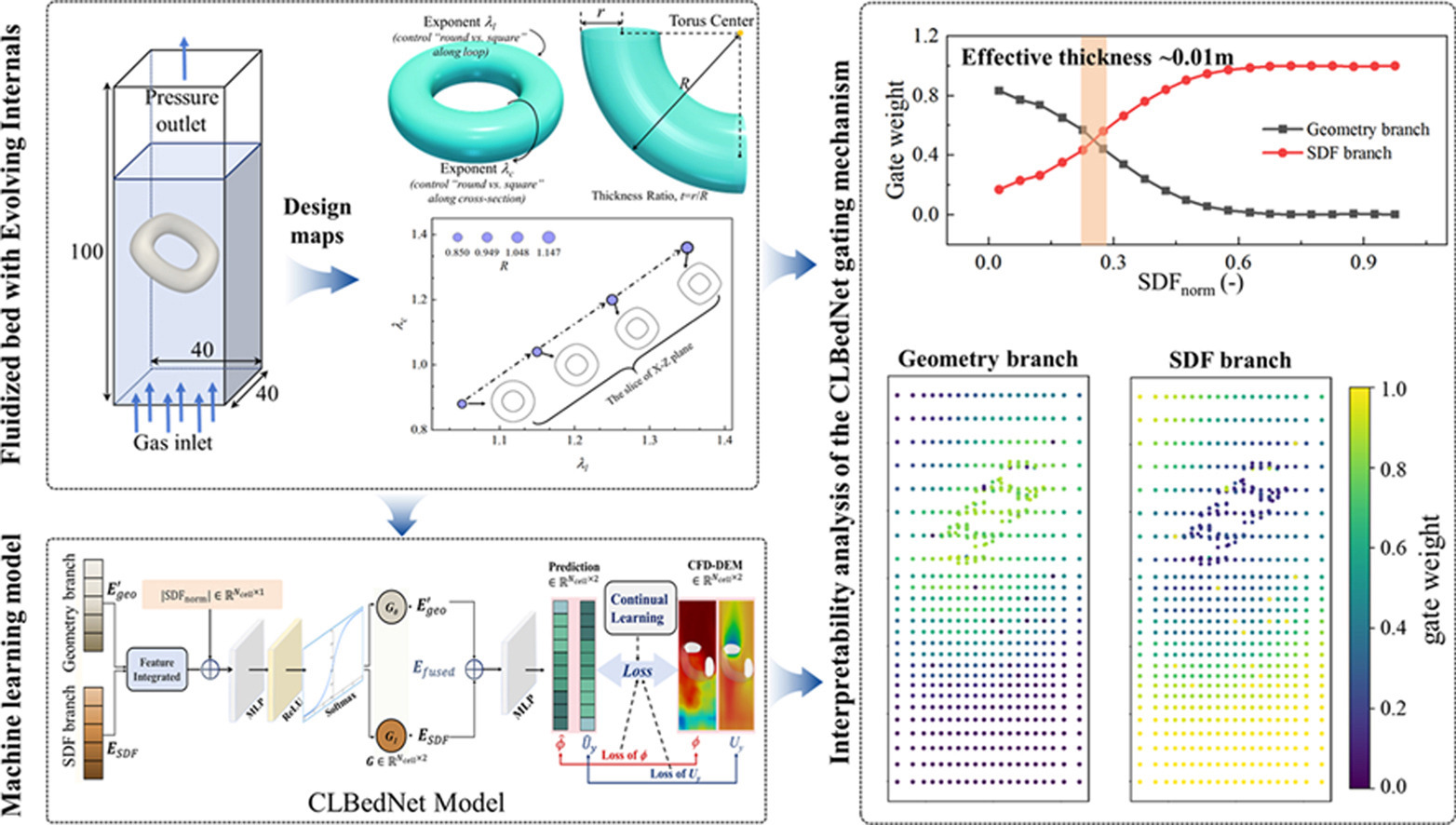
• CLBedNet uses a dual-branch surrogate (point cloud + SDF) to predict voidage and axial gas velocity fields.
• A wall-proximity-aware gating module adaptively fuses near-wall geometry cues and bulk SDF features.
• The integrated continuous learning suite alleviates catastrophic forgetting during the update of incremental models.
• Gate–SDF trends identify a learned “effective thickness”, improving interpretability of geometry influence.
• CFD-DEM-level fidelity with ∼104× faster inference enables high-throughput design and digital-twin use.
Abstract
The design of complex internals in fluidized beds is hindered by the computational cost of numerical simulations and the lack of efficient surrogate models capable of capturing near-wall flow fields across evolving geometries. This study proposes a novel dual-branch architecture integrated with a continual learning suite for the rapid prediction of fluidization hydrodynamics around superquadric internals, named CLBedNet. The model fuses point cloud features with signed-distance representations, employing a wall-proximity-aware gating mechanism to adaptively weight each branch based on wall proximity. A continual training category comprising knowledge distillation, replay buffer, and online elastic weight consolidation are introduced to mitigate catastrophic forgetting during the introduction of evolving geometries. It is shown that CLBedNet can achieve high-fidelity predictions for voidage and axial gas velocity distributions of fluidized bed with varying internals, which is promising for establish digital twin and the high-throughput optimization of industrial fluidized-bed reactors.
Graphical abstract
Keywords
文章导读