
期刊文章
过刊浏览
- Volumes 108-119 (2025)
-
Volumes 96-107 (2025)
-
Volume 107
Pages 1-376 (December 2025)
-
Volume 106
Pages 1-336 (November 2025)
-
Volume 105
Pages 1-356 (October 2025)
-
Volume 104
Pages 1-332 (September 2025)
-
Volume 103
Pages 1-314 (August 2025)
-
Volume 102
Pages 1-276 (July 2025)
-
Volume 101
Pages 1-166 (June 2025)
-
Volume 100
Pages 1-256 (May 2025)
-
Volume 99
Pages 1-242 (April 2025)
-
Volume 98
Pages 1-288 (March 2025)
-
Volume 97
Pages 1-256 (February 2025)
-
Volume 96
Pages 1-340 (January 2025)
-
Volume 107
-
Volumes 84-95 (2024)
-
Volume 95
Pages 1-392 (December 2024)
-
Volume 94
Pages 1-400 (November 2024)
-
Volume 93
Pages 1-376 (October 2024)
-
Volume 92
Pages 1-316 (September 2024)
-
Volume 91
Pages 1-378 (August 2024)
-
Volume 90
Pages 1-580 (July 2024)
-
Volume 89
Pages 1-278 (June 2024)
-
Volume 88
Pages 1-350 (May 2024)
-
Volume 87
Pages 1-338 (April 2024)
-
Volume 86
Pages 1-312 (March 2024)
-
Volume 85
Pages 1-334 (February 2024)
-
Volume 84
Pages 1-308 (January 2024)
-
Volume 95
-
Volumes 72-83 (2023)
-
Volume 83
Pages 1-258 (December 2023)
-
Volume 82
Pages 1-204 (November 2023)
-
Volume 81
Pages 1-188 (October 2023)
-
Volume 80
Pages 1-202 (September 2023)
-
Volume 79
Pages 1-172 (August 2023)
-
Volume 78
Pages 1-146 (July 2023)
-
Volume 77
Pages 1-152 (June 2023)
-
Volume 76
Pages 1-176 (May 2023)
-
Volume 75
Pages 1-228 (April 2023)
-
Volume 74
Pages 1-200 (March 2023)
-
Volume 73
Pages 1-138 (February 2023)
-
Volume 72
Pages 1-144 (January 2023)
-
Volume 83
-
Volumes 60-71 (2022)
-
Volume 71
Pages 1-108 (December 2022)
-
Volume 70
Pages 1-106 (November 2022)
-
Volume 69
Pages 1-122 (October 2022)
-
Volume 68
Pages 1-124 (September 2022)
-
Volume 67
Pages 1-102 (August 2022)
-
Volume 66
Pages 1-112 (July 2022)
-
Volume 65
Pages 1-138 (June 2022)
-
Volume 64
Pages 1-186 (May 2022)
-
Volume 63
Pages 1-124 (April 2022)
-
Volume 62
Pages 1-104 (March 2022)
-
Volume 61
Pages 1-120 (February 2022)
-
Volume 60
Pages 1-124 (January 2022)
-
Volume 71
- Volumes 54-59 (2021)
- Volumes 48-53 (2020)
- Volumes 42-47 (2019)
- Volumes 36-41 (2018)
- Volumes 30-35 (2017)
- Volumes 24-29 (2016)
- Volumes 18-23 (2015)
- Volumes 12-17 (2014)
- Volume 11 (2013)
- Volume 10 (2012)
- Volume 9 (2011)
- Volume 8 (2010)
- Volume 7 (2009)
- Volume 6 (2008)
- Volume 5 (2007)
- Volume 4 (2006)
- Volume 3 (2005)
- Volume 2 (2004)
- Volume 1 (2003)
Volume 116
Research progress on multiphase aerosol processes in heated tobacco products: A review
Qifeng Shen a, Zhonghua Xiao b, Huaquan Sheng c, Xuan Wang c, Lehua Lu c, Yihan Gao c, Naiping Gao a *
a College of Automotive and Energy Engineering, Tongji University, Shanghai, 201804, China
b College of Energy and Mechanical Engineering, Shanghai University of Electric Power, Shanghai, 200090, China
c Shanghai New Tobacco Product Research Institute, Shanghai, 201315, China
10.1016/j.partic.2026.06.030
Volume 116,
September 2026,
Pages 369-395
Received 12 May 2026, Revised 20 June 2026, Accepted 25 June 2026, Available online 2 July 2026, Version of Record 15 July 2026.
E-mail:
gaonaiping@tongji.edu.cn
Highlights
• Key models for HTP aerosols, including flow, heat transfer, nucleation, retention, and release, are summarized.
• A review of cigarette rod parameters categorized by sections for their impact on HTP aerosols.
• Heating and puffing parameters are analyzed as key operational factors affecting the release of HTP aerosols.
• Physics-informed AI and operator-learning approaches are discussed for HTP aerosol modeling.
• Uncertainty quantification is highlighted to improve the credibility of HTP aerosol simulations and experiments.
Abstract
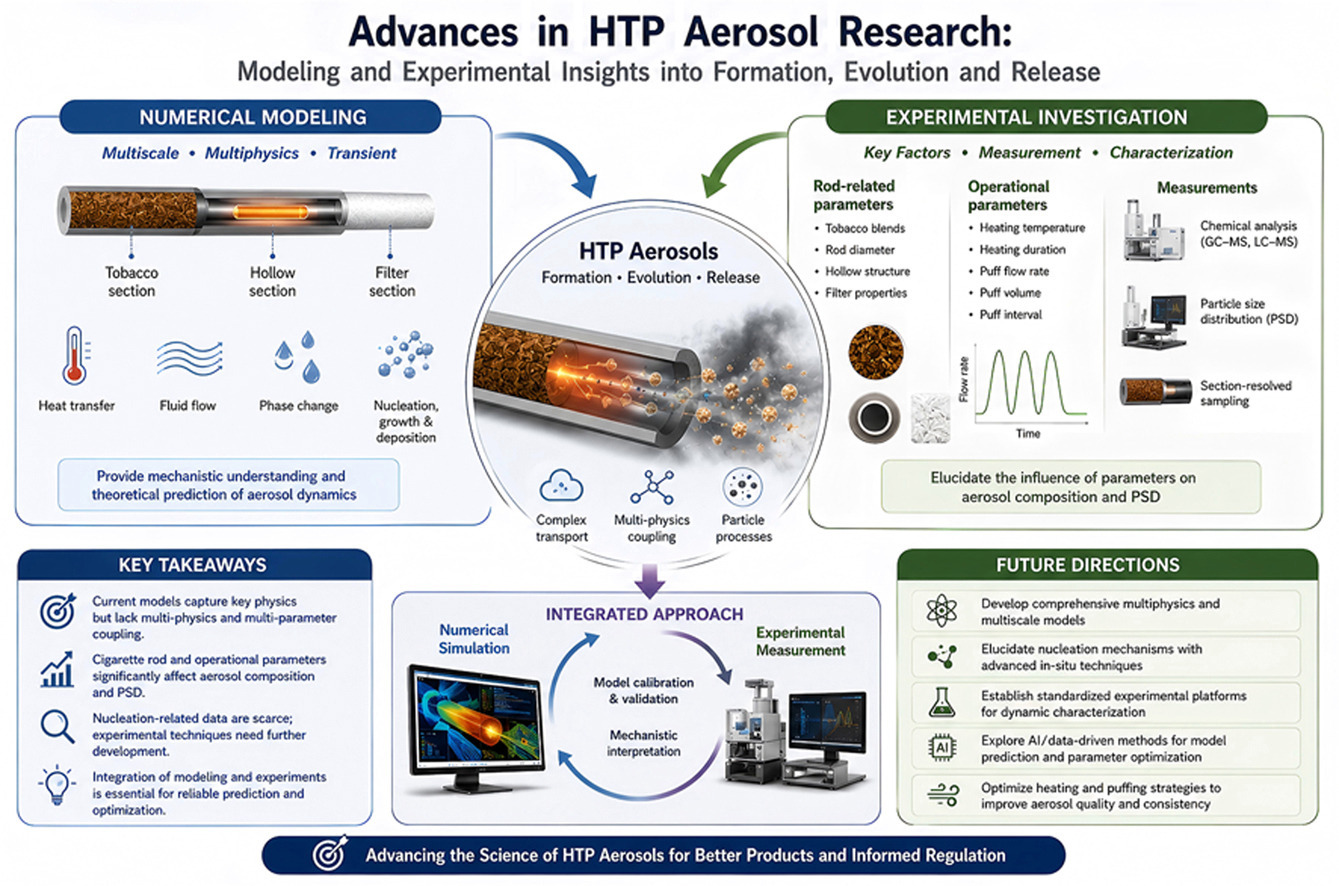
The heat-not-burn tobacco products, operating at lower temperatures, have shown potential in reducing the formation of harmful constituents, mitigating environmental emissions, and improving the smoking experience. However, the complex materials and structures of heated tobacco products (HTPs), together with the transient heating and puffing processes, poses significant challenges to the quantitative understanding of aerosol formation, evolution, and retention. This review systematically analyzes 223 publications published since 2015 and summarizes recent advances in HTP aerosol research from numerical and experimental perspectives. From the modeling viewpoint, various section-wise models for the tobacco section, hollow and filter section are critically compared, with emphasis on their capabilities and limitations in capturing key physical and chemical effects. From the experimental perspective, the influencing factors are classified into rod-related parameters and operational parameters, and their effects on aerosol release characteristics are discussed. The analysis reveals that multi-physics and multi-parameter coupling studies remain limited, while experimental data on nucleation and dynamic aerosol evolution are still scarce. This review emphasizes the need for integrated multi-section models that couple precursor release, cooling-induced nucleation, particle growth, and filter retention, while incorporating uncertainty quantification and AI-assisted strategies to support future HTP aerosol research and product optimization.
Graphical abstract
Keywords
Aerosol; HTP; Numerical simulation; Experimental measurement; Cigarette rod parameters; Operational parameters
文章导读