
期刊文章
过刊浏览
- Volumes 108-119 (2025)
-
Volumes 96-107 (2025)
-
Volume 107
Pages 1-376 (December 2025)
-
Volume 106
Pages 1-336 (November 2025)
-
Volume 105
Pages 1-356 (October 2025)
-
Volume 104
Pages 1-332 (September 2025)
-
Volume 103
Pages 1-314 (August 2025)
-
Volume 102
Pages 1-276 (July 2025)
-
Volume 101
Pages 1-166 (June 2025)
-
Volume 100
Pages 1-256 (May 2025)
-
Volume 99
Pages 1-242 (April 2025)
-
Volume 98
Pages 1-288 (March 2025)
-
Volume 97
Pages 1-256 (February 2025)
-
Volume 96
Pages 1-340 (January 2025)
-
Volume 107
-
Volumes 84-95 (2024)
-
Volume 95
Pages 1-392 (December 2024)
-
Volume 94
Pages 1-400 (November 2024)
-
Volume 93
Pages 1-376 (October 2024)
-
Volume 92
Pages 1-316 (September 2024)
-
Volume 91
Pages 1-378 (August 2024)
-
Volume 90
Pages 1-580 (July 2024)
-
Volume 89
Pages 1-278 (June 2024)
-
Volume 88
Pages 1-350 (May 2024)
-
Volume 87
Pages 1-338 (April 2024)
-
Volume 86
Pages 1-312 (March 2024)
-
Volume 85
Pages 1-334 (February 2024)
-
Volume 84
Pages 1-308 (January 2024)
-
Volume 95
-
Volumes 72-83 (2023)
-
Volume 83
Pages 1-258 (December 2023)
-
Volume 82
Pages 1-204 (November 2023)
-
Volume 81
Pages 1-188 (October 2023)
-
Volume 80
Pages 1-202 (September 2023)
-
Volume 79
Pages 1-172 (August 2023)
-
Volume 78
Pages 1-146 (July 2023)
-
Volume 77
Pages 1-152 (June 2023)
-
Volume 76
Pages 1-176 (May 2023)
-
Volume 75
Pages 1-228 (April 2023)
-
Volume 74
Pages 1-200 (March 2023)
-
Volume 73
Pages 1-138 (February 2023)
-
Volume 72
Pages 1-144 (January 2023)
-
Volume 83
-
Volumes 60-71 (2022)
-
Volume 71
Pages 1-108 (December 2022)
-
Volume 70
Pages 1-106 (November 2022)
-
Volume 69
Pages 1-122 (October 2022)
-
Volume 68
Pages 1-124 (September 2022)
-
Volume 67
Pages 1-102 (August 2022)
-
Volume 66
Pages 1-112 (July 2022)
-
Volume 65
Pages 1-138 (June 2022)
-
Volume 64
Pages 1-186 (May 2022)
-
Volume 63
Pages 1-124 (April 2022)
-
Volume 62
Pages 1-104 (March 2022)
-
Volume 61
Pages 1-120 (February 2022)
-
Volume 60
Pages 1-124 (January 2022)
-
Volume 71
- Volumes 54-59 (2021)
- Volumes 48-53 (2020)
- Volumes 42-47 (2019)
- Volumes 36-41 (2018)
- Volumes 30-35 (2017)
- Volumes 24-29 (2016)
- Volumes 18-23 (2015)
- Volumes 12-17 (2014)
- Volume 11 (2013)
- Volume 10 (2012)
- Volume 9 (2011)
- Volume 8 (2010)
- Volume 7 (2009)
- Volume 6 (2008)
- Volume 5 (2007)
- Volume 4 (2006)
- Volume 3 (2005)
- Volume 2 (2004)
- Volume 1 (2003)
Volume 116
Effect of aggregate gradation on the mesoscopic damage evolution of cemented gangue backfill
Xikun Chang a b, Lixia Gu a b, Dongmei Huang a c *, Xin Pan d, Bin Lu e, Shaoyu Liu a c, Zhixin Zhu a c
a State Key Laboratory of Disaster Prevention and Ecology Protection in Open-pit Coal Mines, Shandong University of Science and Technology, Qingdao, 266590, China
b College of Energy and Mining Engineering, Shandong University of Science and Technology, Qingdao, 266590, China
c College of Safety and Environmental Engineering, Shandong University of Science and Technology, Qingdao, 266590, China
d Employee University of Xinwen Mining Group Co., Ltd., Jinan, 271100, China
e Inner Mongolia Green Mining Technology Co., Ltd., Ordos, 017000, China
10.1016/j.partic.2026.06.038
Volume 116,
September 2026,
Pages 396-410
Received 3 May 2026, Revised 26 June 2026, Accepted 28 June 2026, Available online 9 July 2026, Version of Record 15 July 2026.
E-mail:
skd993906@sdust.edu.cn
Highlights
• Aggregate gradation governs the compressive behavior of coal gangue backfill.
• Skeleton gradation regulates force-chain evolution and crack propagation.
• Optimal aggregate gradation refines microstructure and enhances strength.
• Gradation-dependent meso-structure shapes damage evolution and failure modes.
Abstract
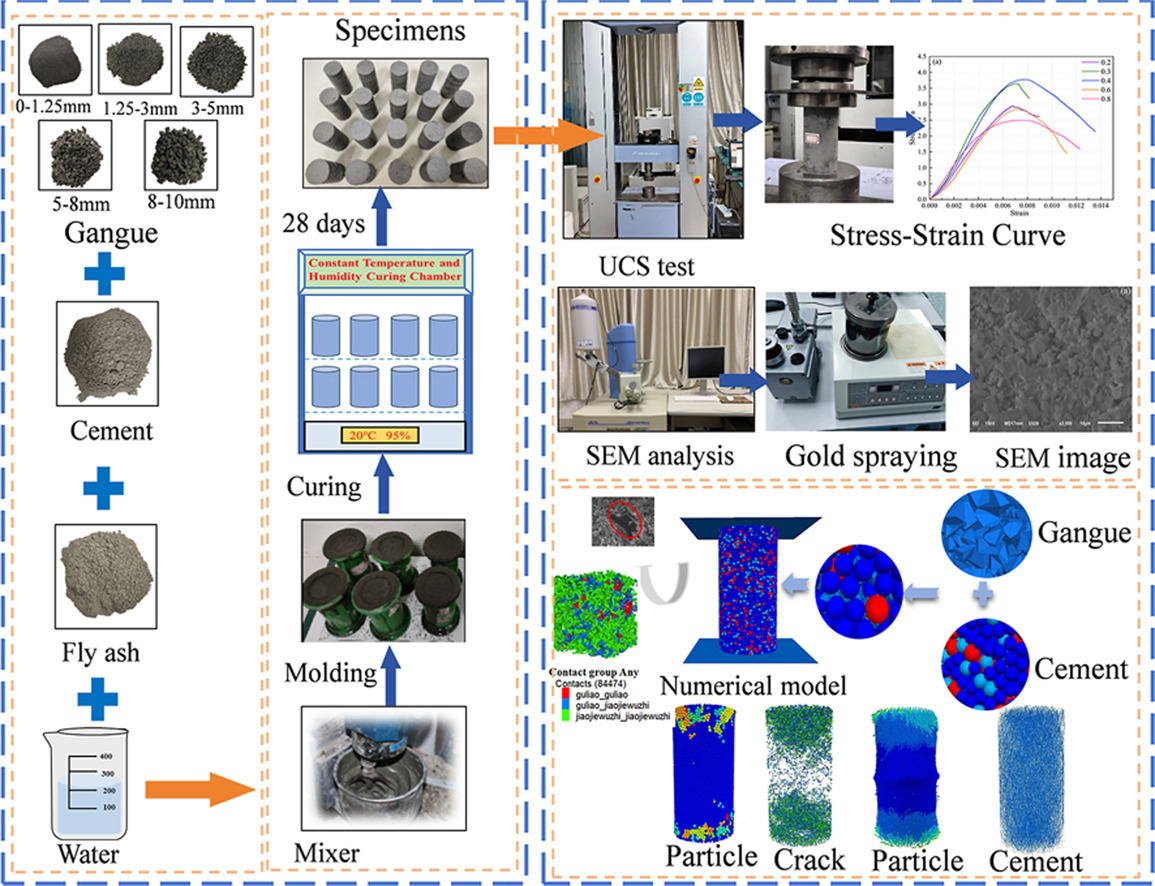
Cemented gangue backfill (CGB) is important for solid-waste utilization and goaf stability, and aggregate gradation strongly affects its performance. In this study, CGB specimens with different Talbot gradation indices were examined by uniaxial compression tests, pore-structure analysis, and PFC simulation to clarify the effects of gradation on mechanical behavior and mesoscopic damage. The UCS and elastic modulus first increased and then decreased with increasing gradation index. The best performance occurred at a gradation index of 0.4, with UCS 4%–50% higher than those of other gradations and a relatively high modulus. This gradation also produced the lowest two-dimensional porosity and probability entropy, 8.49% and 0.86, respectively, indicating denser particle packing and a more stable pore structure. Pore parameters were closely related to strength and stiffness, confirming that pore-structure optimization improves CGB performance. During loading, stress was mainly transferred through dominant force chains. At a gradation index of 0.4, the force-chain network was more continuous, delaying damage coalescence and stabilizing post-peak behavior. Tensile cracks dominated, accounting for more than 70% of all cracks, while shear cracks increased rapidly after peak stress, indicating a transition to mixed tensile–shear failure.
Graphical abstract
Keywords
Cemented gangue backfill; Talbot gradation; Mesostructure; Particle flow code method; Mesoscopic damage evolution
文章导读