
期刊文章
过刊浏览
- Volumes 108-119 (2025)
-
Volumes 96-107 (2025)
-
Volume 107
Pages 1-376 (December 2025)
-
Volume 106
Pages 1-336 (November 2025)
-
Volume 105
Pages 1-356 (October 2025)
-
Volume 104
Pages 1-332 (September 2025)
-
Volume 103
Pages 1-314 (August 2025)
-
Volume 102
Pages 1-276 (July 2025)
-
Volume 101
Pages 1-166 (June 2025)
-
Volume 100
Pages 1-256 (May 2025)
-
Volume 99
Pages 1-242 (April 2025)
-
Volume 98
Pages 1-288 (March 2025)
-
Volume 97
Pages 1-256 (February 2025)
-
Volume 96
Pages 1-340 (January 2025)
-
Volume 107
-
Volumes 84-95 (2024)
-
Volume 95
Pages 1-392 (December 2024)
-
Volume 94
Pages 1-400 (November 2024)
-
Volume 93
Pages 1-376 (October 2024)
-
Volume 92
Pages 1-316 (September 2024)
-
Volume 91
Pages 1-378 (August 2024)
-
Volume 90
Pages 1-580 (July 2024)
-
Volume 89
Pages 1-278 (June 2024)
-
Volume 88
Pages 1-350 (May 2024)
-
Volume 87
Pages 1-338 (April 2024)
-
Volume 86
Pages 1-312 (March 2024)
-
Volume 85
Pages 1-334 (February 2024)
-
Volume 84
Pages 1-308 (January 2024)
-
Volume 95
-
Volumes 72-83 (2023)
-
Volume 83
Pages 1-258 (December 2023)
-
Volume 82
Pages 1-204 (November 2023)
-
Volume 81
Pages 1-188 (October 2023)
-
Volume 80
Pages 1-202 (September 2023)
-
Volume 79
Pages 1-172 (August 2023)
-
Volume 78
Pages 1-146 (July 2023)
-
Volume 77
Pages 1-152 (June 2023)
-
Volume 76
Pages 1-176 (May 2023)
-
Volume 75
Pages 1-228 (April 2023)
-
Volume 74
Pages 1-200 (March 2023)
-
Volume 73
Pages 1-138 (February 2023)
-
Volume 72
Pages 1-144 (January 2023)
-
Volume 83
-
Volumes 60-71 (2022)
-
Volume 71
Pages 1-108 (December 2022)
-
Volume 70
Pages 1-106 (November 2022)
-
Volume 69
Pages 1-122 (October 2022)
-
Volume 68
Pages 1-124 (September 2022)
-
Volume 67
Pages 1-102 (August 2022)
-
Volume 66
Pages 1-112 (July 2022)
-
Volume 65
Pages 1-138 (June 2022)
-
Volume 64
Pages 1-186 (May 2022)
-
Volume 63
Pages 1-124 (April 2022)
-
Volume 62
Pages 1-104 (March 2022)
-
Volume 61
Pages 1-120 (February 2022)
-
Volume 60
Pages 1-124 (January 2022)
-
Volume 71
- Volumes 54-59 (2021)
- Volumes 48-53 (2020)
- Volumes 42-47 (2019)
- Volumes 36-41 (2018)
- Volumes 30-35 (2017)
- Volumes 24-29 (2016)
- Volumes 18-23 (2015)
- Volumes 12-17 (2014)
- Volume 11 (2013)
- Volume 10 (2012)
- Volume 9 (2011)
- Volume 8 (2010)
- Volume 7 (2009)
- Volume 6 (2008)
- Volume 5 (2007)
- Volume 4 (2006)
- Volume 3 (2005)
- Volume 2 (2004)
- Volume 1 (2003)
Volume 116
Structural regulation of polylactic acid porous microspheres by different porogens
Ni Su, Hong Yin, Shenfeng Yuan, Zhirong Chen, Qilei Zhang *
Key Laboratory of Biomass Chemical Engineering of Ministry of Education, College of Chemical and Biological Engineering, Zhejiang University, Hangzhou, 310058, China
10.1016/j.partic.2026.06.031
Volume 116,
September 2026,
Pages 411-423
Received 31 January 2026, Revised 14 May 2026, Accepted 22 June 2026, Available online 4 July 2026, Version of Record 15 July 2026.
E-mail:
zql@zju.edu.cn
Highlights
• Solution-penetrating and gas-foaming porogens for PDLLA microspheres were compared.
• Electrolyte porogens offered excellent tunability for pore size and porosity.
• NaHCO3 and NH4HCO3 created large interconnected cavities within microspheres.
Abstract
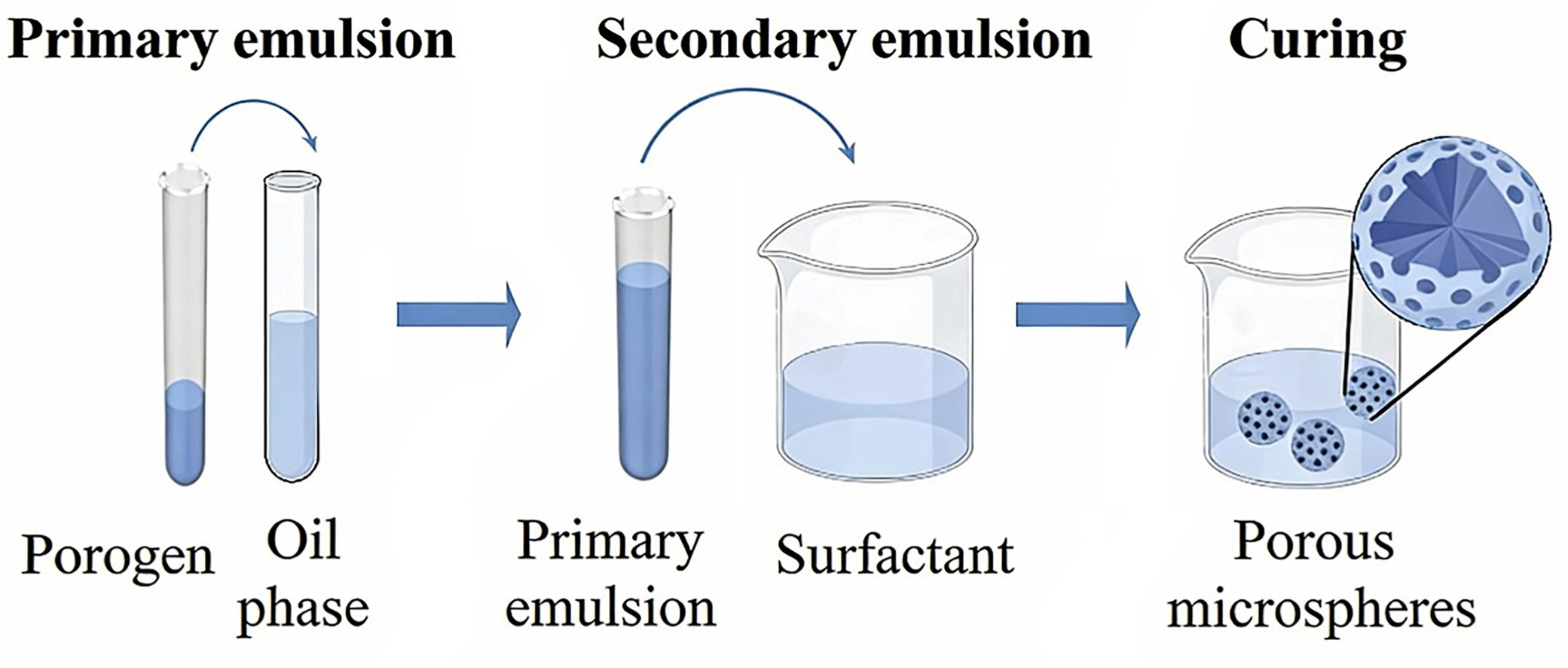
This study systematically compared the regulatory effects of solution-penetrating (NaCl, NaAc, sucrose, MgSO4) and gas-foaming porogens (NaHCO3, NH4HCO3) on the structure of poly (D, L-lactic acid) (PDLLA) porous microspheres prepared via double emulsion-solvent evaporation. The results demonstrated that solution-penetrating porogens affected the particle size of the microspheres, and the largest particle sizes (65–74 μm) were achieved when using MgSO4 or sucrose as porogens. Moreover, the non-electrolyte sucrose returned more well-structured microspheres with a narrower particle size distribution (span values of 0.829–0.776). Meanwhile, electrolyte porogens performed better in tailoring pore-structure parameters such as pore size and porosity. Parameters such as pore volume, pore size, and porosity increased with the increase of porogen concentration, while bulk density and specific surface area gradually decreased. Gas-foaming porogens could form large interconnected cavities but reduced the uniformity of the microspheres under acid induction. This study found that the pore-forming results of gas-foaming porogens bear certain similarities to those of the solution-penetration mechanism. This is because the foaming agents also possess salt ion characteristics, so their action does not rely solely on the bubbling effect but, to some extent, depends on the osmotic pressure of the ions, which provides theoretical and practical guidance for the controllable preparation of PDLLA porous microspheres.
Graphical abstract
Keywords
Porogen; Polylactic acid; Porous microspheres; Solution penetration; Gas foaming
文章导读