
期刊文章
过刊浏览
- Volumes 108-119 (2025)
-
Volumes 96-107 (2025)
-
Volume 107
Pages 1-376 (December 2025)
-
Volume 106
Pages 1-336 (November 2025)
-
Volume 105
Pages 1-356 (October 2025)
-
Volume 104
Pages 1-332 (September 2025)
-
Volume 103
Pages 1-314 (August 2025)
-
Volume 102
Pages 1-276 (July 2025)
-
Volume 101
Pages 1-166 (June 2025)
-
Volume 100
Pages 1-256 (May 2025)
-
Volume 99
Pages 1-242 (April 2025)
-
Volume 98
Pages 1-288 (March 2025)
-
Volume 97
Pages 1-256 (February 2025)
-
Volume 96
Pages 1-340 (January 2025)
-
Volume 107
-
Volumes 84-95 (2024)
-
Volume 95
Pages 1-392 (December 2024)
-
Volume 94
Pages 1-400 (November 2024)
-
Volume 93
Pages 1-376 (October 2024)
-
Volume 92
Pages 1-316 (September 2024)
-
Volume 91
Pages 1-378 (August 2024)
-
Volume 90
Pages 1-580 (July 2024)
-
Volume 89
Pages 1-278 (June 2024)
-
Volume 88
Pages 1-350 (May 2024)
-
Volume 87
Pages 1-338 (April 2024)
-
Volume 86
Pages 1-312 (March 2024)
-
Volume 85
Pages 1-334 (February 2024)
-
Volume 84
Pages 1-308 (January 2024)
-
Volume 95
-
Volumes 72-83 (2023)
-
Volume 83
Pages 1-258 (December 2023)
-
Volume 82
Pages 1-204 (November 2023)
-
Volume 81
Pages 1-188 (October 2023)
-
Volume 80
Pages 1-202 (September 2023)
-
Volume 79
Pages 1-172 (August 2023)
-
Volume 78
Pages 1-146 (July 2023)
-
Volume 77
Pages 1-152 (June 2023)
-
Volume 76
Pages 1-176 (May 2023)
-
Volume 75
Pages 1-228 (April 2023)
-
Volume 74
Pages 1-200 (March 2023)
-
Volume 73
Pages 1-138 (February 2023)
-
Volume 72
Pages 1-144 (January 2023)
-
Volume 83
-
Volumes 60-71 (2022)
-
Volume 71
Pages 1-108 (December 2022)
-
Volume 70
Pages 1-106 (November 2022)
-
Volume 69
Pages 1-122 (October 2022)
-
Volume 68
Pages 1-124 (September 2022)
-
Volume 67
Pages 1-102 (August 2022)
-
Volume 66
Pages 1-112 (July 2022)
-
Volume 65
Pages 1-138 (June 2022)
-
Volume 64
Pages 1-186 (May 2022)
-
Volume 63
Pages 1-124 (April 2022)
-
Volume 62
Pages 1-104 (March 2022)
-
Volume 61
Pages 1-120 (February 2022)
-
Volume 60
Pages 1-124 (January 2022)
-
Volume 71
- Volumes 54-59 (2021)
- Volumes 48-53 (2020)
- Volumes 42-47 (2019)
- Volumes 36-41 (2018)
- Volumes 30-35 (2017)
- Volumes 24-29 (2016)
- Volumes 18-23 (2015)
- Volumes 12-17 (2014)
- Volume 11 (2013)
- Volume 10 (2012)
- Volume 9 (2011)
- Volume 8 (2010)
- Volume 7 (2009)
- Volume 6 (2008)
- Volume 5 (2007)
- Volume 4 (2006)
- Volume 3 (2005)
- Volume 2 (2004)
- Volume 1 (2003)
Volume 116
Thermo-catalytic hydrogen from methanol steam reforming in a particle-driven solar energy loop
Zehao Li a b, Shuo Li a, Yitong Jiang b, Hui Cao a, Tianwei Tan a *, Huili Zhang a *
a State Key Laboratory of Green Biomanufacturing, Beijing University of Chemical Technology, Beijing, 100029, China
b Beijing Advanced Innovation Center for Soft Matter Science and Engineering, Beijing University of Chemical Technology, Beijing, 100029, China
10.1016/j.partic.2026.05.024
Volume 116,
Received 30 January 2026, Revised 10 May 2026, Accepted 28 May 2026, Available online 15 June 2026, Version of Record 16 July 2026.,
Pages 424-436
Received 30 January 2026, Revised 10 May 2026, Accepted 28 May 2026, Available online 15 June 2026, Version of Record 16 July 2026.
E-mail:
twtan@mail.buct.edu.cn; zhhl@mail.buct.edu.cn
Highlights
• Methanol is catalytically steam reformed in a solar reactor using particles as heat supply medium.
• Excess solar heat is stored as sensible particle heat to operate the process on non-sun periods.
• Co/α-Al2O3 is used as catalyst.
• The H2 yield exceeds ∼2.6 mol H2/mol CH3OH. CO and mostly CO2 closes the carbon balance.
• No catalyst coking is observed and the reaction rate and selectivity are very high.
Abstract
Green hydrogen is produced by the endothermal catalytic steam reforming of methanol (CSRM). The endothermic CSRM reaction (CH3OH + H2O → CO2 + 3H2) is conducted at temperatures between 300 and 350 °C. Since CSRM principles suffer from the required heat input, it was proposed to apply a solar energy heat supply throughout the process loop. The reaction is performed in a particle-driven concentrated solar concept, where inert olivine carrier particles are used to harvest, store, transport and use the captured solar heat. A Co/α-Al2O3 catalyst is present as a fixed bed multi-tube reactor. These small-diameter tubes are indirectly heated by the circulating olivine particles in a surrounding fluidized bed. H2-yields exceed 2.6 mol H2/mol CH3OH, >85% of the theoretical yield. The methanol carbon is converted to CO2, with very minor concentrations of CH4 and CO detected. The solar loop heat balance proves the thermal efficiency of the solar CSRM concept.
Graphical abstract
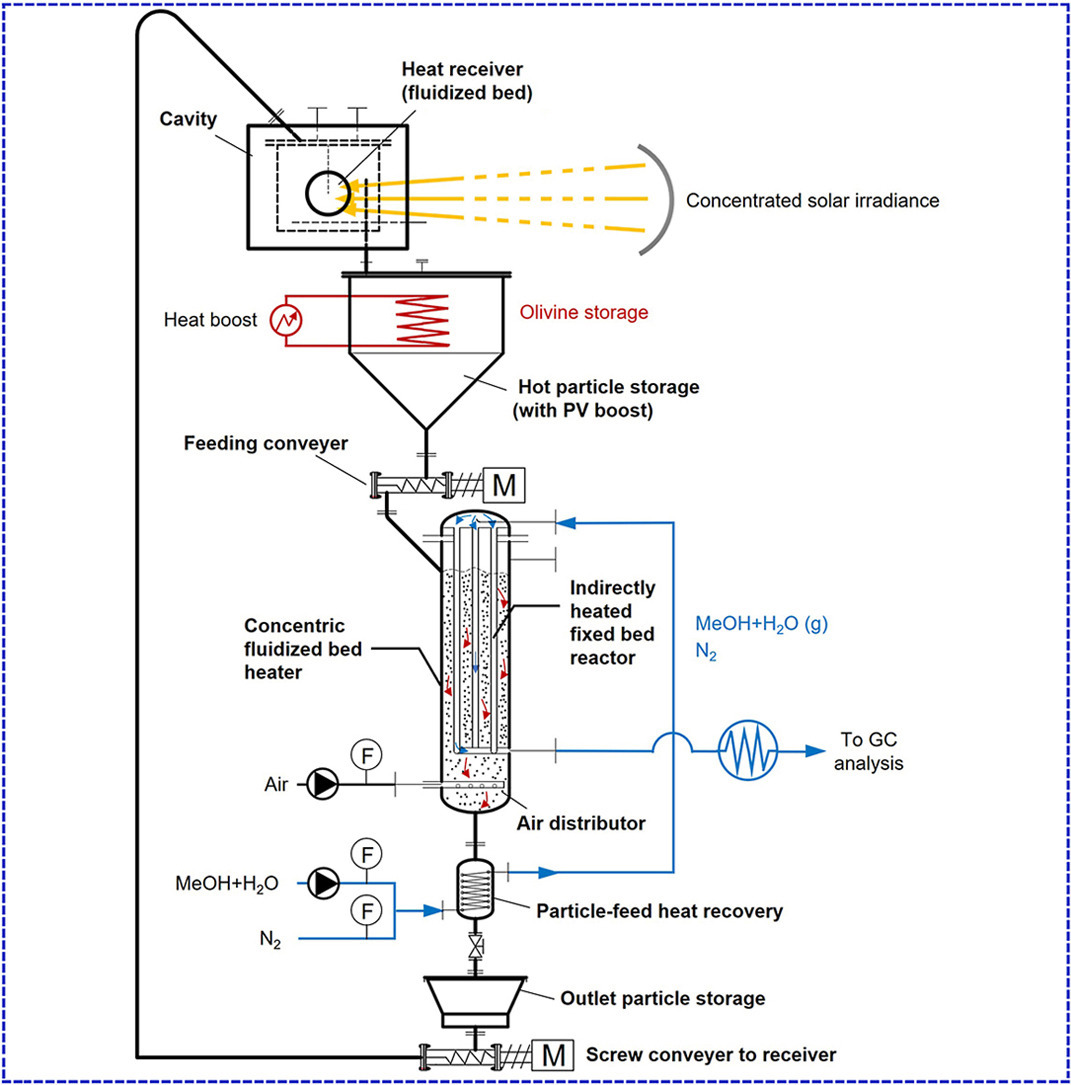
Keywords
Hydrogen; Catalysis; Methanol; Concentrated solar heat; Particle loop reactor; Heat storage
文章导读